
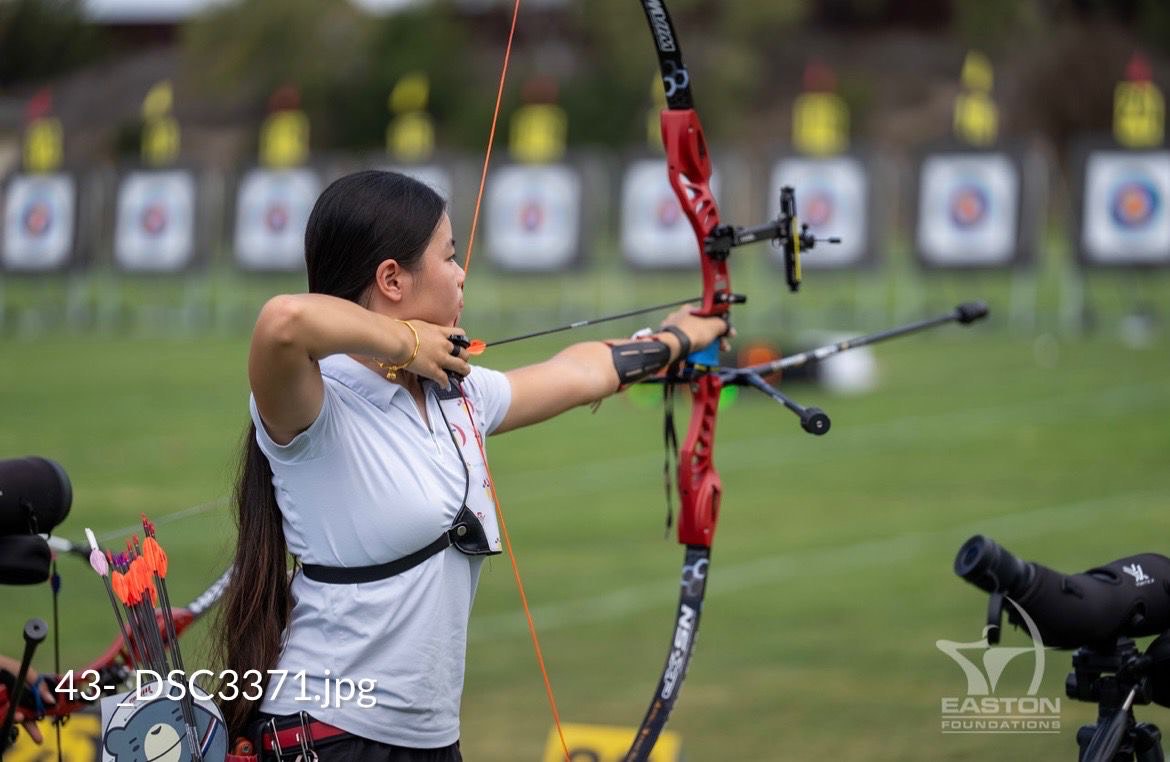
An archer waits, bow in hand, staring down the target standing 60 meters down range for her. She reaches into the quiver beside her, gripping an arrow and placing it into position in her bow, an Olympic Curve. Drawing the bowstring to her face, she pauses for four seconds to calibrate the shot. She lets the arrow fly. One second later, the arrow is buried in the target, striking the yellow center. Ten more points are added to her score.
The athlete Yuna Shi (‘28) is not just a Bishop’s student. She competes in archery internationally — and is aiming even higher.
Yuna’s love for the sport was sparked at a young age through various summer programs. At the time, she lived in Belgium, limiting her ability to train competitively because she could not find locations to practice. However, at age 12, her family moved to the United States, allowing her to practice at the Chula Vista Elite Athlete Training Center, an Olympic training site.
When she was younger, Yuna participated in team sports like swimming, but explained, “Team sports always put a lot of pressure on me. I felt like I had to reach this level that other people held me to.” But for archery, she found that she could “set [her] own expectations.”
Yuna often practices alone, without a coach. She estimated that she shoots 80 to 90 arrows per hour. To perfect her form, she said, “I do a mix of teaching myself and sending videos to coaches and friends because they know [my mechanics] and I trust them not to confine me to their personal technique and mentality.”
She added that “each person has their own technique that fits them. I personally feel that having one coach can limit an archer’s performance.”
Archery requires accountability. Yuna practices every day, spending 25 hours each week practicing. Despite the intense training, Yuna stays motivated because, she explained, “I just really like the sport. I want to do well in it.”
Yuna’s determination to improve is key to her performance. “Archery is an individual sport,” she said, “so I’ve learned both how to discipline myself and also not be too harsh on my mistakes.” She added, “You just have to be able to not beat yourself down or just continuously compare yourself to others.”
Coach Meghan Carr, Physical Education and Health Department Chair, commented on Yuna’s mental fortitude. As the overseer of sports credits for Bishop’s students, including activities done outside of school, she is familiar with Yuna’s participation in archery.
Coach Carr explained, “She is committed, and she is dedicated to the craft and to her love of archery.” She also praised Yuna’s perseverance, saying, “It takes a lot of focus and patience.”
Coach Car concluded, “[Yuna is] just humble, very humble for how accomplished she is.”
Yuna still finds inspiration in training with professional archers at the Olympic Training Center. She explained her “There are some of the best archers in the country,” she said, “so I look at how they shoot and think to myself, ‘I want to get there one day.’”
Yuna highlighted Christian Stoddard, who was a member of the U.S. recurve men’s team that won a silver medal at the 2025 World Archery Championships. She remarked, “I really admire his focus and tenacity.”
Her training is tested during archery tournaments, which consist of a qualifying round and an elimination round. In qualifying, archers compete individually, shooting two rounds of 36 arrows, and are ranked based on their score. In order to finish in the top three, an archer will aim for a score of about 640 out of 720 available points, slightly less than nine points per attempt.
The rankings determine the bracket in the elimination round in which archers compete head-to-head. The archers shot three arrows, each at the same time. Winning a specific round or “end” earns two points, a tie earns one point each, and a loss results in zero points. Each set is played to six points.
From a scoring standpoint, she said, “I consider eight to be a mid shot and seven to be really bad.” But, she explained, “Whenever I shoot badly, or even when I shoot well, I just forget about it and treat each shot as its own.”
Last season, Yuna took a yearlong break from competing to focus on her form. As an archer, she said, “You need a lot of grit and a willingness to learn and adapt, especially during form changes. Some of them can feel really off for a few shots, but you have to stick with it and trust that you’ll do fine.”
She reflected on what archery demands, saying, “Archery is 100 percent technique for physical, and 100 percent how you think of yourself for the mental aspect.”
Through her relentless practicing, Yuna returned to tournaments and “sort of came out of nowhere.” She explained, “I was this random person beating top scores. And then after that, everyone was wondering, ‘what will she do next?’” Yuna admitted that she feels the pressure of the attention on her, but she said, “I just put that in the back of my mind and focus on my shooting.”
Yuna has proven she can perform at a high level, coming in third place at the 2025 International Singapore Youth Olympic Festival in the women’s under-18 division. She also won the 2025 Pacific Coast Championship, breaking a 10-year old state record. This year, she plans on competing in the national competition circuit, hopeful to add more achievements to her resumé.
Brian Kim (‘27), a former nationally ranked archer who trained with Yuna for a bit, analyzed her skill, saying, “A lot of her talent stems from the amount of work that she’s putting in. She was usually the first one in and the last one out [of practice].”

He concluded, “I think she’s one of the most hard-working archers I know.”
Despite her skill, Yuna explained that she does not mind that archery receives little recognition. “I treat it as something I do more for myself rather than for winning anything or for getting attention.”
However, she wished archery were more widely available. “I think it would be nice for other people to be able to take this path as well and explore archery,” she remarked.
The sport is not easily accessible for several reasons, including the costly equipment, limited training grounds, and the challenge of finding coaches. For example, a complete Olympic recurve bow costs about 3,000 dollars.
Her own experience shows why exposure to the sport matters. Some of her favorite moments as an archer have come through camps like those where she discovered her passion. For the past few years, during breaks from school, she has traveled to South Korea, where archery is most popular in the world, to participate in specialized training programs.
She said, “Being able to attend the camp alongside elite archers was an amazing experience for me.” “I think I made my best memories there with all the friends that I met, who really helped grow my love for the sport,” she added.
In the future, Yuna explained that she wants to take her talents to the Olympics. “I am planning to go to the 2028 Olympic trials, and my main focus is making the 2032 Olympic team,” she said.
As for now, she concluded, “I’m just doing it for fun.”