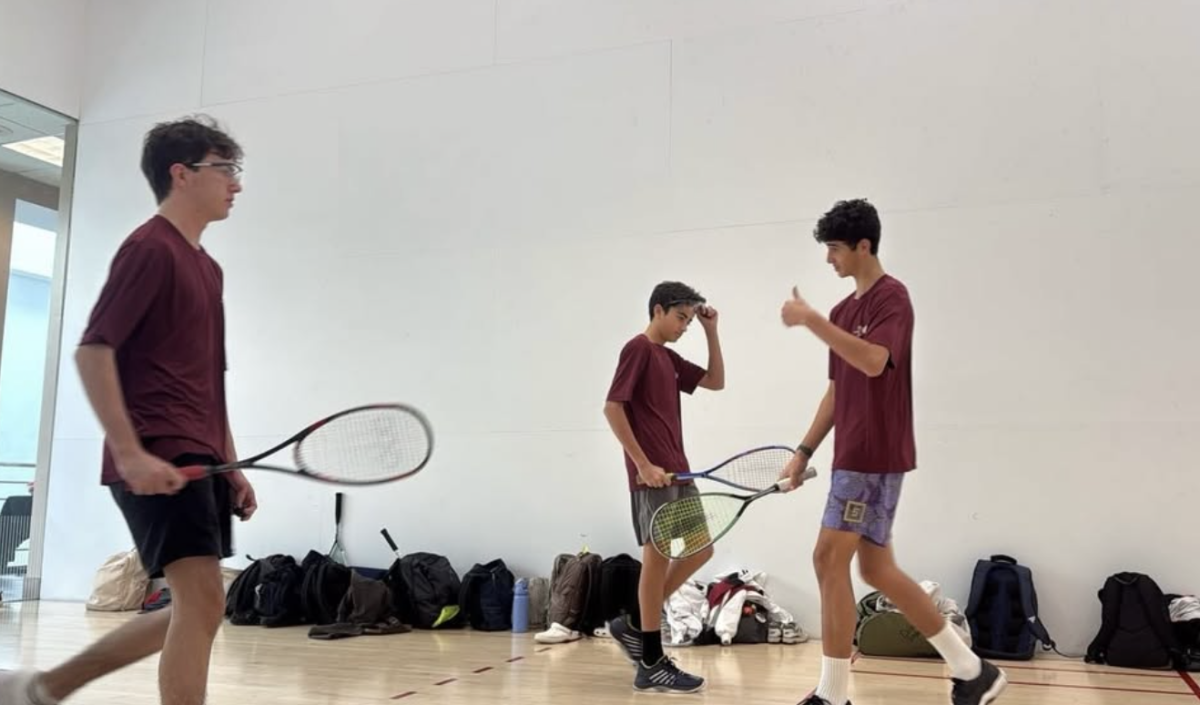
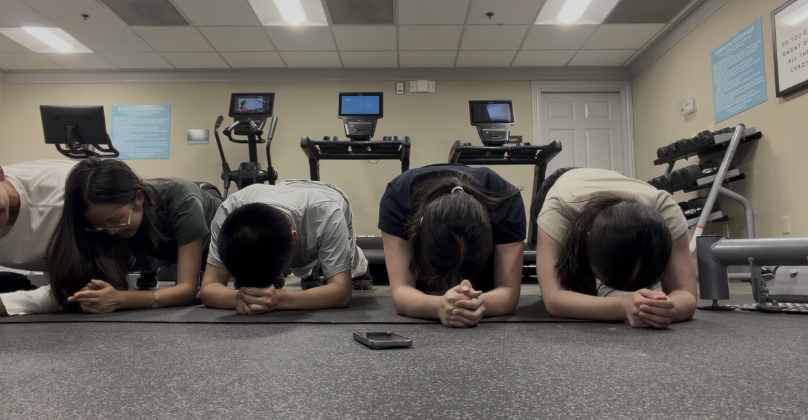

Not all math tests are taken in uniform rows of desks, or with bubbled Scantron sheets. On Saturday, April 18, Bishop’s students participated in the highly competitive Stanford Math Tournament (SMT), a national high school mathematics tournament based at Stanford University spanning a wide variety of math topics up to calculus. Rather than taking a traditional sit-down exam format, the tournament participants faced activities built around intense team communication and competitive spirit.
The teams were organized by the Bishop’s math club, which meets on C Day lunches in Math Teacher Dr. Jay Zhao’s room. In the past, the club has always applied and sent teams of members to selective competitions such as SMT. This year, “we got really lucky — we got two teams [accepted] this time,” said President of Math Club Aaron Cheng (‘28). Aaron and Jack Jin (‘26) collaborated to write a Team Selection Test (TST), which members took to determine placement in either the primary team, Bishop’s Kumquats, or the secondary team, Bishop’s Cucumbers.
Once the TST results came out, team coaches Aaron and Jack decided that the Kumquats would consist of Aaron, Jack, Kiran She (‘28), Michael Sun (‘28), Jerry Li (‘28), and Adrian Fong (‘29). The Cucumbers would consist of Isabelle Qiao (‘29), Tracie Liu (‘28), Adam Fang (‘27), Rudy Zhang (‘26), Claire Li (‘28), and Jonathan Huang (‘28). Both teams practiced hard in the weeks leading up to the tournament day, staying after school and working together on problems from previous years.
On April 17, the teams left campus early at noon to catch their flight to San Francisco. After staying overnight at an Airbnb booked by parent chaperones, the team spent the following day participating in several math rounds and competitions, each in its own unique format.
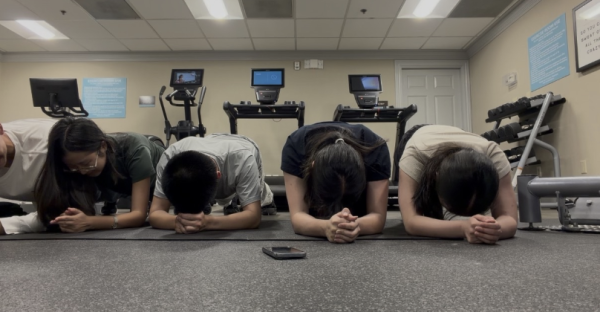
The day opened with a brief ceremony in Stanford’s Hewlett 200 lecture hall. Then, the teams began their first event, the Power Round. “It’s a very interesting style of competition because it’s proof-based,” said Kiran, “Instead of solving problems the traditional way, you have to write a bunch of proofs on a subject that you’ve probably never heard of before.” This year, their task was to experiment with matroids, an abstract concept used in graph theory, the study of mathematical graphs, and linear algebra, the study of linear equations, vectors, and matrices.
In the final five minutes, Kiran recalled trying to focus as frantic whispers of “did anyone solve this problem?” and “can someone check my work?” were exchanged between team members. “We had five minutes left, and I was working on this tricky problem at the end of the first section,” recalled Kiran, “and I figured it out [with] one minute left.” Finally, the team handed in their packet confidently, congratulating each other with cheers and high-fives.
Next came the Team Round, which was Rudy’s favorite event. As a senior, Rudy became the “unofficial” leader of the Cucumbers, and he felt that they performed pretty well. The team had 50 minutes to solve 15 difficult questions from topics such as elementary number theory and algebra. Rudy felt that “working in a team environment [was] both more fun and more engaging for everyone involved.”
During their lunch break, the Kumquats and Cucumbers ate pizza, chatted about problems, and repeatedly tried to push each other off a grassy hill. The members mentally prepared themselves to take the upcoming Individual Round after lunch, where each member got to choose two out of five subject-based 10-question tests, with the options being general, algebra, geometry, calculus, and discrete, a branch of math dealing with distinct, countable elements.
The day then culminated with the Guts Round, a fast-paced contest where teams were given one out of eight problem sets, and had to submit their current set to obtain the next one. With the scoreboard updated live, the students were constantly kept on their toes, checking the rankings of each team between problems. “When we do Guts, we’re always looking at us, and we’re looking at CCA (Canyon Crest Academy),” said Aaron. As one of the only teams that the Bishop’s math teams normally recognize at competitions, “there’s always a little bit of rivalry and competition going on.”
Tracie and Kiran both “really liked the Guts Round” because of the speed factor. Kiran and Aaron reminisced about a moment during the round when Kiran solved a problem “on the toilet,” and sprinted back to notify his teammates about his discovery. “A lot of times we kind of just do math as individuals, but coming together and working with others is just really exciting,” Tracie said, smiling.
This year, the Bishop’s teams performed the best they had in school history. Aaron placed 10th in the Individual Round, among 800 students. The Bishop’s Kumquats achieved Distinguished Honor Roll, or top 25%, overall, and the Cucumbers achieved Honor Roll, or top 40%. As a highlight, the Kumquats narrowly overtook CCA’s primary team, CCA Conspiracy, by a fraction of a point in the Team Round.
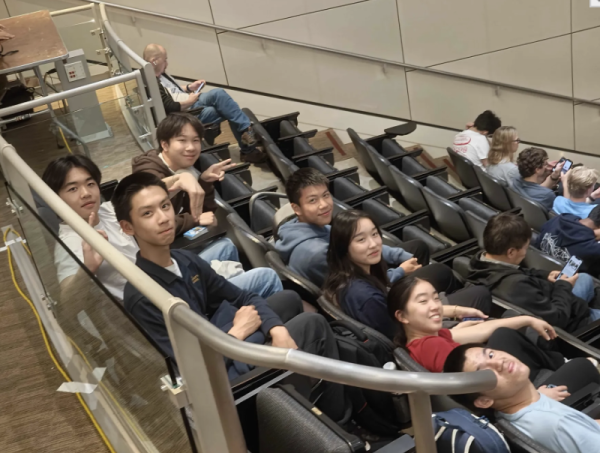
Aside from the numerous awards, many of the team members expressed that they enjoyed the bonding time the tournament offered. Claire reflected, “Between rounds, we had a lot of fun because we kind of hung out with each other and just chilled and talked.” The teams spent their time socializing, and they even reconnected with Nason Li (‘25), a Bishop’s alumnus who attends Stanford.
On the other hand, he was also happily surprised about this year’s performance, and hopes that the Kumquats and Cucumbers can elevate Bishop’s reputation in math competitions to the next level. “I actually have a vision for our future math comps,” Aaron shared. He has observed Bishop’s students’ strong calculus background, and noted that “if we really lock in on the [Individual Round], we have a chance of winning top 10.” “We’re all really strong in our own ways, but we need to make it come together,” he concluded.
As Claire jokingly put it, tournaments like these are a beautiful reminder of “how fun math can be when you’re crashing out on your teammates, and I’m crashing out on my teammates.”
Through a day of contests, scoreboards, and collaboration, the students came together through tough problems and time pressure, and, in the end, simply enjoyed each other’s company.