
The month of March signals the start of many things. The start of spring, the last quarter of the school year, and the beginning of one of the most anticipated sporting events in the country: the National Collegiate Athletic Association’s (NCAA) Division 1 Basketball Tournament, better known as “March Madness”.
March Madness is one of the most-watched sporting events in the USA. The championship between the University of Michigan and the University of Connecticut brought in 18.3 million viewers, in a game which Michigan would ultimately win. The whole tournament averaged 10.7 million viewers: an all-time record.
With the odds of creating a perfect bracket at 1 in 9.2 quintillion, creating a bracket serves better as an opportunity to test your ball knowledge (and luck) than winning the $1 billion prize offered for a perfect bracket. Brackets add a competitive edge to the tournament, aside from supporting your favorite team.
A March Madness bracket is a chart filled out before the games begin, used to predict the winners of each game, from the first round to the championship, in the single-elimination college basketball tournament.
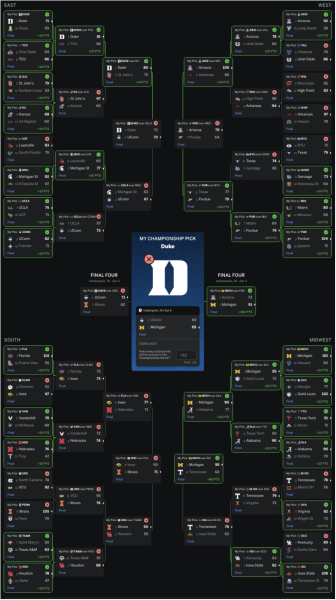
Each year, millions of fans create brackets with the hopes of predicting the impossible. This year alone, 26,568,126 brackets were made on ESPN, each one hoping to achieve the first-ever perfect bracket. This year, only 14,000 brackets remained standing after just the first day. Once brackets are busted, the joy of March Madness basketball is found in the experience, watching the games, and having fun with friends and family.
For those who only tune in to college basketball during the tournament, making a bracket is more often about luck than knowledge, but for those who follow year-round, a bracket is a good way to test their expertise.
Math Teacher and Varsity Assistant Coach Mr. Daniel Clark is among those people. “I follow it all year,” he said, “I have my teams that I like to follow, like the University of Oregon, where I went, and the University of North Carolina, who I’ve always liked since I was a little kid.”
As a coach for almost two decades, Mr. Clark approaches March Madness with experience; however, as a math teacher, he knows a perfect bracket is almost impossible. “I think most of the games are ones where the winner is predetermined,” he said, explaining his approach to bracketology. Yet, March Madness is “always gonna have the upsets in the Cinderellas, and those are really hard to predict. But most of the time, the winner’s gonna be the team that you think is gonna win.”
Statistics support his approach. Only twice in NCAA tournament history has a 16-seed, the lowest seed, beaten a 1-seed, happening in 2018 and 2023. However, 12-seeds have become famous for their upset potential, winning around 35% of their first-round matchups against 5-seeds. That trend continued this year, with High Point University beating the University of Wisconsin in a thriller that came down to the last seconds of play. High Point’s victory was responsible for leaving just over 3% of the 25 million brackets made perfect only hours into the tournament.
However, many gave themselves a pat on the back after betting on High Point to win. College basketball fan David Beamer (‘28) made the choice based on the stats and games he watched over the season. “I like High Point over Wisconsin a lot,” he explained in the days before the tournament, “High Point is a really high-powered offense… and Wisconsin’s defense struggled with that a lot, and they’ve been exposed quite a lot this year.” High Point’s offense scored 89.7 points per game, the fifth highest of all college basketball teams.
Meanwhile, Wisconsin had the 55th-ranked adjusted team defensive efficiency at 102.1 points per 100 possessions. Adjusted team defensive efficiency is a stat that predicts how many points an average offense would score against the team in question per 100 possessions. With a weak defense going up against a powerful offense, the game was an upset waiting to happen.
Cece Jeffery (‘27) also chose High Point, calling it “one of the best predictions of [her] ‘March Madness Career.’” However, she got overly ambitious, choosing High Point over 4-seed Arkansas in the following round. Unfortunately, it was a game that High Point ultimately lost, hurting her bracket.
Loyalty plays a role in bracket creation as well. “I always start by putting Arizona as my winner. I have never chosen another team to win the tournament, in fact,” said Cece when asked about her strategy for bracket making. She then follows this by choosing teams based on how they looked when she watched them play during the season. Her approach worked well this year, with Arizona being a 1-seed and making the final four game, where they would end up falling to Michigan.
Not all her choices are based on logic, though: “To be honest, there are many games that I will choose a random underdog because the upsets in March Madness are more frequent than not,” she admitted.
David, a Duke University fan, had the Blue Devils winning the championship, which is usually a safe bet considering Duke has one of the strongest basketball programs in the country. This year, Duke was the team most chosen to be the champion, with 23.10% of brackets made having them going all the way. But this year wasn’t the year for Duke fans, as they lost in the Elite Eight quarterfinals to the University of Connecticut, with Braylon Mullins hitting a deep go-ahead three-pointer with 0.4 seconds left on the clock to seal the win.
It’s the unpredictability of the tournament that creates unforgettable moments. As David described it, “anything can happen, that’s what’s so fun about March.”
This year, one of the most exciting games came from a dramatic showdown between the 10-seed Santa Clara University and the 7-seed University of Kentucky. In the final seconds of the game, Santa Clara hit a clutch three-pointer to take the lead, only for Kentucky to hit a deep, buzzer-beating three of their own to send the game to overtime, where they would eventually win the game 89-94. “The crowd went wild, “ Cece recounted, “and that included my friends and me watching the game in the student center during a free period.”
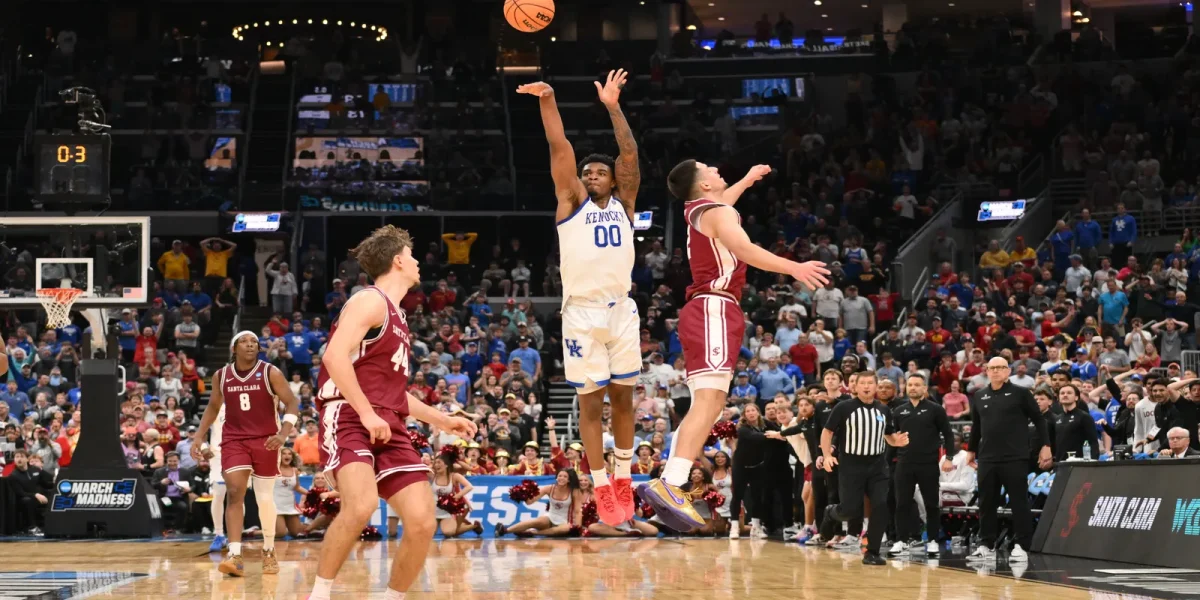
(Jeff Curry)
The excitement of the tournament is best captured through the experiences of individual fans. “Every year I make brackets and watch the games with my friend,” said Jonah Hong (‘28). “(March Madness) is one of my favorite times of the year.”
With the tournament over this year, David put it best, remarking, “I’m already looking forward to the next one.”