

Each December, a small Christmas tree appears in the Bishop’s Student Center. Instead of ornaments, its branches hold laminated tags, each one with a photo, a name, and a short wish list from a refugee child living in San Diego. Within days, the tags disappear, taken by students, families, and advisors who participate in one of Bishop’s most meaningful traditions: the Giving Tree.
Now in its eleventh year, the Giving Tree Program connects the Bishop’s community with refugee children and families across San Diego, offering them a personal way to give during the holiday season. Led by Director of Global Education and Religion Teacher Dr. David Moseley, the program partners with three local organizations — RefugeeNet, Kupanda, and The Karen Organization — to support students from countries including South Sudan, the Congo, Myanmar, Syria, Afghanistan, and Somalia. Each year, Bishop’s families donate an estimated $10,000 to $20,000 worth of gifts.
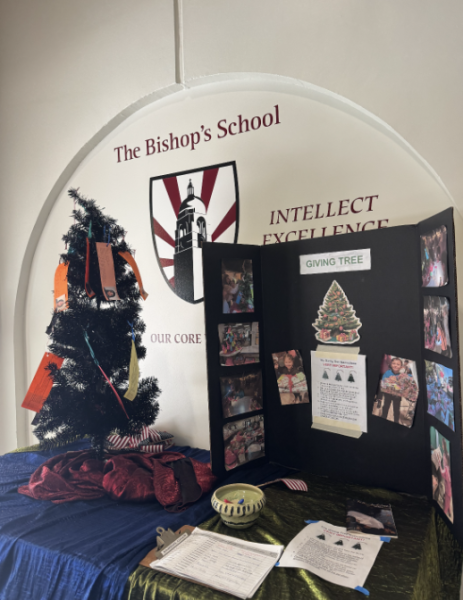
“These are newly arrived Americans,” Dr. Moseley explained. “Many of them have escaped war, poverty, violence, oppression, or persecution. Some have spent years, even decades, in refugee camps before finally arriving here.” Before resettling, refugee families undergo extensive vetting through the United Nations and U.S. State Department, only to face the challenge of rebuilding their lives in one of the most expensive cities in the country.
The Giving Tree grew out of Bishop’s long-standing relationship with refugee tutoring programs, which once brought Bishop’s students into local communities for in-person interactions several times a week. As Bishops’ students’ schedules changed and traffic afterschool became an issue, Dr. Moseley and others sought a new way to maintain that connection. “We wanted to personalize it,” he said. “Instead of generic gifts, we collected wish lists directly from the kids and matched them with our families.”
Each gift tag includes a brief description of a child and specific items they hope to receive. Members of the Bishop’s community choose a tag, shop for the gifts, wrap them, and return them to campus by a set deadline.
Zachary Haubenstock (‘28) said, “I found it fun because shopping for gifts is fun, and I was able to do it to help the community.” After seeing that the kids wanted a Roblox gift card and a remote control race car, Zachary pointed out that they had the same interests as him. “I was like, ‘This is so exciting. I get to buy something for a kid similar to me,” he said, highlighting how, even though we have different backgrounds, there are often more similarities than differences between refugees and us.
Ava Mody (‘29) said, “I really liked being able to buy a gift for someone and know that I was doing something good, because when they opened it, even if they didn’t know it was me, I get to feel like I helped in a way.” Although the children may not know the students personally, they know that someone took the time to get them something they would like.
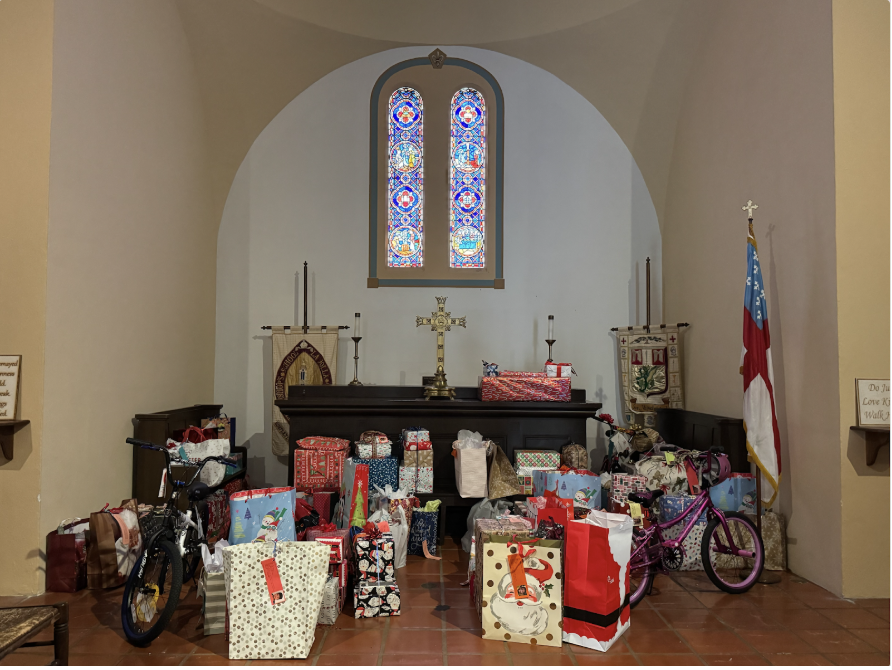
The gifts are then delivered to the children, many during a holiday celebration hosted by the Bishops. This year, the celebration took place on Wednesday, December 17th, at Saint Luke’s Episcopal Church in North Park. For the students who receive them, the experience is unforgettable. “For any child, receiving something on their wish list is a huge deal,” Dr. Moseley said. “But for these kids, it’s often something they would never normally expect to get.”
This year, 94 refugee students were adopted through the program, and participation from the Bishop’s community was especially strong. “We had no trouble adopting the kids this year,” Dr. Moseley noted. “Parents, students, and advisories were incredibly generous. Sometimes people even adopted two students. All the gifts came back on time, which is always a relief.”
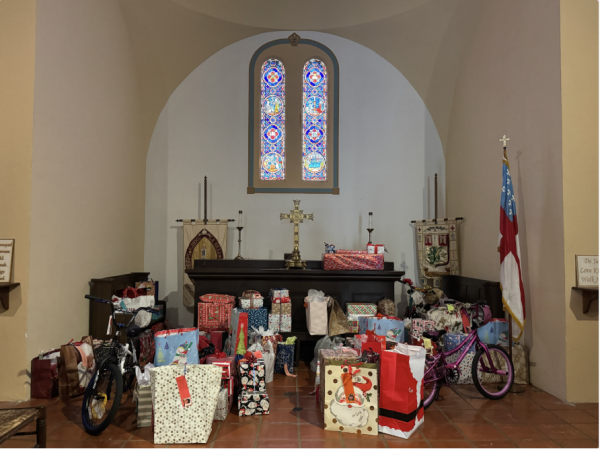
In addition to gifts for children, the Giving Tree also supports entire families. Over the years, the program has collected grocery gift cards, household essentials, kitchen starter kits, towels, and other necessities. Many refugee parents work multiple jobs to support their families, and the added cost of the holidays can be overwhelming. “It means a lot to the parents as well,” Dr. Moseley said. “Knowing there are people here who care about their kids makes a real difference.”
After more than a decade, certain moments have stayed with Dr. Moseley. He recalls watching children struggle to carry gift bags larger than themselves or reacting in disbelief when long-awaited items appear. One year, a Congolese girl asked for a Gucci purse — an unexpected request far beyond the program’s budget. “It was a $4,000 purse,” Dr. Moseley said, laughing. “But we managed to find an imitation within the limit. When she opened it, she was absolutely thrilled. Everyone around her started saying, ‘Why didn’t I ask for a Gucci purse?’”
For Dr. Moseley, the Giving Tree’s impact extends beyond the gifts themselves. “This season is about giving, not receiving,” he said. “A lot of us come from families where our material needs are met. This is an opportunity to reach out to our newest neighbors.” As an immigrant himself, he sees the program as a reflection of shared history. “Unless we’re Native American, all of us come from immigrant or refugee backgrounds at some point. America has always been a place of hope, and this is a way to welcome the newest Americans among us,” he said.
When asked how participating in The Giving Tree made him feel and why he has participated for multiple years, Henry Martin (‘28) said, “You know, it made me feel good giving back to the community.” He added, “I feel like just doing small deeds can really take them somewhere, bring them new possibilities. You never know how meaningful that gift can be.”
Ava echoed this idea, saying, “By me spending an hour to go buy the gifts, that could be the thing that makes them really happy on Christmas Day, just to see the toy they have been wanting. And that could be the thing that makes their Christmas a little better.
This year, English Teacher Mr. Mark Radley and his advisor purchased a bike and helmet for the refugee child they chose. This senior advisory participates every year, sharing their generosity with the community.
When asked why this event is so important, English teacher and Advisor Mr. Mark Radley said, “The holiday season reminds us to look outward with generosity, and the project gives us a tangible way to spread love and sunshine: small, thoughtful acts can make a real difference in someone else’s life.”
As the Giving Tree continues to grow, Dr. Moseley hopes the tradition remains a lasting part of Bishop’s culture. “I just hope it keeps going,” he said. “People get excited when the tree goes up. It’s become one of the biggest charitable drives we have in terms of participation.”
For the refugee children and families who receive them, the Giving Tree offers more than presents — it offers a sense of welcome and belonging in their new home.