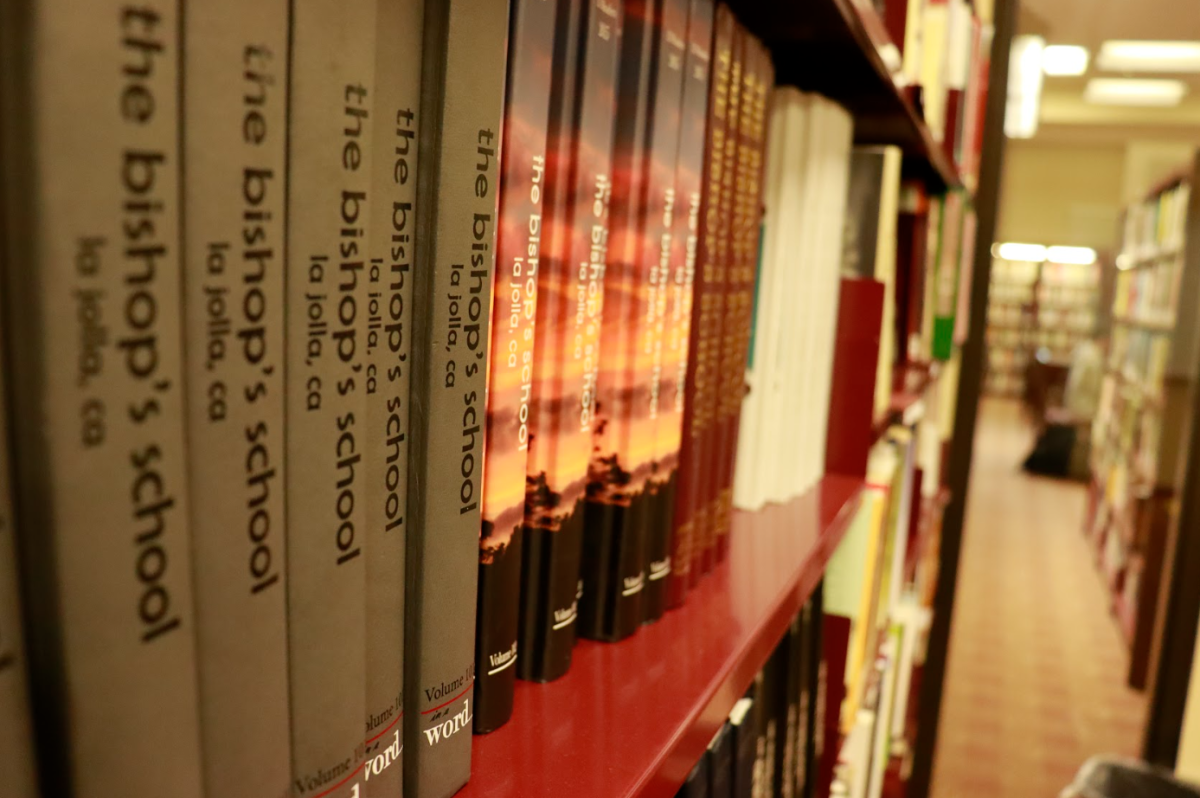


“Top of the morning, delegates. Welcome to America in the year … 1901!” shouted Emma Liu (‘27), as she vigorously cane dueled against Daniel Guo (‘28), enacting a scene of a laborer attacking her wage-cutting employer after a strike at a steel mill turned deadly. Both Emma and Daniel were staff members for The Bishop School’s 11th Model United Nations (MUN) conference, also called Knights MUN, on December 6th, 2025.
But what is MUN? According to the United Nations (UN), it is a way for students to familiarize themselves with the UN and hold UN-style debates and conversations with their peers. But perhaps Mr. Matthew Valji, History and Social Sciences Teacher and Co-faculty Sponsor for Bishop’s MUN, summed it up the best, saying, “Model United Nations is a way for students to engage with international affairs and relations and diplomacy in a fun and engaging way. It’s not just an academic subject. It can actually be really enjoyable.”
MUN is modeled after real United Nations conferences and thus retains their same speaking structure. Students can speak during a moderated caucus, where delegates raise their placards and are added to a speakers list with predetermined speaking times. They can also vote to enter unmoderated caucuses, during which delegates mingle among themselves and have open discussions.

All MUN conferences kick off with a guest speaker. This year, Knights MUN invited Robert A. Sherman, who also happened to be the neighbor of Co-Secretariat General Marly Berlin (‘26) in Cape Cod, Michigan. The Secretariats, or the leadership team for Bishop’s MUN, are led by Marly and Eliana Leff (‘26) as their Secretariat Generals this year. Sherman, a former ambassador of Portugal, spoke about his involvement with Obama’s presidential campaign and his personal experiences in navigating international relations with foreign countries. He concluded his speech by bestowing useful tips and advice upon the attending delegates.
All committees had two main staff organizers, the Chair and the Vice Chair. Some larger general assemblies also had a page. At Bishop’s conferences, the Chairs are always secretariat members, members of MUN leadership. The other roles at Knight MUN, ranging from Vice Chair to backroom staff, were open to all members of the Bishop’s MUN club.
This year’s Knights MUN featured a wide range of topics for students to navigate, with both standard MUN general assemblies and historical ones. General assemblies are typically larger committees that tackle more pressing issues, this year including Women’s Health Disparities and Cyber Warfare. General assemblies are the most common type of committee at conferences, and five out of eight committee rooms hosted general assemblies at Knights MUN.
Many students who were new to the Bishop’s MUN team also staffed the conference this year, including Anya Maru (‘29), Evelyn Fu (‘29), and Kathleen Owens (‘29) — all vice chairs for different committees. “It was a great opportunity as I learned about the ins and outs of what hosting a conference really feels like,” explained Evelyn.
During the committee, the Chair is expected to act like the teacher in the room, responsible for directing students and organizing the debate. The Vice Chair is more passive and mostly manages the webpage used for MUN called MUN Command. MUN Command contains the timers, the speaker’s list, and proposed motions. Pages are only in larger committees and are often on standby. All three students are also simultaneously evaluating the delegates to decide awards.
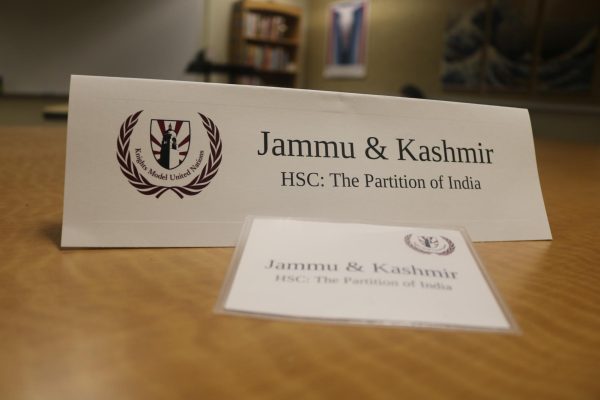
Samuel Stallings (‘28) served as a Vice Chair this year for the Historical Security Council, addressing the Partition of India (1947). He reflected that the delegates were very “eager and passionate about their discussions,” which made the conference “really enjoyable.” He also thought that although it was a lot of work, the experience was worth it as it was really fun. However, he considers taking on a different role at the next conference.
Preparing for this event took time and effort from many people. Faculty Advisors Ms. Abby Perelman and Mr. Valji started their preparations last school year. “During the previous school year, we checked in with facilities and administration to secure the date for the conference to confirm that it’s on the school’s master calendar and that that date is approved,” Ms. Perelman explained.
Secretariat members started preparing in September for the conference in December, Eliana explained, “We brainstormed different committee ideas, interests, and a couple of weeks later, we finalized them.” She added, “Then we sent out our application for staffing interests, see who’s interested in staffing.” Staffing interest forms were sent out on October 16th and were finalized on November 18th. “It’s a very long process,” Ms. Perelman said.
This year was the first time staff were trained before the day of. “We noticed that sometimes some of the newer students who were helping staff would be a little bit unprepared or wouldn’t know what was happening,” Eliana explained, “So we trained them ahead of time to know how to use the different technologies like MUN command and to know the different procedures to maintain a level of professionalism within the committee.”
As a Co-Secretary General, Eliana served as the upper secretariat member on standby this time around. “I did not run a committee this year because we wanna have a Secretary General on hand to put out any fires during the conference,” Eliana explained, “because when you’re chair, you are pretty much locked into the committee. You cannot move, you cannot leave, but we need someone on hand to be able to do things.”
However, Eliana did play a crucial role in designing and envisioning this year’s Crisis Committee, the Gilded Ages. What separates Crisis committees from other events is their fast-paced debate style that requires delegates to do a little impromptu speaking, but also allows delegates to work in the shadows, brewing their secret plans by sending their “notes” to backrooms.

The Gilded Age committee is a joint crisis committee (JCC). Whereas regular committees function as their own entity, a JCC merges two committees together — usually two opposing sides, or “blocs”. These committees participate with each other in a unique way, as events that happen in one room also affect the trajectory of the other. The Gilded Age JCC pits the Captains of Industry, chaired by Grace Yao (‘25), against the Journalists and Reformers, chaired by Katherine Teyssier (‘26).
Crises in general are also unique as they have a front room and a back room. So, whilst delegate Andrew Carnegie may act philanthropically and claim to give away his wealth to support the poor, he can secretly continue exploiting his workers by giving commands to the backrooms as long as other people don’t find out.
The staff in the back rooms had a particularly tough time as they needed to organize all the notes that delegates were passing in, and to also materialize them into ways it would affect the front rooms. Backroom was directed by Emma, along with Daniel, Eric Li (‘26), Noan Cheng (‘26), Kent Isakari (‘27), and Sophia Noves (‘27). “It was really hard work, but at the end, seeing how much the delegates enjoyed the committee, it was well worth it,” said Noan.
To spice things up, the entire back room dressed up as robber barons, thanks to the help of Ms. Jean Moroney, Performing Arts and Costume Design teacher. They acted out skits including the (multiple) assassination attempts on John D. Rockefeller, the Coca-Cola drug epidemic, a mysterious bird flu pandemic, the election of 1908 with a surprising victory from Eugene V. Debs, and finally, cheering the end of the Gilded Age with a toast of champagne (apple cider).
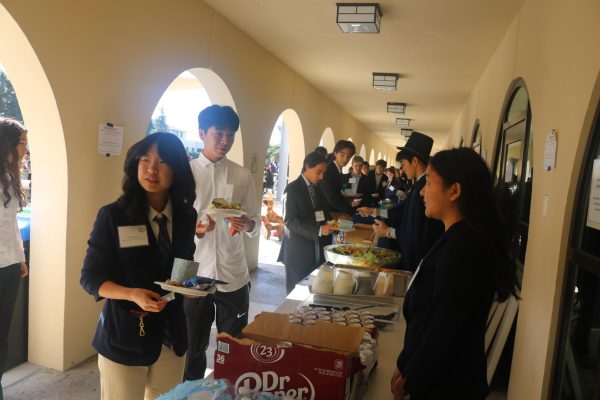
Knights MUN started at Bishop’s in 2013 as a way to expand the club and to provide “a great opportunity for our students to build real on-the-ground leadership skills,” explained Mr. Valji. “Those skills that are actually really critical in life and really critical out in the real world, but also provide students with a creative space to grow.”
As session 11 of Knights MUN came to an end, the students from all over San Diego began filing out of Bishop’s. They left after debating China’s seat in the UN, discussing disarmament strategies, or wearing top hats and pockets stuffed with monopoly money.
“We’re very fortunate to have seen it grow and grow over the years, seeing it become one of the largest high school-run conferences in the region,” remarked Mr. Valji. Through Knights MUN, Mr. Valji hopes that students will “feel empowered because they soon will be the generation of people that are going to have to grapple with and solve these very tangible problems.”