
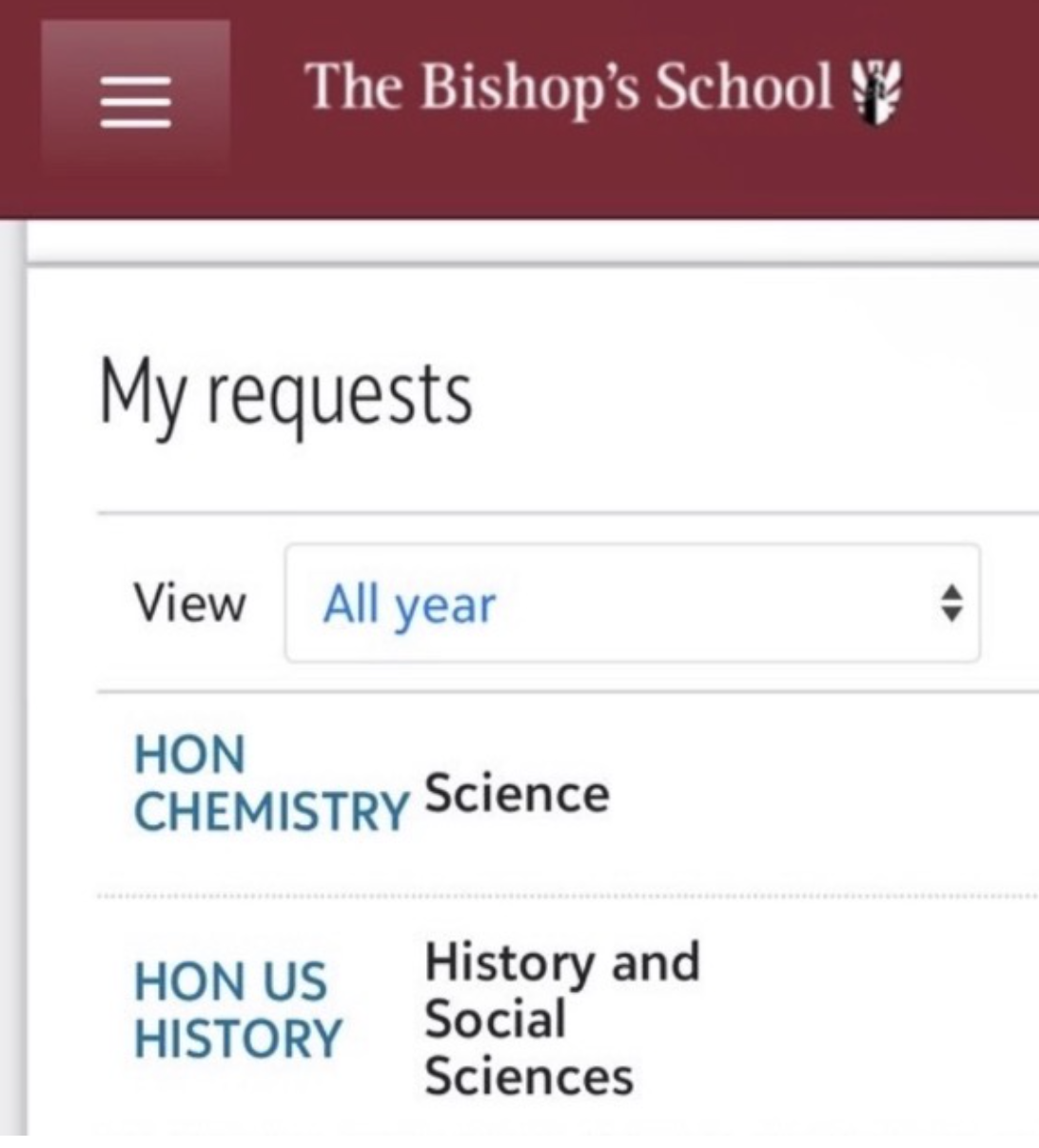
Every spring, familiar questions begin circulating among freshmen: Should I take HUSH? Honors Chem? Both? Neither? For some students, adding one or both of these Honors courses becomes part of a broader effort to challenge themselves academically and prepare for the years ahead. For others, the choice raises concerns for themselves about workload, balance, and whether the classes will leave enough time for their lives outside the classroom.
The two sophomore courses — Honors United States History (HUSH) and Honors Chemistry — have gained a reputation as particularly demanding courses at Bishop’s, and some of the most challenging academic options available to sophomores. Along with that reputation comes a familiar set of questions: How do students know if the challenge is worth it? And perhaps the most frequent: are the classes worth the +1.0 grade bump?
Honors United States History (HUSH)
Among the two courses, HUSH is often described by sophomore students as consistently demanding (in that there is approximately an hour and a half of homework each night). While rumors about the class tend to focus on its difficulty, students who have taken it believe the challenge lies less in complexity of the material and more in the pacing of the class, volume of the work, and having the discipline to do it.
Freshmen considering HUSH often hear similar messages: expect a lot of reading. Brooke Gibbons (‘29), a current Freshman planning to take HUSH next year, mentioned, “I heard that HUSH is a lot of content in a short amount of time.” She added, “That news kind of scared me.” While true, that perception, paired with the broader reputation of Honors courses as being extremely challenging and time consuming, can make the class feel intimidating before students even step into it.
HUSH Teacher Dr. Charissa Keup acknowledged, “It is a big jump from Modern World History (MWH) in the amount of reading that [students] have to do, and the rigor of the class I would say can sometimes be a tough adjustment.” She remarked, “This class has a lot of content but also a lot of skills — you have to work hard, and it takes a lot of time.”
Some sophomores, however, emphasize that the structure and consistency of HUSH is what actually makes it manageable. Current HUSH student JT Cochrane (‘28) ultimately decided to drop Honors Chemistry after taking both courses. From his experience, he explained, “HUSH is literally just reading. If you’re a good reader and can understand information quickly, it might work better for you.” He stated, “HUSH is very structured; it’s like ‘this is the homework every night that you need to do — go and do it.’”
That consistency in workload can be an advantage, but it also means it can be easy to fall behind and difficult to quickly recover. Students who succeed in the class often point to habits beyond keeping up with reading, like taking organized notes and being proactive in reviewing the material. For Noah Smith (‘28), the workload is manageable with the right approach.
Still, teachers caution that success in HUSH is not just about keeping up with assignments, but about how students approach their overall workload. History and Social Sciences Teacher Mrs. Emily Smith emphasized, “Students must see their life in sophomore year as a giant puzzle.”
One of the most common patterns she has noticed is that something is ultimately sacrificed. She explained, “The puzzle pieces need to fit together so that students have time to sleep… the first thing that is sacrificed is almost always sleep.” Students need to consider how all aspects of their lives fit together — sleep, family time, extracurriculars, and homework. In 2024, the Centers for Disease Control and Prevention (CDC) reported that the percentage of high school students who do not get enough sleep increased from 2009 to 2021; by 2021, about 77% of high school students nationwide are having insufficient sleep. Mrs. Smith stressed, “There are a lot of students that certainly have the aptitude [to take multiple Honors courses], but there are only so many hours in the day.”
Advanced Placement (AP) exams and credit are another reason students often consider taking Honors courses at Bishop’s. As Dr. Keup explained, “If you do well in this course, you can usually do well on the AP exam. It does take some extra effort outside of the classroom, because we are not an AP class, but my students, historically speaking, have done well on the AP exam.”
It is important, however, to consider that Bishop’s does not actually do the AP program, in which classes are taught strictly according to the AP structure and curriculum. Some classes, like HUSH, may well prepare students for the exam if they so choose to take it.
In that sense, HUSH becomes about both the raw difficulty and the fit. For students who are strong readers, can stay consistent with their work, and are willing to engage deeply with the material, the class can feel structured and manageable. But for those who underestimate the time commitment and the necessary consistency, the course’s pace can quickly become overwhelming.
Honors Chemistry (Honors Chem)
If HUSH is described as consistent and structured, Honors Chem is often described, in a way, as the opposite — more self-directed, and for many students, more challenging to navigate.
Freshmen students echoed concerns about workload and time commitment, especially when paired with other demanding classes. Ian Shin (‘29), a Freshman planning to take both Honors classes, said, “I’m worried about being able to manage the course load. Especially during the spring season, when I have practice every day and multiple games a week.”
However, students who have taken Honors Chem say that the experience depends heavily on how you approach learning. Unlike more structured classes, the course often requires students to take initiative and work through concepts independently. “No one tells you what you need to do,” JT mentioned. He added, “Some weeks are full chem weeks… others are more limited. Time management is extremely important.”
For some students, that lack of structure can be the most difficult adjustment. Ashali Rastogi (‘28) — another student who ultimately decided to drop the course — mentioned that she wished she had understood earlier how much independence the class requires before taking it. “You kind of have to figure it out on your own,” she said. “If I knew that before, I probably wouldn’t have taken it because I like more direction.” Ashali also explained that when concepts don’t come easily, the time commitment can increase significantly; she added, “If you don’t get it completely, you’re putting in so much extra work.”
At the same time, other students find the intellectual challenge rewarding in some ways. Noah said, “Chem is a lot more difficult for me, but I think the workload is easier — if you’re the type of person who can think through conceptual things very quickly, it’s not a very difficult class — except for specific tests.” He added, “Not knowing everything and having to be flexible enough to apply what you do is an important skill as well.”
Science teachers note that the difference in experience between the on-level and Honors courses mainly comes down to interest and mindset. Dean of Faculty Mr. Ben Heldt teaches freshman physics, and explained that students should think carefully about where they want to invest their time. “Interest is a great predictor of success,” he said. “If you aren’t interested, it can be a slog.”
Mr. Heldt emphasized, “There are important questions to ask yourself: What does your entire schedule look like? Are your extracurricular activities increasing? Is this the first season you might play a varsity sport — or start?” He explained, “9th to 10th grade is a big step up in many different respects. All expectations increase all at the same time, and it is really the time when you have to start prioritizing.”
Honors Chemistry Teacher Ms. Alison Valentine explained that the course is less about memorizing content and more about fundamentally changing how students take ownership over their thinking. “This is not a passive intake of information,” she said. “This is banter and discussion! It is never sitting quietly and taking notes.” She explained, “If you are hoping to just take in the information and apply it to practice problems, it might not be the best fit. Students should be comfortable being uncomfortable in how they approach learning.”
That shift can be jarring. Many students enter the classroom confident in their study habits, only to find that some of those strategies may no longer work — Ms. Valentine called this an “academic epiphany.” She laughed, “It’s almost like stubbornness…which is a weird way to describe it. People just feel comfortable in how they do things.” She explained, “If that is no longer efficient, then students equate difficulty with their own strength. ‘This is hard’ does not necessarily equal ‘I am bad at this!’” The difficulty reflects a new kind of thinking, not a lack of ability.
Ms. Valentine explained, “I describe Physics, Bio, and Chem as three romance languages: French, Italian, and Spanish. There are a lot of similarities in structure, fundamental core principles, and thinking — but just because you speak one doesn’t mean you can speak all… and that is totally okay.”
In that sense, the course asks for something deeper than time or effort alone. It requires initiative, reflection, and a willingness to be uncomfortable — whether that means struggling through a concept, adjusting study habits, or accepting that understanding takes time. “If you are excited for that,” Ms. Valentine said, “then it is the place to be.”
Final Takeaways
The decision ultimately comes down to something broader than just a curriculum choice. The question is what kind of year a student wants to have — and what they are willing to prioritize along the way.
“I think the biggest misconception is that a good reason to take them is for the grade bump,” said Mrs. Smith. Instead, she explained, “There needs to be a genuine interest in the content to actually succeed. I find that a lack of interest often leads to a struggle.” It is also important to consider that struggling does not equate to a lack of ability, and instead may be because the course itself is challenging and demands sustained effort and engagement over time.
Sanjeevni Vaidya (‘28), a sophomore taking both Honors courses, expressed, “I honestly wish someone had told me that while they are challenging, they are also manageable if you have the right habits and believe in yourself.” Both students and teachers emphasized that the real challenge of sophomore year is not whether students are capable, but whether they have a genuine interest and the time to balance everything.
Honors classes, in many ways, ask students to engage with difficulty rather than avoid it, and to respond to feedback as part of the learning process rather than as a measure of failure. That process can be uncomfortable, and it is important to remember that certain things come easier than others.
Sanjeevni said, “In 9th grade, I relied on whatever study materials the teacher gave us. This year, however, I needed to find other ways to study and prepare. I regularly used YouTube videos, AP practice websites, Khan Academy, and other resources to improve my understanding and study for tests.”
Success in Honors courses often comes down to habits and mindset. Teachers point to many of the same qualities. Mrs. Smith named “independence, reading comprehension, critical thinking… and a healthy relationship with feedback” as factors in helping students succeed.
Ultimately, the decision to take HUSH, Honors Chemistry, both, or neither is not about choosing the most impressive courses, but considering your interests, schedule, and overall life during sophomore year. In the end, the question is not just Can I take this? — but should I?