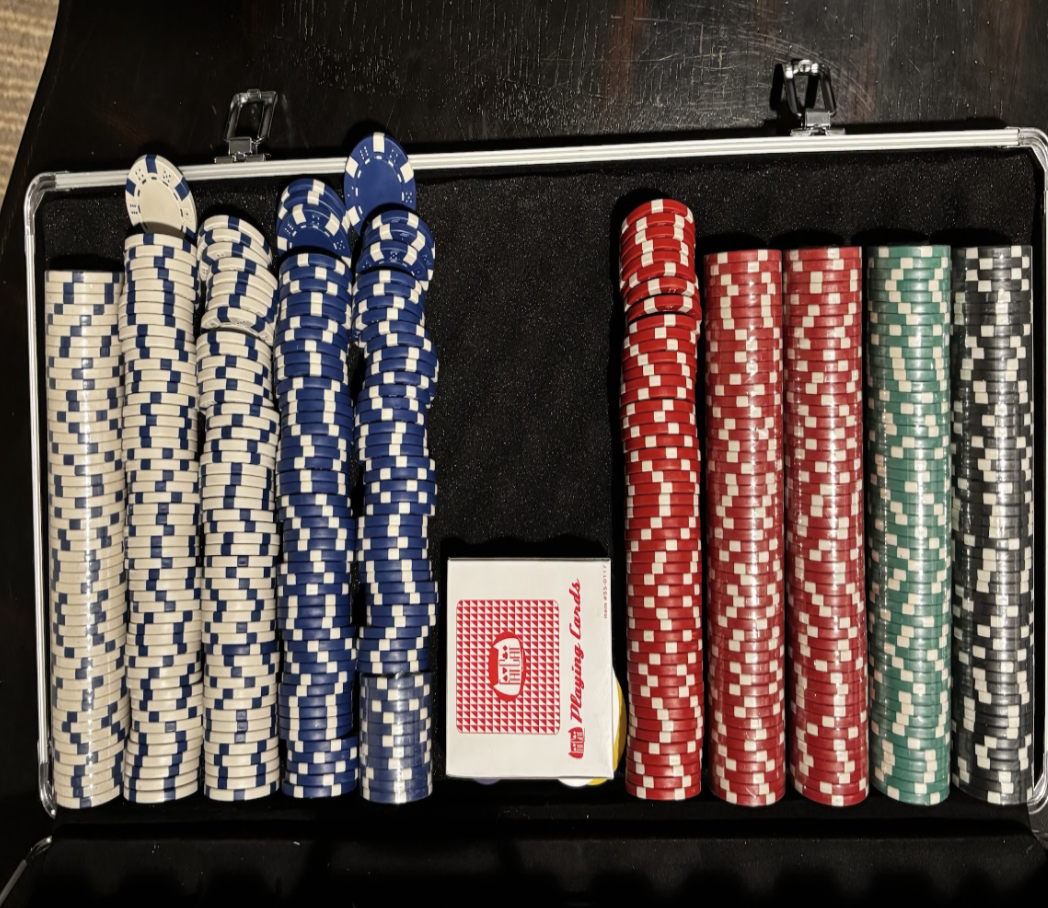
Philip Vano’s (‘28) poker chips are a familiar sight at group hangouts with JT Cochrane (‘28), Jackson Binn (‘28), Sam Harvey (‘28), and Henley Willingham (‘28). Because the group plays so often, having a set of chips has become essential — and as poker’s popularity has grown, chips have become a popular birthday and holiday gift.
Calculating odds isn’t something students reserve for math class. They’re often doing these same calculations around a circle of cards — reading faces, weighing risks, and chasing a competitive thrill. Poker, a card game traditionally played to gamble money, has been around for generations – and is thriving at Bishop’s as a competitive, skill-based game..
Whether it’s for social connections, adrenaline rushes, or bonding time, poker is becoming a popular pastime among teenagers, including Bishop’s boys. At least three large groups of boys at Bishop’s meet regularly to play poker — during the weekend or sometimes, even during lunch.
Ninth graders Bruce Esajian (‘29), Alex Serhan (‘29), and Isaac Smedra (‘29), along with their younger siblings and family friends, often spend their free time playing poker together. They use the game as a way to bond, learn from one another, and steadily improve their skills for fun.
JT Cochrane (‘28), a frequent poker player, boiled it down to one common theme: competition. “I think it’s just everywhere now. School, sports, and even these little games have so much higher pressure because of how much you want to prove you are the best.” Bruce Esajian (‘27) agrees by saying, “the winning part is what we love”.
But why isn’t Poker proving to be enticing for girls? A study from a National Poker Magazine that conducted a survey focused on the dynamic between women and poker, found that “over two thirds (68%) of women agree that poker feels like a male dominated game.” Sadie Van Huizum (‘28) has many friends that are boys who engage in poker, and when asked why she doesn’t play, she said, “if we ever hangout, we would never feel inclined to play in a round and when I hang out with my friends we would never consider playing it just for fun. I feel like guys do it to prove who is better and competition and I don’t think any of my friends feel that urge.”
According to Director of Counseling Mrs. Megan Broderick, this competition often doubles as a social tool. Students, she explained, “are socialized to connect through games,” and “in some ways, shared competition is their most comfortable way of connecting.”
Beyond competition, poker serves as a social bridge that brings students together and builds confidence and friendships. Because it is so accessible, “it’s a great equalizer. If somebody is maybe not so great at sports, but they find that they have a skill at poker, there’s some confidence boosting there,” Mrs. Broderick explained.
Evan Hamadeh (‘26) has been playing poker since he learned it in 7th grade on a fishing trip with his dad and friends. His interest, passed down through generations, was later re-sparked in 9th grade after watching a single YouTube video with friends. “In 9th grade, it’s not like we have a car. We just sat around someone’s house, pulled out a box of chips, and we all learned how to play together,” he said.
Now, Evan has a central group of five friends who consistently play together. Sometimes they play during lunch, and anyone can jump in, as long as they don’t exceed the standard eight players. “It’s just about connecting,” Evan said. “Nobody really cares who wins or loses, it’s just for bragging rights and the fun of it all.”
Over time, Evan explained, his group’s approach to the game has changed. Poker once felt new and complicated, but as they played more, each person settled into a role. “At first, we just messed around and didn’t know what we were doing. Now our group understands the skills we need, and we see clear patterns,” said Evan. He added, “Poker is more academic than you would think. There’s a lot of probability, and there’s a lot of statistics in it. It’s not just guessing.”
Mrs. Broderick, along with her colleague, Bishop’s Counselor Ms. Lauren Gray, describes poker as an acceptable source of adrenaline and a way to increase dopamine levels without being on a screen. She said, “We felt like this was a positive shift, like they’re trying to engage together and not be on their phones.” For Jackson Binn (‘28), that dopamine is what makes the rounds exciting. “We’re addicted to the rush — the thrill of playing for a good time,” he said.
Mrs. Broderick also explained that “poker is new on campus. I have worked here for over a decade, and it has never been as popular as it is now.” Both Ms. Gray and Mrs. Broderick have noticed an unprecedented upsurge in students playing both inside or outside their offices during the school day. However, together, they make it very clear that exchanging money for poker while being under the age to do so (ranges between either 18 or 21 at commercial casinos), can be a highly addictive and dangerous activity for young people. In a statistic by a Public Health Journal, an estimated 17.9% of youth globally have gambled in the past year, and could easily be a possibility in our community. Mrs. Broderick and Ms. Gray reiterated the importance of looking out for kids from the beginning to ensure the safety and well-being of whoever plays the game.
Frequent poker play can carry risks and consequences, including addiction. An article in The Guardian reported that “Up to 46% of regular poker players experience gambling-related problems,” emphasizing the high rate of addiction. Mrs. Broderick noted that a “trajectory toward an unhealthy relationship” can emerge from habitual playing and emphasized that moderation is key. She says, playing once a week, enjoying the game, and being able to move on even after a loss signals a healthy balance.
She also added something that is both important and necessary to keep in mind: “It is very problematic for minors to be exchanging money for poker. Not only is it illegal but it also excludes people who may not be able to or want to spend money.”
Many students, however, describe poker at Bishop’s as primarily recreational, a view shared by Ben Turner (‘27), who said, “losing isn’t going to take away from anyone as a person, and we all know that. We play for fun and to win. The possibility of loss isn’t strong enough to keep us from playing.”
Bruce Esajian (‘29), who began playing in 7th grade, is one of many 9th grade poker players. At least 20 of his friends play, and they all play together three or more times a month. In fact, poker is almost always the activity of choice when they hang out. “I mean, it’s so good that it gets all of us to put down our phones and focus on something for a while. Honestly, it’s pretty rare to find something that engaging for that long.”
Claire is a current Sophomore at Bishop’s, and this is her first year writing for The Tower! Claire hopes to bring fresh perspectives and engaging stories to her readers, as well as highlight all the moments that make Bishop’s such a great community. At school, Claire loves being a member of the student council as her class representative, as well as a member of the swim team. When she is not at school, she loves to spend her time traveling, chasing the sun, being with her friends and family, and competitively swimming. Claire can’t wait to begin this year of writing for The Tower, exploring new stories, and sharing them with everyone here at Bishop’s!
Comments (0)
The Tower welcomes comments from members of The Bishop's School community on articles published online. The Editors approve comments before publication. Comments may be omitted in order to maintain a respectful environment for discussion. Profanity, violation of privacy, spam and unsolicited advertisements are examples of grounds for omission. The Tower does not approve anonymous comments.