

Math teacher and longtime newspaper reader Mr. David Johnston recalled starting his mornings by flipping to the sports page and comics of the Los Angeles Times, and returning home each afternoon to read the Evening Tribune. “It was part of the routine, something that any number of people my age grew up doing,” he described. These two papers would later merge amidst a shrinking print market.
By late 2025, the Medill State of Local News report revealed that over 3,000 local print newspapers had closed down nationally, as readers increasingly turned to online news websites and social media for information. The Atlanta Journal-Constitution, one of the largest U.S. daily newspapers with a 157-year print history, published its final physical edition on December 31, 2025, before transitioning to an entirely digital format.
In many ways, these national trends are reflected in the Bishop’s community. Library Director Ms. Alisa Brandt explained that print references are being turned into digital databases, and newspapers have been entirely replaced by school-wide online subscriptions to publications including The Washington Post and The Wall Street Journal.
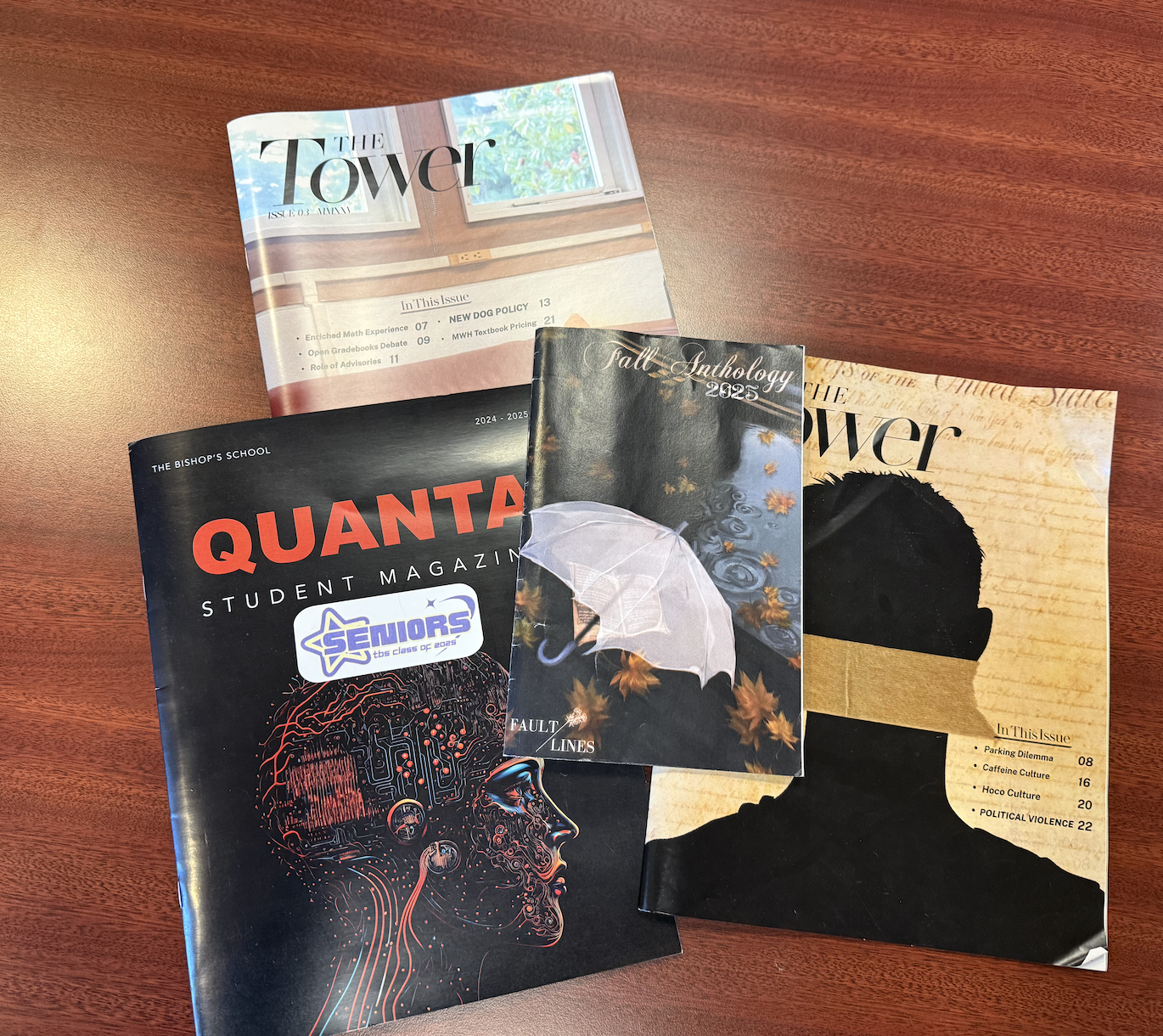
As Ms. Brandt put it, digital platforms are often more accessible. Faultlines Editor-in-Chief Aline Woiwode (‘27) noted that while the publication’s traditional literary magazine will remain in print, their new book review series will be published exclusively online. “We haven’t had a lot of digital issues in the past,” she said, “but it’s easier for students to access digitally.” Quanta Editor-in-Chief Angela An (‘27) added, “This year we’re almost certainly going to do two issues, one on print, one on digital.”
Editors are finding ways to adapt digitally, yet print still continues to be a familiar presence across campus — open on tables throughout the Student Center, surrounded by middle schoolers on the steps leading up to Gilman, and stacked in teachers’ classrooms. History teacher Ms. Katy Rees explained, “there’s a certain sense of community in having things printed in a publication… that is permanent versus something online that disappears within a week or two.”
“There’s excitement over it too,” she added. “I think about when people would look forward to magazines and who’s going to be on the cover, and you don’t do that with a website. You don’t say, ‘oh, what’s on this website?’ You just stumble on it.”
Though print magazines have been declining for decades, they have remained at Bishop’s because in a media landscape dominated by algorithmic curation, our community continues to choose the depth, serendipity, and shared experience that print provides.
Ms. Brandt described that while digital platforms are convenient, many news websites are designed to prioritize engagement, and have changed the way we read and engage with information. “When you look at things online, it’s not about you learning something. It’s really about ‘how do I keep this user engaged by looking at the screen?’” Ms. Brandt said. “They have certain hotspots on a webpage that catch your eye and it distracts from the whole experience.”
Digital platforms also offer an unprecedented volume of information. Growing up, Ms. Rees read newspapers and magazines cover to cover. “I probably knew about fewer subjects than students today are exposed to, but I had more opportunities to read in depth,” she said. Today, she noted that she finds herself skimming information online rather than reading closely. “It’s not just students, it’s me as well. And it’s not just a function of short attention spans, being lazy, or anything like that. The neuroscience is that when we read online we skim, but when we read print we read for depth and pick up on more nuances and context,” she explained.
A study by the Interdisciplinary Reading Research Structure (ERI) of the University of Valencia in 2023 reinforces Ms. Rees’ point. The same amount of time spent reading on paper leads to about six to eight times more comprehension than time spent reading on screens.
Zachary Haubenstock (‘28) grew up in a household where the newspaper was on the table for breakfast every morning, but also alongside the rapid expansion of digital news and easily accessible information. He noticed, “When stuff goes online, it’s a lot easier to spread misinformation. The rise of clickbait and political polarization also contributes to news being generally more provocative.”
Ms. Rees and Mr. Johnston noted that today’s news environment often functions as an echo chamber. “Algorithms shape the world that we see,” Ms. Rees explained. “You read an article about a topic, they’re going to push another article on that topic. You like a post that has a particular stance, you’re going to get 20 more posts that share that same stance. And after a while, you’re not ever seeing any other perspectives and you’re definitely not seeing nuanced perspectives.”
As a result, as Mr. Johnston described, print still holds value because it offers serendipity and community that digital platforms can’t replicate. “I like the fact that if I’m looking through the paper, the algorithm isn’t putting this together,” he described. Whereas online content is personalized, print magazines are curated. As Mr. Steve Brown, former Bishop’s English Teacher and Publication Advisor of The Tower, said, “People who put [print magazines] together have a taste. They’re choosing things that they think are interesting, so you always get a little bit of surprise, and sometimes you find things you didn’t expect to like, but that was really interesting.”
“When we grew up, where people got the newspaper, there was much more of a shared experience. And one of the nice things about the school is that I do think we have a shared community. But as a society, do we have a shared community? Not as much,” Mr. Johnston added.
Angela noted, “The magazines lying around on tables and picking them up when you see them is a really unique aspect of what we have here at Bishop’s… it’s an integral part of Bishop’s student life.” She added, “They’re peer-written and peer-reviewed and peer-published. So this is work completely created by fellow students, which makes it even more accessible to hear what they’re saying, learn what they want to learn, and what they want to teach.”
Curation allows print to foster a sense of community. “For print articles, I’ll actually talk with my friends about them. We’ll read them during milk break or lunch and during our spare time because they’re just right in front of us, and it’s just a nice way to spend your time,” Angela said. “But with web articles, unless they’re like social media-based, super quick highlights, I typically don’t interact or talk about them with my friends.” Zachary added, “I picked up [the last Tower issue] at the library, and I took it home. I read it, and I showed it to my parents, and they read it.”
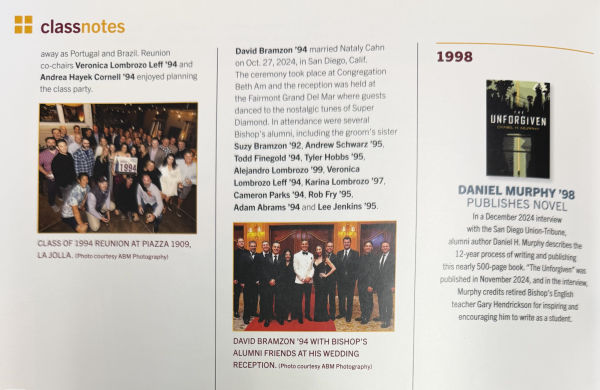
“Our goal is, we call it earning coffee table status,” Ms. Cathy Morrison, Director of Marketing and Communications and Editor-in-Chief of the Bishop’s Magazine explained. “We hope that the photography and the stories are interesting enough that people will have it out on their coffee table, or they’ll read the articles, and so they’ll keep it around for longer.” She added, “[Print] is a nice keepsake. The web has so many things on it, but if you have the physical copies, you can keep a stack of them and go through them whenever you want.”
Print brings increasingly rare collective reading, conversation, and connection in a media landscape shaped by algorithms. “We’re all writers, readers, or editors of print publications,” Angela said, “and I really enjoy that.”