
On a January evening, beneath delicate stained glass and warm lights, Reinhold Glière’s Russian Sailor’s Dance echoed beautifully off the walls of the St. James by-the-Sea Episcopal Church. The day before, the Bishop’s Chamber Orchestra, alongside parent volunteers, took shifts moving violins, cellos, and music stands to the church — transporting, piece by piece, a Bishop’s concert off campus.
This year’s performing arts calendar raised questions among students and faculty about fairness, access to performance spaces, and how much preparation time each ensemble receives.
The concert had originally been scheduled in the Taylor Performing Arts Center (TPAC) for November 1, but families raised concerns because the date fell the day after Halloween and coincided with a major college application deadline. With no other on-campus dates available in the fall, the orchestra did not have a replacement date until it received permission to perform at St. James.
According to Performing Arts Department Chair and Theater Arts Teacher Dr. Kristen Tregar and Assistant Head of School for Curriculum and Academics Mr. Brian Ogden, fairness is one of the central goals of the scheduling process. “We work from shared principles that guide decision-making,” Mr. Ogden said, “such as supporting student well-being, honoring academic priorities, sharing access to facilities, and balancing the different needs of programs over time.”
Yet, Dr. Tregar explained that the process becomes more complicated in practice because the calendar must account for shifting holidays, school events, limited performance spaces, production setup time, and the competing needs of multiple ensembles. “It’s a very difficult-to-manage puzzle,” Dr. Tregar said.
With unavoidable sacrifices from each ensemble, Dr. Tregar called the allocation outcomes a “tragedy of the commons.” As Dance Teacher Ms. Yvette Luxenberg explained, “If one person got what they actually wanted, then everybody else would get something that literally doesn’t work… So everybody has to give a little for [the final schedule] to even be possible.”
Performing Arts Council (PAC) President Eliana Leff (‘26) noted that while coordinating across multiple ensembles requires significant time, communication, and compromise, “it is natural for students to feel frustrated when decisions impact them in ways that feel unclear or unfair. Both of these perspectives can coexist.”
Ms. Lux explained that part of the difficulty of balancing the calendar comes from the nature of the performing arts department itself: within these limitations, each art discipline has different needs — and each teacher is responsible for advocating for their own program. “It’s the nature of the beast a little bit that you do have to go in wanting to advocate for what is best for your program because you are the only one, even in a department,” Ms. Lux said. “It’s really like six individual disciplines that are thrown together.”
Dr. Tregar explained that, for the most part, teachers have been willing to work through scheduling conflicts collaboratively. For example, Ms. Lux agreed to set the dance show earlier in the semester this year because she had a later date the year before. Ms. Lux explained, “Can dance always be the last show of every semester? No, because everyone wants the most time to teach their stuff.” However, she continued, “You can’t have it all. You work in a school, and you have to work together, and your main purpose is to serve students, so you have to just make it work.”
Director of Choral Music Dr. Christine Micu noted, “There’s only a limited number of days and a limited amount of time. And that’s hard. It’s one of the hardest things we do in our department.”
How the Performing Arts Calendar is Built
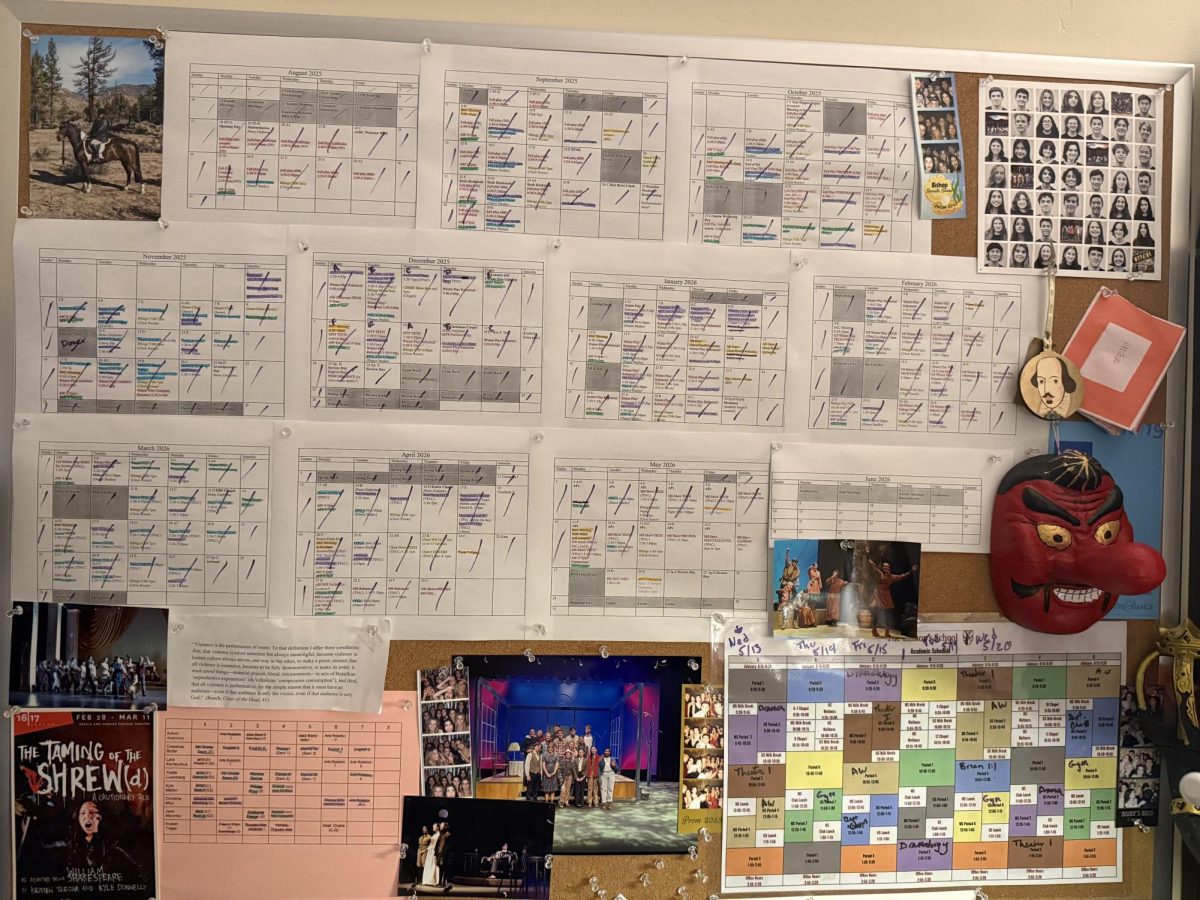
The Performing Arts Department — which includes Dr. Tregar, Ms. Lux, Technical Director Mr. Kyle Melton, Dr. Micu, and Director of Instrumental Music Mr. Robert Anderson — begins building the calendar for the following school year each April.
It is built on top of two calendars: the Gregorian calendar, which accounts for federal holidays, and the academic calendar, which includes dates such as school-wide breaks put together by the Bishop’s administration, and important events such as Bish Bowl, the Christmas Tree Lighting, and Gala, which are factored into the academic calendar by Bishop’s Events Coordinator Ms. Kanda Thomas.
The performing arts calendar is largely determined by the Gregorian calendar. “Each year’s a little bit different. Next year will be particularly challenging because of the ways in which the Gregorian calendar has shifted and the ways in which other school events have been scheduled,” Dr. Tregar said. She noted that in the 2026-2027 calendar, Labor Day falls later than usual, retreats are two weeks after school starts instead of three, and Veterans’ Day falls on a Wednesday, among other shifts.
“Every year, you have to have a whole new mindset because you have no idea where the dates are going to fall,” Ms. Lux said.
The academic calendar also plays a major role in shaping the performing arts calendar. Ms. Thomas explained that she receives an initial draft of the performing arts calendar to review each year, and at least 25% of it ultimately changes.
For example, in next year’s performing arts calendar draft, the date the Fall Play was scheduled for conflicted with Bish Bowl. “So Dr. Tregar and I needed to sit down and basically refigure the entire fall calendar for performing arts because Bish Bowl could not be moved,” Ms. Thomas explained.
Ms. Lux added, “You put some possible things together, and then you have to adjust once you see where other non-negotiables lie.”
After receiving the academic calendar, the department begins constructing the initial draft of the performing arts calendar by considering the time blocks of the middle and upper school performances.
As Dr. Tregar explained, MT8 and the middle school show are always last in the semester for two reasons: they need more time to do the same thing that an upper school group would do, and they are not going into final exams or APs, so it makes sense to put them around finals week.
Second, Dr. Tregar explained, the department has to ensure that every curricular area has at least one fall concert and one spring concert while also accounting for objective capacity constraints. Bishop’s has three primary spaces for performances: the chapel, the TPAC, and the Blackbox. The TPAC holds around 160, the Blackbox holds around 75 at the maximum, and the chapel around 190. “We’re a very physically small canvas, trying to do a lot of really big events all at the same time,” Ms. Thomas explained.
Thus, capacity can play a large role in space allocation. “MT8 is packed for every performance in the TPAC… if we wanted to move MT8 to the Blackbox, we could, but to allow the same number of audience members that reliably come, we’d need twice as many shows in there,” Dr. Tregar said. “It’s about who comes, how many shows we need.”
Dr. Tregar also explained that certain spaces work better for certain ensembles. “From an acoustic perspective, the chapel is great for music. The echo that you get in there sounds lovely for choral music or chamber music. It’s really hard for actors to be able to manage the echo, so it’s not great [for actors],” she said.
On the other hand, Dr. Tregar explained, the Blackbox is “acoustically dead,” meaning it’s not ideal for choral or classical instrumental music, but works for the actors. She added that the dancers also prefer not to use that space because the floor is not sprung, which absorbs impact and gives dancers safer support.
It’s limited space, amidst the time required to prepare performances — both through teaching, rehearsals, and technical setup — that constitute the two primary constraints in performing arts scheduling.
Managing Limited Performance Dates and Space
With multiple ensembles sharing the same calendar, preparation time is one of the primary constraints in performing arts scheduling. As Dr. Tregar described, because performing arts students spend most of the semester preparing for their culminating concert, “Everybody wants their concert to be effectively the final exam, which means everybody’s trying to go as late in the semester as they possibly can… Is it the ideal time to go at the beginning of November? No, it’s not. But somebody has to,” she said.
Mr. Melton explained that technical theater students — which includes scenic design, lighting, sound, props, and stage management — learn through a more “hands-on experience,” and because of the timing of the fall play, their final always takes place in October. Although Mr. Melton has built his curriculum around that timeline, he explained that it creates pressure to “learn very quickly and do very quickly” in the first half of the semester.
For dance, Ms. Lux explained, performing earlier in the spring semester meant losing three weeks of rehearsal. “Was it a no-go? No, we did it,” Ms. Lux said. “But is it my ideal? No. Because now we have seven weeks left and we’ve already had our final exam.” Mr. Anderson agreed that additional preparation time would help instrumental ensembles feel “more prepared and confident,” a benefit he said applies to students preparing for “a concert, a game, a production, or a competition.”
He continued that because the orchestra does not meet during the school day, preparation time is more limited, and an earlier date can significantly affect the length of their concert, the difficulty of the repertoire, or the “kind of experience we are able to create for students.”
For choir, Dr. Micu described, later fall concert dates also better align with Bishop’s holiday traditions, including tree lighting and Christmas chapel, because it minimizes the need for students to transition between different repertoires.
These time constraints are intertwined with space limitations — performance spaces must be shared with classes while also accommodating technical preparation, set construction, students involved in multiple ensembles, and student and faculty workload.
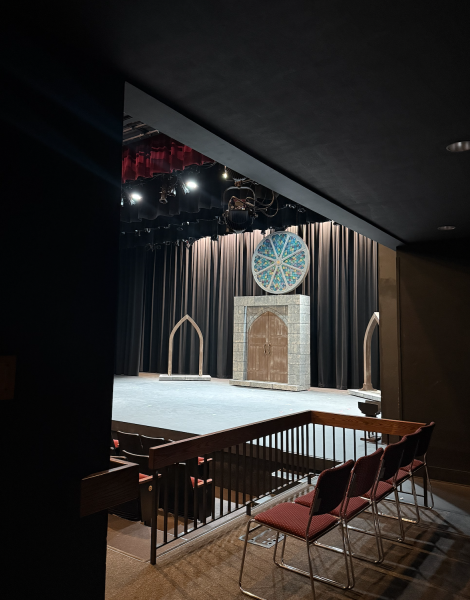
First, as Dr. Tregar explained, the Blackbox is primarily used as a classroom, which limits its availability for productions. As a result, productions that require significant staging and set-construction time must rely on the TPAC. “Ordinarily, the amount of time that it takes to build a set at a minimum is usually around six weeks,” Dr. Tregar explained. “That would be with professionals — we’re working with students.”
Although it depends on the set, Mr. Melton explained that if he handles the initial setup and preparation, such as building and clamping wall structures, Bishop’s students can get it done in a similar timeframe. However, because sets cannot easily be moved or shared, multiple productions cannot be fully staged in the same space at the same time.
The technical theater class constructs sets using stock platforms, which are assembled into a rectangular base, before adding wall pieces ranging from four-by-eight to two-by-eight feet. “We put all those pieces together on stage, and then we have to paint all that in place,” Mr. Melton described. When Mr. Melton worked at the Old Globe, the scene shop was spacious enough for crews to build an entire set offstage, disassemble it, move it, and reinstall it quickly. “We don’t have that ability,” Mr. Melton said. “So we have to build everything in place.”
Moreover, ensembles such as dance have a longer tech process, during which the theater is reserved exclusively for their use. As Ms. Lux explained, the dance concert requires a three-week tech process because it is closely connected to the technical theater program, whose students need time to review spacing videos in the TPAC and design lighting around the dancers’ movement.
The time required to reset the TPAC between each production further limits scheduling flexibility. Dr. Tregar explained that last October, technical theater had to strike and store the entire Beowulf set before rolling out the Marley floor, a vinyl surface that gives dancers traction and cushioning. There was only one weekend between the fall play and the start of dance spacing, she added — the same week the fall orchestra concert had originally been scheduled for November 1.
This spring, scheduling dance earlier helped clear the theater for orchestra, jazz, and choir concerts later in the semester, as the dance concert requires the Marley floor, which other ensembles cannot perform on,
These constraints are exacerbated by the number of students involved in multiple ensembles. Because many students participate across disciplines, performances cannot overlap. “We have a lot of students who do more than one discipline. That’s awesome… but we can’t have a choral show and a dance show on the same day in different spaces,” Dr. Tregar said, “Everything’s gotta be sort of by itself.”
Administrative guidelines — such as no student activities on Sundays, no events past 7:00 p.m. on weekdays, and restrictions on Saturdays when there are Friday holidays — further limit the available time for rehearsals and performances.
“When you’re looking at rehearsing for five hours instead of two hours, you can get a lot more done, and you can pack a lot more stuff in,” Mr. Melton explained. “When we started pulling away from that, that is where the contentious part comes because there’s just all these extra factors that make it hard to schedule.”
Ms. Thomas explained that these policies are in place for student well-being: “Prior to that policy being written, we would often have events running until 9, 10 p.m. … Our students would then go home and do homework until two, three o’clock in the morning… The School quickly realized that was not sustainable.”
Dr. Tregar explained that before she arrived, the theater program scheduled a significantly higher number of productions, including separate plays for underclassmen and upperclassmen, multiple middle school performances, seasonal shows, dance productions, and numerous concerts. “There was just all this stuff happening all the time to the point where the only way to be able to get all the work done was to just effectively live here,” she described.
Dr. Tregar added, “and that’s not sustainable for anybody. So, another one of the things we try to think about when we’re building the calendar is, how do we have weekends, how do the teachers have the ability to spend time with their families, how do students have enough time to eat and sleep and do their homework?”
Some adjustments the department has implemented in past years involve modifying productions to fit within existing time and space constraints and collaboration between different ensembles.
Dr. Tregar explained that in recent years, MT8 performed without a set because there was not enough time to complete a full build and teardown after the dance concert, which was scheduled later in the semester. Instead, the show was designed to remain on the Marley, allowing it to fit within the existing schedule.
In addition, although Acting Workshop had previously staged full productions in the TPAC before Dr. Tregar started teaching at Bishop’s, they shifted the showcase to the Black Box during Acting Workshop’s regular Monday after-school rehearsal time. Dr. Tregar explained, “Most people don’t want to attend a show on a Monday. But we ask families and friends to come support the work of the Honors actors on a Monday night each fall because that is time that is already allotted to us in our usual space. It stays out of the way of other performances and allows for other disciplines to perform on days that are more highly preferred.”
The department is currently exploring ways to use the Blackbox more fully. Next year’s fall play is currently slated to be performed there, which would require classes normally held in the Blackbox to move into the TPAC, additional performances to make up for the smaller audience capacity, and possibly a smaller cast because of reduced dressing room and green room space. “The upside is that it frees up time in the fall for other performances and it also gives Mr. Melton and his team an opportunity to work on getting the black box to a state of readiness for performance that is consistent with our current capabilities in the TPAC,” Dr. Tregar explained.
The department has also explored collaboration between ensembles as a way to use time and space more efficiently. Two years ago, the choir and orchestra performed Mozart’s Requiem together in a shared concert. As Mr. Anderson noted, “It was wonderful. The Requiem is a piece that was really worthwhile for the orchestra students to work on independently. And as was the choral parts independently. And then we come together and give a concert that has musical and educational value for each group separately, but then also comes together and collaborates well.”
“I’ve been trying to encourage everybody to think about ways to share. What I’ve personally tried to do is, wherever I can, feature students that are active in the other areas,” Dr. Tregar added. During Beowulf, she brought in dancers to add more movement-based elements; The Misanthrope featured chamber musicians, and Hamlet incorporated the jazz band. If I can find a way to put students in performing arts in some way, in another area’s concert, I will try to do it,” she said.
Dr. Micu noted that next spring, dance and choir will collaborate in a combined show, with dancers performing to live vocal music. Dr. Micu explained that this decision is partly driven by limited space and the need to free up room in the calendar: “It takes the pressure off Mr. Melton and Mrs. Moroney and the tech people so they have more time and space to do what they need to do,” she said. However, she added, “It’s always really great to have an opportunity to collaborate with another teacher.”
Nevertheless, collaboration comes with its challenges. Mr. Anderson noted, “In many collaborations between instrumental music and staged art forms, including ballet, opera, and musical theater, instrumentalists often support the action on stage. That can be valuable, but it is different from an orchestra concert where the instrumental students’ work is the central focus.” He added, “For that reason, I think collaborative performances can be a great addition to the calendar, but they should not fully replace opportunities for instrumental ensembles to present their own concerts.”
These trade-offs raise broader questions about how time and space should be distributed across programs.
Defining Equity Across Programs
Because “every teacher wants the best possible experience for their students,” as Mr. Anderson put it, “that naturally makes scheduling complicated.” In compromise, Mr. Anderson explained, it’s important to find “a schedule that supports as many students as possible while recognizing the different needs of each program.”
For Mr. Ogden, equity means taking into account the unique needs of each program, their technical and curricular requirements, the workload of both students and faculty, and the overall balance of the calendar. “The goal isn’t equal minutes, but supporting meaningful opportunities across the program as a whole,” he explained.
For example, as Ms. Lux put it, it would be inequitable if “one particular group of students in one discipline always goes before they feel ready.” Ms. Lux explained that the feasibility of performing earlier in the semester depends on each program’s rehearsal structure and preparation needs, and that some groups are better positioned than others to do so; including groups who rehearse every day after school compared to performing arts classes that may only meet during the school day or in the evening.
She concluded, “equity comes from what is doable for that particular class, knowing how often it meets and how much is required.”
Eliana agreed that, for students, equity in performance opportunities ensures that “all ensembles have adequate preparation time leading up to performances, rather than being assigned dates without sufficient consideration for readiness.”
Ms. Lux emphasized the need to balance “need” and “want” — “I prefer the TPAC, but I can’t go in the chapel,” Ms. Lux said. For choir, Dr. Micu explained that experiencing both spaces matters because each venue offers students a different kind of musical and performance experience. “It’s important to me that we have a place that’s beautiful to sing. So I don’t mind having our winter concerts in the chapel because it is a really beautiful acoustic, but it’s also nice for one of our concerts every year to be in the TPAC where the audience is more comfortable because it’s not wooden seats, and we can do a little bit more with lights and it’s a little bit more of a production,” she said.
Ultimately, challenges and tensions are inevitable. Mr. Anderson shared, “I do think it is worth continuing to reflect on how we define equity for students across the performing arts, especially when different groups have very different structures and schedules.” He explained how the orchestra is in a “unique position” because it meets after school rather than during the academic day, which can “make scheduling more complicated.”
“At the same time, the students’ work is meaningful and deserves regular visibility within the Bishop’s community,” Mr. Anderson noted. “I was grateful for the opportunity to perform at St. James this year, and off-campus performances can be valuable experiences for students. Still, I believe it is important for orchestra students to have consistent opportunities to share their work on campus, in the school’s own performance space, alongside the other performing arts programs.”
Ms. Lux explained how, in the school she was at before Bishop’s, scheduling the calendar within the performing arts department was “just as contentious and just as frustrating,” due to the nature of the performing arts. “We’re part of a department, but each person is kind of their own solo,” Ms. Lux said. “So even though we’re part of a whole, everyone has a tendency to be like, well, I need to advocate for my program.”
She gave an example of the math department, where teachers may teach different levels and classes but are still working within the same subject and toward similar academic goals. “Performing arts are just different. You feel a need to advocate for your students and make sure that your voice is heard in a way that other departments just don’t have… Everyone’s like, ‘but I want my week, but I need this theater, but I need these performances, but I need…’ and because you are working by yourself — of course your department chair is supporting you and of course your colleagues are supporting you and saying great job and coming to your show — but at the end of the day, it’s just you,” Ms. Lux said.
Eliana explained that common themes in student feedback include “a desire for clearer communication, more consistency in scheduling, and a better understanding of how decisions are made.” From her own experience and her conversations with peers, she sometimes feels that “their concerns are acknowledged, and their “feelings are validated,” but seldom acted upon, which can be frustrating.”
Dr. Micu concluded, “Nothing fits into a nice, neat little box. It’s really complicated… I wish there was more time. There’s not anything in my control that I can change, so it’s a matter of mindset and looking at it as an opportunity rather than as a restriction.”