

Saola. Also known as the Asian unicorn, an animal so elusive that most people have never heard of its name. Yet, flip to nearly any page in Mai Der Vang’s newest book, Primordial, and the saola appears again and again. What is this mysterious creature? And what does it have to do with poetry?
The Mulgrew Poetry Series, named posthumously after former English Chair Mr. Mulgrew, invites a visiting poet to Bishop’s each semester for a reading and class visits. English Teacher Mr. Adam Davis said, “[Mr. Mulgrew] was a great champion of literature and especially poetry. With his blessing, we started this series roughly 16 years ago, and then after his passing, we renamed the series in his honor.”
This spring, Mr. Davis invited Mai Der Vang to Bishop’s. Vang is the author of three poetry collections: Afterland, Yellow Rain, and most recently, Primordial. The fall semester poet, Cecily Parks, recommended Vang be the next visiting poet for the series. “I’ve been a big fan,” Mr. Davis said about Vang’s work. “And she and I actually attended the same graduate program in poetry, several years apart.”
On April 16, Vang stood before Scripps 102, or the “Big Room,” packed with teachers and students. Many held pencils poised to annotate their own copies of the book. Before she began, Mr. Davis introduced the sea of eager listeners to what they were about to hear. “What does survival demand?” he asked. “These are uneasy poems,” he also prefaced.
Immediately, Vang immersed the room in poems about saola, the endangered animal at the heart of Primordial. Pulling out her laptop, she projected a photograph of the creature onto the screen.
Often referred to as the Asian unicorn — for the pair of long parallel horns on their head — the saola is among the world’s rarest animals. First documented by scientists in 1992, the animal remains mysterious. Its last spotting was in 2013.
Then Vang introduced Martha.

Martha was one of the few saola to have been briefly captured and observed by humans. The photograph projected before the listeners showed her standing in captivity, her head tilted away from the camera. Martha died only three weeks after being captured. Only after her death did researchers discover that Martha had been pregnant. “They didn’t know what to do with her,” Vang said, calling Martha’s story “heartbreaking.”
Noan Cheng (‘26) said, “The showing of [Martha] and the cover of her book was wonderful, providing a visual element and really elevating, I suppose, the whole of the experience.”
Vang debuted the saola in Afterland, published in 2017, but her fascination with the species only grew from there. She learned that the saola was so distinct that scientists created its very own genus — a biological classification group — just for the animal. English Teacher Dr. Clara Boyle was also struck by the uniqueness of the animal. “I can’t stop thinking about the fact that they had to create a category for saola,” she said.
With Primordial, she kept returning to the creature. “I wanted to do the animal justice,” Vang said.
Vang read lines about the mysterious creature softly, transcending her listeners into the forests of Vietnam and Laos — saolas’ native land.
Yet another reason why Vang feels so connected to the animal is her own ancestry. She is of Hmong descent and the daughter of Laotian refugees. During the 1960s to mid 1970s, the Laotian Civil War, also known as the Secret War in Laos, swept over the country. “Even though I did not live through the Secret War, it is very much part of my historical and cultural identity,” Vang said on her website.
Vang then read her poem “Saola Goes to the Laundromat.” “What would happen if a saola lived in California?” she had wondered. “It made for some odd poems.” And even when scenes as simple as a laundromat near a 7-Eleven, Vang’s voice stayed soft as she read. “Mai Der Vang was such a sincere and gentle reader,” Ariadne Georgiou (‘26) said. The audience stayed silent, enraptured with her words.
Once more, Vang turned to her computer and projected another image to the room — this time, of a saola standing within a forest. Coincidentally, just like Martha, this saola was pregnant. The photograph later became the cover for Primordial, though in the final version, the animal is partially obscured, swallowed by shadow and foliage.
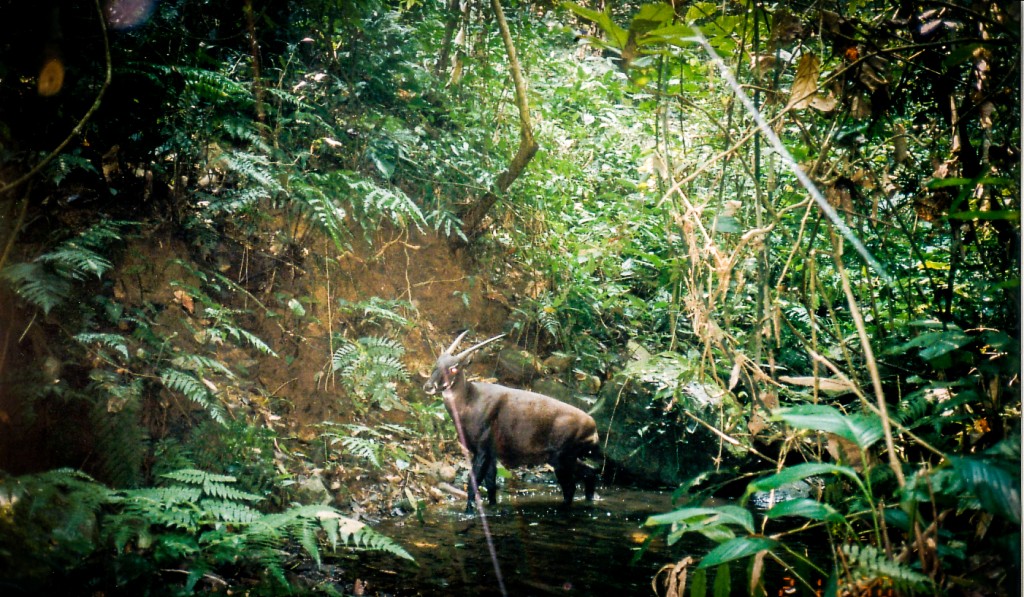
“There’s a good chance this animal is already extinct,” Vang said. Today, saolas are categorized as critically endangered, hovering on the edge of extinction. “I think that few would disagree that extinction in the next decade will be inevitable (unless intervention is successful),” conservational biologist Robert Timmins warned in 2025.
The uncertain status of saola lingered in her mind. Was this animal still alive? “When you have a question you don’t know the answer to, it drives you to write poems,” she reflected.
Primordial’s poems were written during a challenging time in Vang’s life — she was going through pregnancy and later, the postpartum period. The recurring appearance of pregnant saolas in her research further drew her towards the animal.
Vang opened the final twenty minutes of the poetry reading for questions — and the audience had plenty.
For students who had the opportunity to read her Primordial in class, the variation in style was intriguing.
Vang defined a poem as “a series of combined stanzas that are groups of lines and within those lines are groups of words.” The loose definition allows her to experiment with different structures.
The three-page poem “Camera Trap Triptych,” for instance, is presented as three framed panels of boxed text, resembling photographs. “I loved hearing her read from ‘Camera Trap Triptych,’” Ariadne said. “It brought to life the intent behind her choice of form.”

Primordial also includes multiple node poems, a web-like structure of poetry in which lines branch outward from central nodes. “What would happen if I wrote a poem that didn’t conform to the idea of a line? Would it still be a poem?” she asked herself. Sophie Brunner (‘26) said, “I thought that they were such a unique way of doing poetry.”
And perhaps most bizarre of all is “I Understand This Light to Be My Home,” which features intense word clouds of the word “light” and “language.” The birth of the poem was the result of Vang playing around with Adobe Illustrator, copy-and-pasting the words hundreds of times. Vang said she “trusted what her creative impulse wanted to do.”
Mr. Davis decided to teach this poem to his English III class. “I split the class down the middle, and half the class [said] language. The other half did light,” he explained. “And then we got to the word clouds, students would have to basically figure out how much to say ‘language’ or ‘light’ — how much to repeat themselves over and over again.”

Revision is central to Vang’s writing process. She begins by writing her thoughts in prose form. Later, she’ll fine tune the language and find which areas to include line breaks. Vang loves to read her poetry out loud. “People around me get really irritated,” she smiled.
Before she arrives at the final version, Vang will experiment. She’ll write the poem in opposite meaning “just to see what would happen if [she] flipped the poem inside out.” Or, she might put the poem in a different shape or form, perhaps turning couplets into a visual poem.
When asked what the world should take away from her writing, Vang responded, “I have an idea for how people will receive it, and that ends up being false.” Ultimately, her readers help her make sense of her own work. Poetry is her outlet to connect disparate objects — like the saola and her Hmong heritage — but it’s the readers of the poem who explore that connection.
Dr. Boyle was already doing just that. “Hearing her read it aloud — it was so fluent…I think I understand poetry differently when I hear the poet read it,” she said. “There was the way that I read it, and spoke it, and then just the way she speaks to it.”
By the end of the reading, the room remained full. “I’m always so heartened by that, because I think with any poetry reading, you put it in the back of your head, ‘what if no one shows up?’” Mr. Davis said. “It means a lot.”

A line formed around a stack of Primordial waiting to be signed by Vang. Noan Cheng (‘26), one of the last students in the line, talked about his own poetry goals with Vang. “To be honest, I haven’t been to any other poetry readings,” he said afterwards. “Going to this one has made me regret that very much.”
“How amazing that we have fifty plus students in a room, listening to poetry, and just taking that moment together, where we’re off our devices, and off anything else,” Mr. Davis said. “And we’re just engaging with the human voice, which is something that we’ve been doing since Homer and before him, probably. It’s a beautiful thing.”