
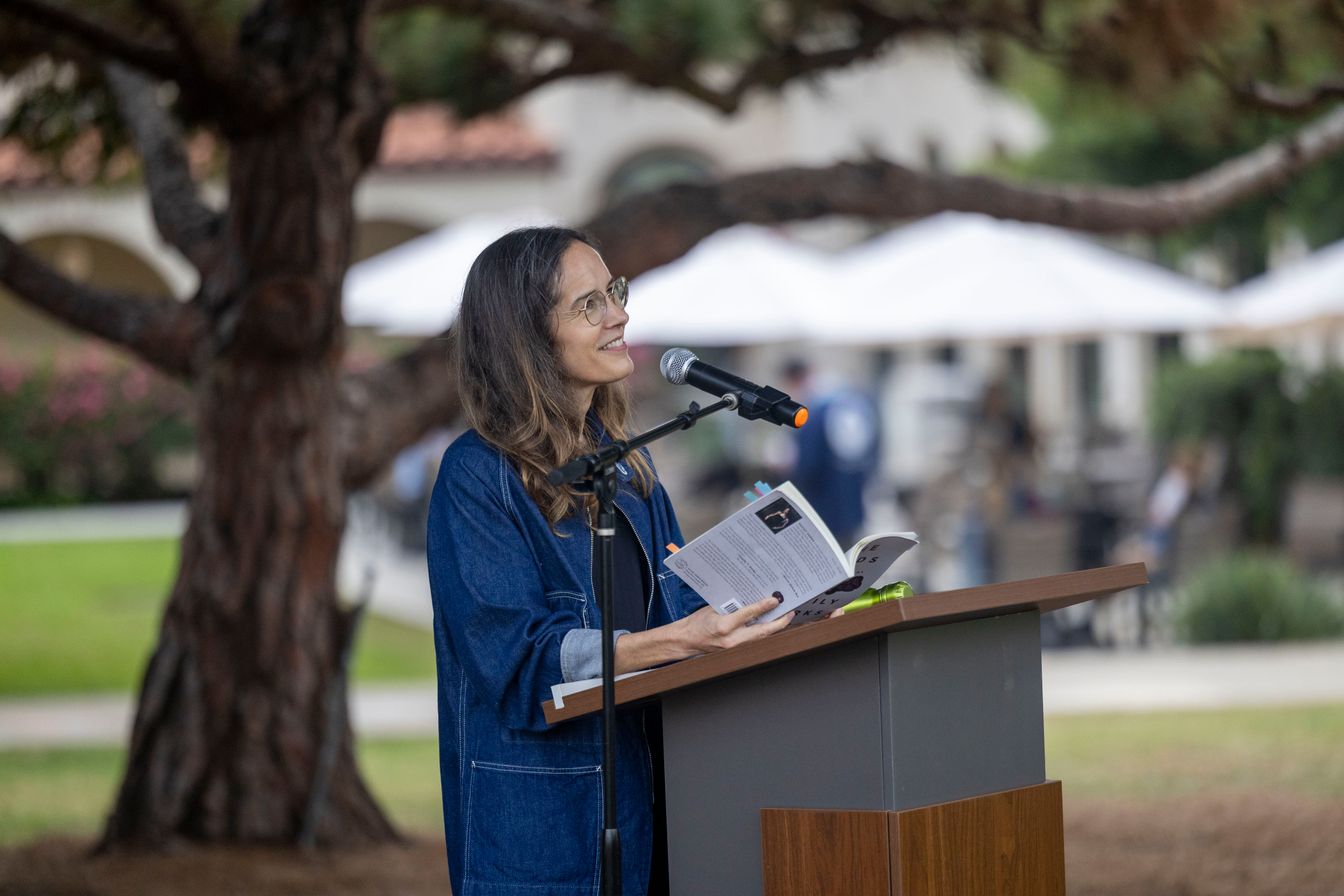
“As we gather here…under the auspices of this sun that has never once charged us for its light unless you talk to my dermatologist,” English Teacher Mr. Adam Davis said, prompting light chuckles from the crowd. “Please join me in welcoming Cecily Parks to Bishop’s.”
On November 12th, the 16th annual Robert Mulgrew Poetry series welcomed Cecily Parks to Bishop’s. The series is named after former English Chair Mr. Mulgrew, who, as Mr. Davis described, “was a great champion of literature and especially poetry. With his blessing, we started this series roughly 16 years ago, and then after his passing, we renamed the series in his honor.” Parks is the author of Field Folly Snow, O’Nights, and most recently, The Seeds. Parks’ visit to the Bishop’s School is a part of her book tour for The Seeds, this being the sixth stop.
Once Mr. Davis concluded his introduction, Parks began to read. From the first poem, nature’s influence in her art is evident. In “Hundred-Year-Old-Window,” she looks out at hackberry branches, a plant that reappears in her final poem, aptly titled “Hackberry.” Her next reading, “The Bats,” featured the endangered species Indiana bats. “You will hear a bit of Macbeth and Emily Dickinson in [this] poem,” Parks said. This proved to be an outlier to much of the rest of her poetry, which takes on a more contemporary style.
Parks then took time to answer student questions in a Q&A session after her reading. As a high schooler, Parks wanted to be a vet, but the science and math classes proved to be difficult in college. Instead, she began to attend fiction workshops, and by her senior year, Parks had become an English major.
As for her introduction to poetry, Parks first decided to attend a contemporary poetry workshop because a boy she liked had also gone. Before that workshop, Parks had mistakenly thought that poetry could only look like that of Shakespeare, or other older works most English classes read. At this workshop, Parks realized that contemporary poetry looked much similar to the writing that she was doing, giving her the confidence to pursue her passion.
Sebastian Nudleman (‘27) shared a similar reaction to Parks’ poetry. “I had never been to a poetry reading before, and I didn’t really know what to expect,” Sebastian said. “I thought previously that a lot of poetry is cryptic and old, [but Parks’] poems were contemporary and mentioned relatable topics that didn’t seem how poetry sometimes seems.”
Parks smiled and noted, “Poetry was the lasting relationship…that boy is not in my life anymore.”

Another prevalent theme in her writing is motherhood. Parks moved to Austin, Texas, 11 years ago with her twin daughters, June and Calla, who were 19 months old. Poems like “December” and “Hackberry” reference her daughters’ first secrets and even quote their voices. Ethan Yang (‘27) said, “I really liked her comments [about] how she regained that connection [with nature] through a combination of poetry and interacting with her kids, who she thought were more in tune with the natural world.”
But the creative process behind Parks’ poems required time. “It looks like I puked on the page,” she said of her first drafts. To begin, she starts with an image and then brainstorms questions that ask herself why she is interested in that image. She likes to think of poetry as academic writing that just looks different on the page.
When asked about writer’s block, Parks shared her method: she takes someone else’s poem that she loves and makes it her own, “like Madlib’s,” she said.
For some listeners, Parks’ reading invoked a few memories. English Teacher Ms. Cresence Birder said, “I remember feeling particularly moved by the poem about bats…I had a funny experience as a kid with a bat in the house.” For English Teacher Mr. Chris Harrington, Parks’ poetry “made me want to grab a notebook and start writing!” he said.
Mr. Davis praised, “We’re dazzled by her wordplay, her backyard rhymes about windchimes and hackberry trees, scenes of domestic bliss blurred by past lives and many what-ifs.” After the reading, some students lined up to get their copy of The Seeds signed, while others crowded around the trays of cookies.
Later, Parks wrote in an Instagram post, “What a dream to read poems about trees under this spectacular tree…[at the Bishop’s School]! Thank you…for hosting me with such warmth and generosity.”