
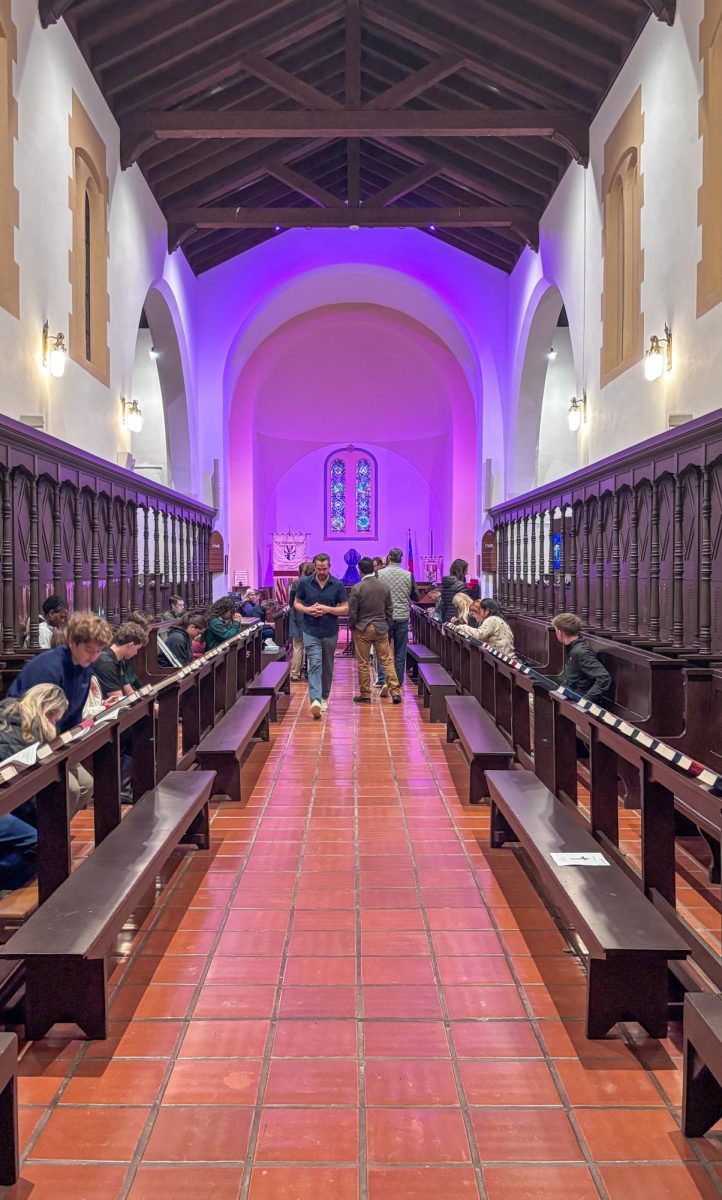
On a cold, rainy February morning, students and faculty filed quietly into St. Mary’s Chapel well before the school day had even begun. Calm organ music reverberated through the pews, creating a relaxing mood distinct from a typical, hectic school morning. At 7:30 a.m., the Ash Wednesday chapel service began, marking the start of Lent for the Bishop’s community.
Ash Wednesday, observed this year on Wednesday, February 18, marks the beginning of Lent, the 40-day Christian holy season of prayer, fasting, and reflection, culminating in Easter Sunday celebrations on April 5. For Christians across the world, it is one of the most spiritually significant days of the year, and at Bishop’s it has become a tradition to observe it together as a community.
Lent traces its roots back to the early Church, when new Christians would spend that same period of time preparing for baptism on Easter. “Converts would go through a preparatory period of instruction and intensified spiritual life,” explained Religion and Ethics Teacher and the Director of the Global Education Initiative, Dr. David Moseley. Catholics have observed Ash Wednesday since the time of St. Gregory the Great. In 1091 A.D., Pope Urban II formally encouraged the entire Church to adopt the practice, according to Dynamic Catholic.
The service opened with Head of School Mr. Ron Kim leading the Collect of the Day, in a short prayer meant to encapsulate the themes of the subsequent service. Following this, English Teacher Dr. Kara Crawford read an excerpt from the Prophet Isaiah, calling upon the congregation to loose the bonds of injustice, share bread with the hungry, and let light “break forth like the dawn.” It served as a powerful reminder that Lent is oriented both outward and inward.
Father Michael Hargreaves, Rector of St. James-by-the-Sea Episcopal Church and a Trustee of The Bishop’s School, spoke on the contrast between giving something up and taking on additional things during Lent, framing the season not just as a period of sacrifice, but as an opportunity to build what he described as a “godly habit.”
The Reverend Nicole Simopoulos-Pigato then issued the Invitation to the Observance of a Holy Lent, calling on the Bishop’s community to observe 40 days of looking both inward and outward, with self-examination and repentance on one hand, and acts of compassion and mercy on the other.
Then came the moment the service had been building toward. One by one, members of the congregation rose from their pews and walked forward to receive the imposition of ashes. As each person bowed their head, Rev. Simopoulos traced a cross on their forehead and recited the phrase from Ecclesiastes 3:20: “Remember that you are dust, and to dust you shall return.”
Finally, as the Litany of Penitence was recited, the call-and-response of collective confession echoed through the chapel. As phrases like “We confess to you, Lord” and “Accept our repentance, Lord” were repeated in unison, the chapel’s shared voice gave the space a particular gravity.
The ashes specifically carry a profound meaning, according to The Rev. Simopoulos. They are made from the palm fronds that were used during the previous year’s Palm Sunday service, dried over the course of the year, and then burned. The reminder that we are dust is rooted in the Genesis creation story, in which God forms humankind from the dust of the earth.
“I am reminded that I am a miracle of God, that we are all miracles of God, risen out of the dust of the earth,” she remarked. Far from being a grim reminder, she sees it as something closer to wonder, in which she observes that “life is short, and that we only have so much time here on this earth to become who God has created us to be.”
For students observing Lent, the season presents itself in many personal ways. Chapel Council member Ryan O’Donovan (‘27) is planning to give up social media — with the exception of Snapchat for team group chats — as a way to free up time for prayer and deeper relationships. “I focus on intentionally giving something up so that when I think about it, I remember I did it for God and for His glory,” he said.
The Ash Wednesday service itself carries a grounding quality for Ryan as well, as he reflected on how it serves as “a reminder of our sins, of the Christianity present in our community, and the tradition our school was founded on.” Furthermore, he acknowledged the school’s Episcopal tradition of placing importance on walking humbly.

The specific number of 40 days and 40 nights of Lent is no accident either. According to The Fathers of Mercy, throughout the Hebrew scriptures and the New Testament, 40 represents a period designated for prayer, reflection, and discernment. Noah’s great flood lasted 40 days and nights. The Israelites wandered for 40 years in the desert wilderness of Mount Sinai. Jesus fasted for 40 days in the desert before beginning his public ministry.
This year, Lent begins in rare alignment with Ramadan, which starts on February 17 and ends on March 21. As Dr. Moseley notes, “Muslims will be entering the holiest period of their year, fasting from sunrise to sunset and focusing on spiritual well-being and development.” Ramadan also places special emphasis on self-reflection and strengthening connection with God, which are themes that are common throughout the Lenten season as well.
Chapel Council member Audrey Donnelly (‘26) framed Lent as a reset of not just habits, but also of perspective. This season, beyond giving up desserts and soda, she is giving up worrying about things that are outside of her control, as well as spending more time journaling and meditating.
“Whether the sacrifice is big or small, choosing to give something up for a greater purpose is refreshing,” she noted. She also clarified the notion that Lent is purely about subtraction. Echoing Father Michael Hargreaves’ sermon during Wednesday’s service, Audrey stated that Lent is “not just about giving something up; for some people, it’s about adding something into your life.”
That openness is part of what made the Ash Wednesday chapel meaningful beyond the Christian aspect of it. All were welcome to receive the imposition of ashes, regardless of faith. Those who preferred not to receive ashes could simply cross their arms over their chest for a heartfelt blessing instead. As Audrey put it, “whether someone participates for religious reasons or not, I think everyone can benefit from Ash Wednesday.”
In her Invitation to the Observance of a Holy Lent, Rev. Simopoulos described Lent as “40 days of looking inward and outward.” For the Bishop’s community, the rainy morning in St. Mary’s Chapel was a quiet beginning to just that period.