

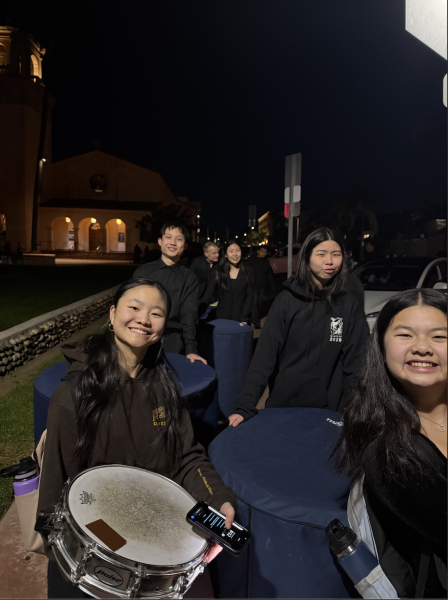
This year, the Bishop’s winter performance began with the clattering of cymbals and tambourines as students marched the percussion cabinet, timpani, a snare drum, and music stands from Bishop’s to St. James two days before the concert. On the day of the concert, students hurried to their new seats and played familiar tunes underneath the figure of Jesus Christ.
The winter concert included chamber music, where small groups of passionate musicians could display their flair. Then, the Middle school orchestra performed a set of three songs, with parts arranged by Mr. Anderson tailored for some instruments like the saxophones. The feature of the winter concert was Beethoven’s Symphony No. 1. Some musicians were already familiar with the tune. “Beethoven’s Symphony is one of my favorite pieces of all time, and I’ve already played it a few times in the past,” said violinist Rachel Xu (‘29). The piece blended elements of various composers and Beethoven’s unique innovations, mixing boldness and tradition. With a joyful yet grand finale, the piece is certainly worthy of taking the spotlight.
The biggest difference between this year’s orchestra performance and those of any previous years is the location. Although it was the Bishop’s orchestra’s first time performing at St. James, the church accommodated the group with hospitality, offering them use of the sanctuary, the garden, and other facilities to prepare. “St. James was gracious enough to offer us a place, and it really made an impact,” said violinist Noan Cheng (‘26). “It was a really good time performing at St. James,” expressed clarinetist Sydney Mafong (‘26).
This year’s preparation for the winter concert looked much different than previous years, involving many additional steps for student performers, parent volunteers, and Mr. Robert Anderson, Director of Instrumental Music, who conducts both the Middle School and Chamber orchestras. The church lacked much of the necessary equipment for the concert, including percussion instruments and music stands for the performers. “We also did not have access to our usual lighting or audio support. These are challenges we rarely face on campus, but they require significant extra planning,” said Mr. Anderson.
Students were tasked with bringing these items into the church. With the help of Mr. Anderson’s middle school students along with reminders from Parent Sponsor Ms. Lu Yuan, parent of concertmaster Kayley Xu (‘27), they were able to set everything in place before the dress rehearsals that took place in the church. “The students handled everything with maturity and flexibility, and many parents generously helped with setup and breakdown. Their support was essential in making the concert possible,” commented Mr. Anderson.
(Daniel Guo)
Aside from the movement of equipment, the rehearsal schedule for the concert slightly differed from past years’ too. As the orchestra was using a non-Bishop’s facility, it meant that they had to adjust accordingly to the schedule of the church.
“More broadly, our biggest challenge is limited rehearsal time,” said Mr. Anderson. As an after-school activity — not a class — the after-school rehearsals have a big impact, as it is the only time all students meet together, he added. Unlike other performing arts courses at Bishop’s, like jazz bands and acting workshops that meet regularly for 70-minute classes, the orchestra has a two-hour rehearsal most Thursday evenings.
Musicians put in a lot of extra effort in making the concert sound as great as possible, like squeezing in extra rehearsals. The percussion section rehearsed five times out of class for Russian Sailor’s Dance, as the piece had complex parts for percussion instruments. Many students, including Genevieve Wierzynski (‘28) and Ellie Mafong (‘29), were tasked with playing multiple instruments due to the shortage of percussionists. “We are all frustrated because the song was not giving us an easy time, but I think overcoming these challenges as a group is what makes the journey a happy one,” said Genevieve. Mr. Anderson also accompanied these students with their independent rehearsals.
Faced with various challenges, the orchestra’s performance was astoundingly successful. Prior to the show, many students were anxious that the turnout rates for the show would be low, “given the performance is not taking place at Bishop’s,” said Noan. However, those doubts were quickly dispelled after a very excited audience almost entirely filled the church. “It’s nice to have a community to show up for our events,” said Sydney. “I am very proud of what they accomplish under those constraints, even while performing challenging repertoire,” said Mr. Anderson, a phrase that he echoed throughout the entire preparation process.
The concert kicked off with a few chamber group performances — a smaller version of an orchestra that consists of about three to ten musicians. From a virtuosic violin sonata performed by Tracie Liu (‘28) to “Julie-O,” a contemporary piece performed by cellist Yina Shate (‘26), the chamber groups added flair and individuality to the concert.
A fan favorite was Chopin’s Barcarolle performed by Caleb Tang (‘26). Many of his “fans” came and watched his performance, including his friend Tyler Chang (‘26), who said, “My goat Caleb Tang really rocked that show with that nine-minute concerto and shook the entire show with his aura.” His math teacher, Mrs. Dolores Williamson, exclaimed, “The highlight of the show had to be watching my advisee Caleb perform.”
After the chamber groups, the middle school orchestra performed three pieces: Nebold’s Angel City, Jacklin’s Dance of the Imps, and LaBrie’s Midnight Howl. All three of these pieces are relatively more contemporary, offering a fresh take on orchestral music. “I loved all the songs we played, and I loved how there were also some modern pieces as well,” said cellist Ethan Chen (‘30).
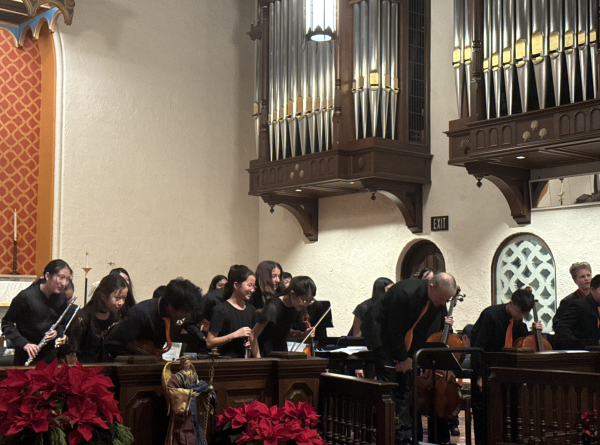
To close out the show, the Bishop’s Chamber Orchestra performed two pieces: the Russian Sailor’s Dance and the entirety of Beethoven’s Symphony No.1. To a non-classical musician, two pieces might seem like a relatively easy task to tackle; however, these repertoires are notoriously difficult due to their necessity of technicality, speed, and technique.
The first piece, Russian Sailor’s Dance, can be best summarized as a cacophony of melodic frenzy along with various tempo changes, building from a steady sound to a fast and energetic ending. The audience was first jerked awake with crashing cymbals, and it set the scene for the final piece.
Many of the musicians, including flutist Neela Laurent (‘28), cellist Julia Schnabl (‘28), and violinist Fiona Zhang (‘28) expressed that Russia Sailor’s dance was their favorite piece to perform, “Sometimes the music was so boring that even I want to fall asleep,” commented Neela, “But I love Russian Sailor’s Dance because it’s really fun and energetic.”
The finale of the show was Beethoven’s Symphony No 1. Composed in 1800, this piece has more than 200 years of history. “Beethoven’s First Symphony was the centerpiece of the program. We performed all four movements, which was ambitious, but the students rose to the challenge impressively. It also made for a powerful and familiar finale,” said Mr. Anderson.
After the concert, some musicians reflected on the overall result of the performance, “I loved playing at the church. But the only thing I didn’t like was that it was a little too echoey, which made it hard to hear and follow the music,” said cellist Madison Chen (‘27). Similarly, Mr. Anderson pointed out that “the sanctuary has much more natural reverberation than our rehearsal spaces, so students had to adjust quickly to the sound. The stage layout was also tighter than what we are used to on campus.”
Fortunately, students quickly adapted to the environmental challenges. “It was amazing to play a whole symphony on my first performance with the Bishop’s Chamber Orchestra, and overall I loved how the sound traveled in the church,” said viola player Paul Schnabl (‘30).
While the Bishop’s Orchestras were met with several roadblocks, the winter concert concluded with a strong chord. The results were proof of the hard work that Bishop’s student musicians dedicate to their craft.