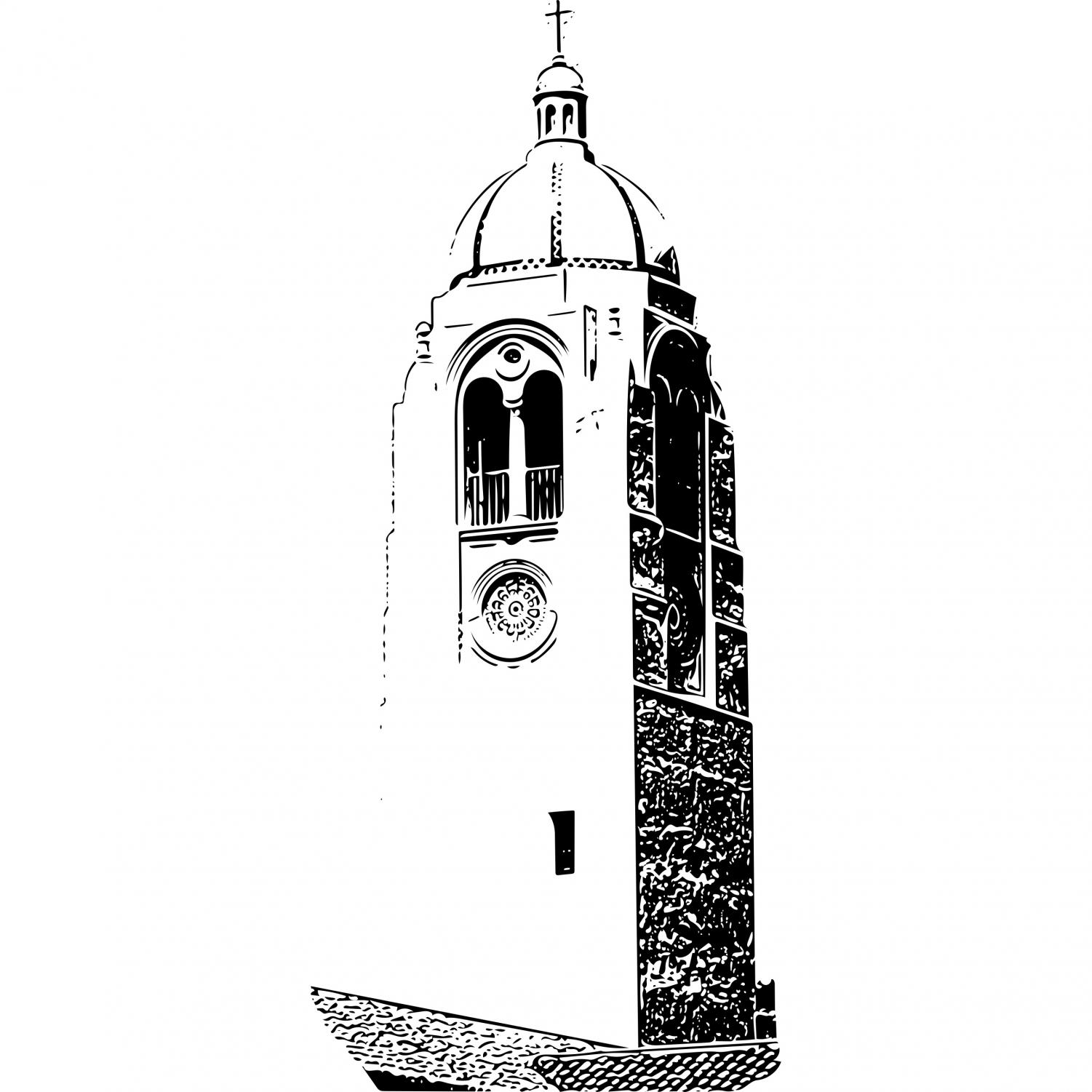

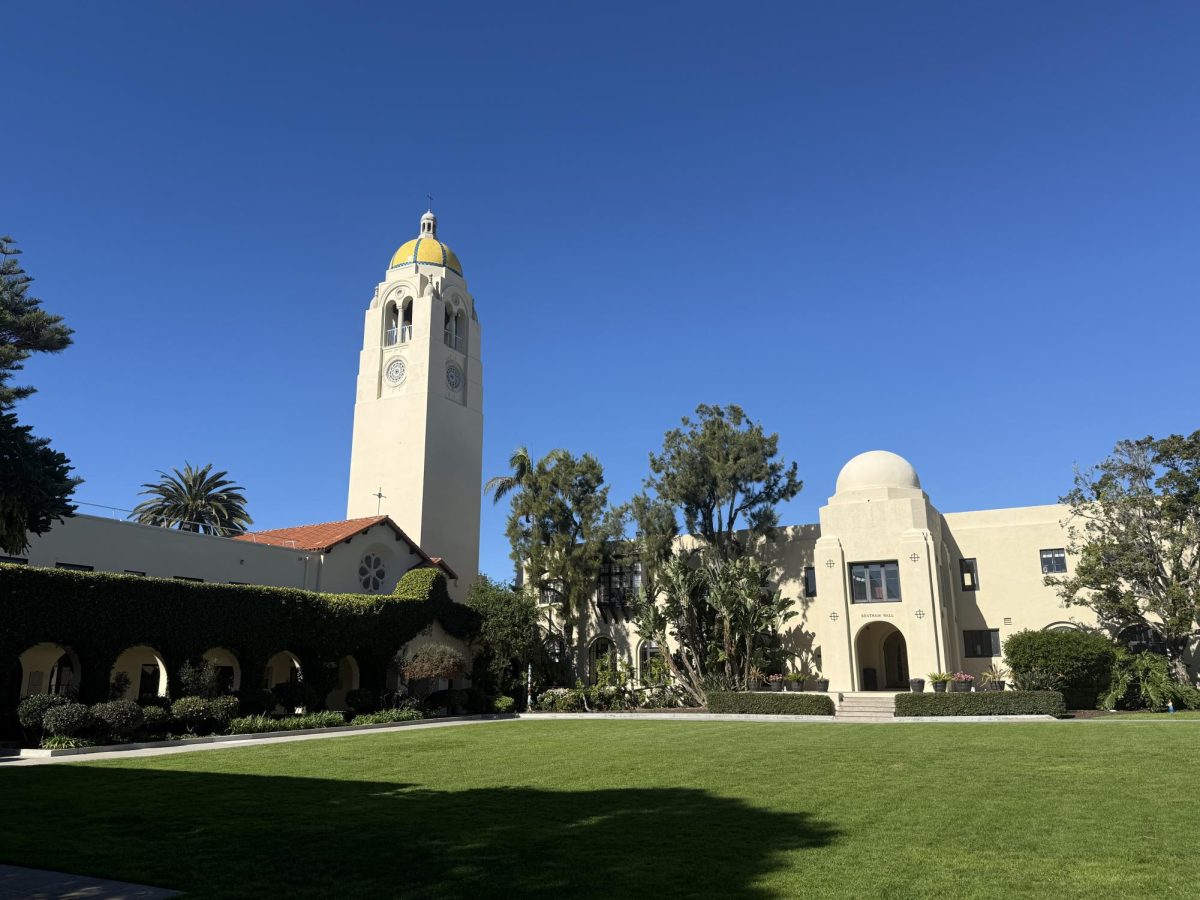
For almost a century, the Bishop Johnson Tower, named after founder Bishop Joseph Horsfall Johnson, has stood over the Bishop’s campus. Designed by architect Carleton Monroe Winslow and added to Saint Mary’s Chapel in 1930, the tower has left generations of students and faculty in awe of its majesty.
Yet throughout the tower’s history, a single question has loomed over the tower: can you climb to the top?
American History 8 teacher Mr. Kamal Assaf (‘88), who has been at Bishop’s for over thirty years, explained, “There was always mythology about it… We wondered about it, but nobody ever dared.” He added, “It was forbidden.”
When Director of Facilities Mr. Brian Williams (‘81) attended Bishop’s from 1975-1981, he said that being caught at the top of the tower meant expulsion.
Mr. Williams explained, “It’s not safe to go up there. We only allow people who are properly outfitted in safety gear, because it’s very steep and kind of tricky.” He described how the interior of the tower isn’t stairs but rather a ladder, making the ascent much harder than it may seem. Despite the ladder having platforms every 12 feet or so, “it’s quite a workout,” he said.
As the Director of Facilities, Mr. Williams has climbed to the top of the tower before.

A lesser known fact about the Bishop’s campus is that before the Bishop Johnson Tower was built, there was a tower on top of Bentham Hall. The original tower was designed by architect Irving Gill, who also designed Scripps, Gilman, and Bentham — Bishop’s first three buildings.
According to Mr. Williams, Gill’s tower was removed by Winslow because “it was kind of an ego thing.” At the time Winslow was working as an architect on campus, and decided he wanted his own tower. And that resulted in the construction of the Bishop Johnson Tower, standing twice as tall as the old tower and quite different in style.
The entrance to Gill’s tower lies in the Registrar Ms. Rachael Garcia’s office, though now it’s just an attic leading up into the dome.

When asked about if there were any plans to open the tower up with safety equipment, Mr. Williams delivered a firm “no.”
Although people aren’t allowed to climb to the top of the tower, Mr. Assaf commented on the Bishop Johnson Tower’s legacy and impact at Bishop’s: “it’s something I see every single day when I walk on campus. There’s not a day that I come and don’t look across the quad and look at that picture.” He added, “I think all students do that. And I think all faculty members do that, because it really reminds you, you’re in a special community.”
Noah Smith (‘28) and Sami Bitar (‘28), who have been at Bishop’s since sixth grade, shared similar sentiments about the tower. Noah sees it as a key feature of both the school and La Jolla: “When I drive in from La Jolla, I’m able to see the tower over by Pearl Street. So I feel like it’s just a testament to how central Bishop’s is to La Jolla and the culture.”
Sami is inspired by the tower everyday he walks on campus: “It symbolizes greatness and what I strive to be like — the tower is the limit.”
Mr. Assaf concluded: “[The tower is] a part of every Bishop’s student’s childhood, and in some ways, part of their history. It’s something that I think every student feels, even if they don’t climb up there.”