

In the corner, a teacher sits, quiet yet attentive, as students discuss problem solutions with each other, sketching diagrams and equations with Expo markers, compiling all their notes, questions, and piles of eraser dust into huge, graph-papered notebooks. Instead of guiding students through solutions himself, in Mr. Feger’s Math 3E class, students present to each other their work on whiteboards that wallpaper the classroom. While this contrasts with a traditional math class, where the teacher lectures, it’s easy for students like JT Cochrane (‘28), along with many others, to imagine this unique environment. It is a staple of Bishop’s mathematics curriculum: the enriched math experience.
While on-level courses are structured concept by concept, the enriched track is purely composed of mixed problem sets taken from Phillips Exeter Academy, a private school in New Hampshire. Notably, in 1930, Phillips Exeter was the first school to introduce philanthropist Edward Harkness’ novel teaching environment, known as the Harkness method, according to an article published in the Close Up Foundation.
According to the 2025-2026 Bishop’s Curriculum Guide, enriched courses like Math 3E are “problem-centered and more demanding.” The philosophy of enriched math is to challenge students to collaborate and engage with the math problems they face beyond their surface. While some students thrive in this independent environment, others prefer a more traditional style, finding the enriched style confusing due to the less active teacher role. Students weigh the pros and cons of enriched courses in extremely different ways, yet their viewpoints all boil down to a single question – how much independence is right for me?
Department Chair of Mathematics Mrs. Catherine Beamer (‘95) explained, “[The enriched track] exists as an opportunity for students to be more independent problem solvers.” Mrs. Beamer highlighted the similarities between an enriched math class and a Harkness method-based English or history class. In both classes, students routinely engage in discussions, and the teacher facilitates the discussion, rather than leading it.
Since the enriched track is built upon Exeter problems, it also frequently reviews topics established in previous courses, which aids students’ retention of concepts. She added, “One beauty of the Exeter curriculum is that it spirals.”
“[An on-level math class] goes through specific units, compared to an enriched class that’s just going from problem to problem,” explained Mr. Jack Feger, who teaches Math 3E and Math 5. On-level classes organize course content by grouping together related concepts and lessons, similar to how a history class might organize course content by time period. In enriched courses, concepts gradually appear throughout the problem sets without warning. For reference, the 2019 edition of Mathematics 1, the textbook used in Math 3E, consists solely of a six-page introduction, and a subsequent list of 869 problems.
JT, who completed Math 3E and 4E before dropping out of 5E and switching into 5, said, “In your history class, they tell you, ‘Okay, here’s what we’re learning about.’ In my [enriched] math class, I never had any experience like that. It was more like, ‘Here’s a set of problems. Now try and go figure them out.’”
JT did not believe the problem was with the teachers — in fact, he emphasized that they were extremely helpful. Instead, he found difficulty navigating the structure of the course. “The material isn’t beyond the students, but the way students are expected to learn the material makes it incredibly challenging, especially for students that don’t necessarily have the time to spend,” he clarified.
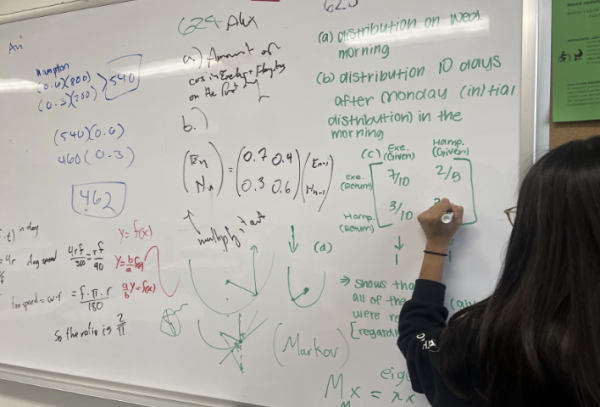
Mr. Feger, who was JT’s teacher for 3E, stated, “In the way I run the class, at least, 3E is much more student-driven, where the students are presenting their problems on the whiteboard, and they’re going up and explaining them. It’s the students’ responsibility to be asking questions and learning from others.” Having joined the math faculty in 2022, he also commented, “It’s definitely a different style that students have to get used to — and that teachers have to get used to as well.”
Kaia Wood (‘29) agreed with JT that the independent nature of the enriched courses is quite daunting. Kaia began sixth grade in Math 1, before moving up by recommendation to Math 2E.
Having experienced both the enriched and on-level tracks, Kaia said, “For some people, being in the E-track is super helpful. You just learn it on your own. You keep moving.” The following year, she struggled to manage the homework load of Math 3E. She later ended up dropping the course, unable to fully catch up with the jumps in material between the on-level and enriched curriculum.
While taking courses outside of school can help, not all students make this choice, since independent study can be a hefty time commitment. JT noted “you can do really well in that class if you go and spend extra time working on it,” but for him, it “was really not possible.” This year, after trying 5E, he made the decision to drop and take Math 5 instead.
Ms. Janice Murabayashi, Assistant Head of School for Adolescent Learning & Development, put forth a sports comparison. “It’s just like [the differences between] JV or varsity football. The varsity kids are more ready for bigger responsibilities, faster games, whatever,” she provided, “Some people will go on to play in college, but it’s totally fine if you never become a professional athlete, right?”
Everyone learns at different speeds, and has different math backgrounds, and has different amounts of time to spend. Some students can do well by spending extra time, while others are busy with other activities, like athletics, theater, or other extracurriculars. Part of the reason for everyone’s differing opinions is simply that they all are at different levels of readiness to take the course in the first place.
When Kaia dropped down to the on-level track, she thought it would be much more fitting for her. To her surprise, she found that much of the curriculum was extremely slow, and did not go as in-depth into the topics they were learning. “I needed some sort of in-between,” she stated, “I could have covered double the concepts by learning it in class.”
Ms. Jennifer Seymour, a current Math 5 teacher and 5E teacher for the past eight years, said that part of the difference between an enriched course and an on-level course was that the former is typically “less broad and more in depth.” An enriched course has the luxury of being able to go into the nuances and applications of a certain topic. Meanwhile, an on-level course cannot dive as deep since it has to cover all the predetermined topics and units.
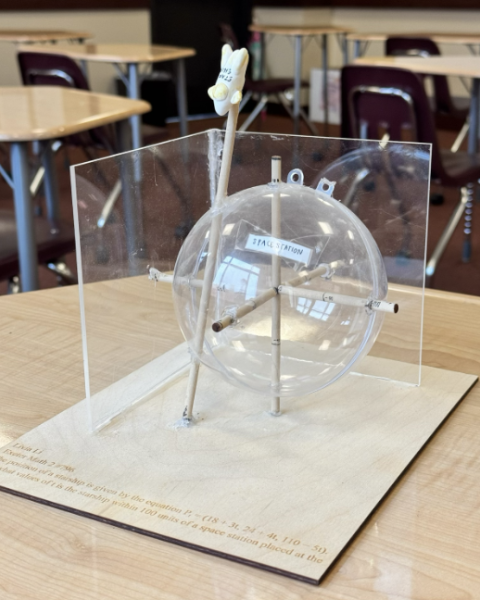
She actively attempts to balance these tradeoffs, like through projects in the Center for Creative Sciences, letting students take a break from textbooks and apply their knowledge in a fresh way. One example is her Exeter Manipulatives Project, which she would assign to her Math 5E students in previous years. Students first chose an Exeter problem from the textbook that they found difficult to visualize, and then made a tangible model of it in the Creative Sciences Center to help future students better grasp the problem.
Even Jaden Shen (‘29), who had enrolled in math courses outside of school and placed up on the math track, skipping Math 3E, still found the structure of the curriculum a little confusing. Nonetheless, he believed that the student discourse is extremely helpful in the long run. “It really helps your speaking skills,” he stressed.
Measuring an enriched-style curriculum’s effectiveness for a student’s learning is not easy. First, not all students are at the same developmental level in terms of mathematical reasoning. In this way, enriched math can be compared to an Honors track, for students enter both systems via teacher recommendation, if the teacher thinks the student is ready for the challenge.
Yet enriched courses’ lack of topic-based structure shows how the differences between on-level and enriched and between non-Honors and Honors are not the same. Students who are not familiar with such an independent approach to math may struggle to keep up, like in Kaia and JT’s case.
In a perfect world, every person could have their own uniquely tailored learning environment. While this is unfeasible, perhaps the on-level versus the enriched curricula do their best, balancing each other out, covering a wide range of student learning styles. At its core, students’ viewpoints on enriched math are directly tied to their viewpoints on independent learning — a perspective that is different for everyone on campus.
Kaia was asked to describe the math track that would suit her best. “I’d have a totally different system if it was up to me,” she grudgingly responded, “but everybody learns differently.”