

Transparent. Necessary. Unfair. Stress-inducing.
Depending on who you ask, these all describe Bishop’s culture around gradebooks.
Two students in different sections of the same class can have completely different experiences accessing their grades. One may be able to check their progress instantaneously, whereas the other waits days for updates, sometimes even having to go in person to check.
At Bishop’s, where academics and extracurriculars push students to their limits, grades often represent more than just numbers; they can shape students’ anxiety, confidence, and motivation to work hard.
An aggregate study by the Kappa Delta Pi Record found that when grades take on a primary focus, students become “less interested in learning, less likely to think creatively, and less likely to choose difficult assignments than those who are encouraged to focus on the task itself.” This grade obsession can also encourage an unhealthy mindset that “knowledge is considered dispensable after it is used to secure a good grade.”
That’s why the question of whether teachers should maintain open or closed gradebooks is more than a simple technicality; it’s a debate that encompasses a wide variety of factors, including stress, transparency, and fairness.
While some teachers swear by the benefits of letting students view exactly where they stand at any given moment, others argue that this constant visibility only fuels anxiety and shifts the focus from learning.
Math Teacher Mr. Jack Feger sees transparency as a fundamental way to keep his students informed. He wants his students “to know where they stand in my class and how far off they are from whatever grade they want,” he stated. “I don’t feel compelled to put a barrier between them knowing what their grade is.”
Math Teacher Dr. Santiago Camacho, who also keeps his gradebooks open, acknowledged that if he were to have closed gradebooks, they would be “mostly convenience for me, so not really student centered.” As he put it, regarding his fellow teachers, “it is important that if they are trusted with teaching a class that they be trusted with the reasoning for opening, or not, gradebooks.”
Although Mr. Feger observes that students’ approach to class is mostly the same, he did acknowledge that with open gradebooks, “there’s probably a little bit more of that arguing over grades,” which can “create headaches at times for the teacher, trying to haggle over those minute points.”
Spanish Teacher Mr. Moisés Gómez-Pastor shared a philosophy shaped by his experience at previous schools, where open gradebooks were mandatory. “I like for students to know how they are doing in class,” he explained. “The grade at the end of the semester, I don’t think it should ever feel like a surprise to them.”
He emphasized that real-time updates allow his students to be proactive in seeking help during office hours before small issues become larger problems. However, he acknowledged the need for balance, noting that students sometimes “freak out” over early grades when only one or two assignments are in the gradebook. “At that point in the year, it’s just one grade,” he said.
For many Bishop’s students, having open gradebooks seems to be a no-brainer. However, some experts disagree with this conclusion. In an article by Tonya Mosley for KQED, a Bay Area NPR Affiliate, Steven Adelsheim, a clinical professor of psychiatry at Stanford University, explained that always-visible grades can create circumstances that heighten anxiety, making students overly focused on minor fluctuations rather than year-long growth. His research also suggests many students feel pressure to constantly monitor grades. Some mental health professionals even recommend checking grades only once a week.
Biology Teacher Ms. Kristina Norrgard closed her gradebook starting this school year, after noticing that students became obsessed over tiny changes. “After anything I returned, even a small assignment, many students would be talking about a 0.2 or 0.5% change in their grade. This seemed to be the opposite of helping their well-being, so I am trying a different approach,” she said. Although she still posts grades for major assignments, students’ cumulative scores are not available to view at any time.
For Ms. Norrgard, the goal is to keep students focused on learning the material instead of being preoccupied with decimal changes. However, to ensure her students are not left in the dark, she said that she provides “a grade update at the end of every unit, though students can always ask me where their grade stands at any point.”
Biology Teacher Mr. Benjamin Duehr echoes this same sentiment. He explained that while transparency is valuable, an open gradebook in his class “would further raise stress of students that are already hyper-aware of grades to make them more obsessive of the impact of each and every point.” Instead, he strikes a balance by returning work quickly, updating grades periodically, and leaving room for grade conversations. Moreover, at a rigorous school like Bishop’s, with a generally high-achieving student body, grade stress is prevalent.
Fairness adds another dimension to this debate. A 2024 Fordham Institute survey of nearly 1,000 teachers highlighted just how inconsistent grading policies are across the country, even within specific school districts. Some schools utilize point-based systems, while others opt for standardized rubrics. Some penalize late work, but others don’t. Bishop’s is no different: students in one class may have an open gradebook updated every few days, while the next class requires time outside of class to see grades.
While many STEM teachers at Bishop’s favor open gradebooks for their transparency and real-time feedback, teachers in more subjective disciplines, such as History and English, often take a different approach, weighing how constant grade visibility affects creativity and risk-taking in their courses.
Modern World History (MWH) Teacher Mrs. Anne Fierberg takes a hybrid approach, keeping her gradebooks open most of the time, but closing them during grading periods and before major assessments are returned to students. Her MWH team coordinates their gradebook status to ensure consistency across all sections of the class. “We usually reveal it around 3:30 in the afternoon because we want students to be able to deal with their reaction to their grade on their own time, instead of having to do it in the classroom with other students,” she explained.
For Mrs. Fierberg, the key benefit of open gradebooks is the opportunity for students to self-advocate. Unlike her previous school, where parents had gradebook access and frequently intervened, Bishop’s “students have more meaningful self-advocacy” because they own the conversation about their progress. She emphasized that even on subjective assessments like essays, her team uses rubrics and grade-norming to maintain confidence in their grading, making transparency feasible even in a humanities context.
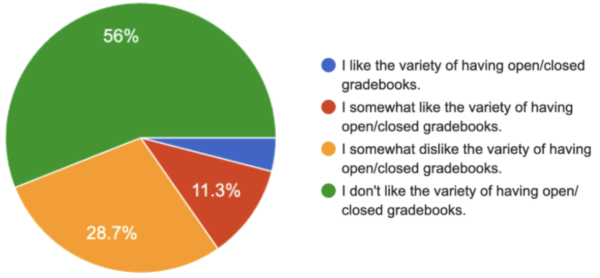
In a recent poll conducted by The Tower with 184 upper school students, when asked about how they felt about the mix of open and closed gradebooks, 56% of students stated that they disliked the variety, while an additional 28.7% of students said that they somewhat disliked the variety. By contrast, only the remaining 14.3% of students answered that they liked or somewhat liked having a combination of open and closed gradebooks.
The poll also suggested that the status of students’ gradebooks impacts the majority of students’ habits with 72% of students reporting that they adjust their studying and preparation for assessments when their gradebook is open.
On the question of stress, the results suggested that open gradebooks seemed to alleviate rather than aggravate grade anxiety. A combined 87.3% of students reported feeling less anxious about their grades when they had access to an open gradebook. Specifically, 61.3% of students felt “much less anxious” with an open gradebook, while an additional 26% felt “somewhat less anxious”. In stark contrast, only a small minority reported that open gradebooks increased their anxiety, with 9.3% feeling “somewhat more anxious” and only 3.3% feeling “much more anxious”.
English Teacher Mr. Mark Radley’s perspective offered a strong case for closed gradebooks, particularly in subjective courses such as his writing-focused classes. He keeps his gradebook closed during the first quarter, instead wanting students to “explore ideas, take creative risks, and focus on improving their craft instead of chasing external validation.”
In his view, grade pressure trains students to ask “‘What does the teacher want?’ rather than ‘What do I think?’ or ‘What do I want to say?’” He explained that giving in-class feedback and extensive comments on written work “helps maintain a focus on growth and improvement.” If open gradebooks became mandatory, Mr. Radley said he would worry about “heightened anxiety and stress,” as well as “reinforced perfectionism.”
At the heart of the issue is a question that matters equally to students and teachers: what is the best solution to find a balance between maintaining transparency and limiting stress? As Mr. Duehr put it, “If students only concern themselves with numbers, without using assignments and assessments as learning opportunities or a way to improve, they are not fully benefiting from these experiences.”
As Bishop’s continues to weigh grading practices, there are strong arguments for both open and closed gradebooks. What’s clear, though, is that grades carry real weight: not just on transcripts, but on student wellbeing, and as long as different classes follow different rules, the conversation about fairness, stress, and transparency is unlikely to stop. For now, Bishop’s students will continue to navigate a complex patchwork of policies, checking some grades daily while waiting days or even weeks for others.
It seems that as long as grades matter at Bishop’s, so too will the question of how best to share them.