

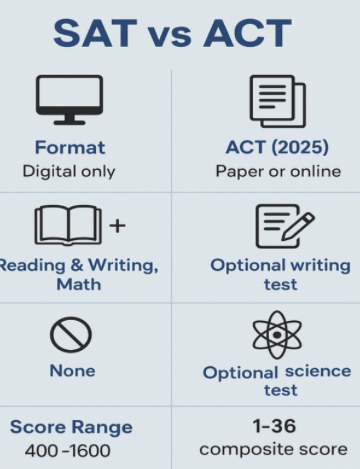
There comes a time when students must make a big decision: Should I take the ACT or SAT? As most juniors and seniors know, and sophomores are now finding out, the ACT and SAT are not only long grueling tests but ones that differ in nature. Before taking both, you should be aware of the main differences and the pros and cons of each within their scoring, content, question formatting, timing, digital vs.paper accessibility, and even cost.
While the ACT and SAT aim to cover the same material, they differ in how the material is presented to you. The SAT tests students’ math, reading, and writing proficiency through 154 questions, and scores ranging between 400 and 1600; this score is an addition of both your reading and math scores, each out of 800. In 215 questions, the ACT covers math, reading, English, and an optional science section. The test is scored out of 36, which is an average of each of the respective sections.
Instead of logging onto the test and finding a clear path to the answer, the SAT,which is an adaptive test, alters the difficulty in its second section according to a student’s performance in the first. This tests your ability to problem solve, focusing on your analytical and interpretation skills according to Harvard Summer School.
For example, the SAT may give problems that ask you to draw conclusions from the given text, forcing you to analyze facets of the paragraph rather than basing your answer off previous knowledge. For those looking to take the SAT, having those skills is crucial to be able to effectively reason your way through problems.
Kalina Parikh (‘28), who took the SAT this year, mentioned, “The questions are harder to understand because they are more interpretive questions.”
For both the ACT and SAT, colleges may allow you to use a superscore — combining your highest scores from each section in order to improve your overall score — however, you are not allowed to mix scores between the SAT and ACT. As stated by the New York Times, in contrast to the SAT, the ACT is created to be straightforward and direct; it merely tests one’s understanding of the content rather than their ability to deduce the deeper nuances behind the question, focused more on the SAT. “In the ACT, the questions are generally easier, or more straightforward, but you do have much less time to answer,” reflected Katie Johnson (‘26).
The reading sections of each test, like many other facets, differ from one another. While the ACT does incorporate dense paragraphs, the SAT has more complex paragraphs, including “emphasizing vocabulary in context, and has more emphasis on rhetoric,” according to the Summit Educational Group.
Kalina stated, “I felt as though the English section of the SAT was a lot harder to understand than the math section, and in the beginning I ran out of time.”
The ACT provides long paragraphs, often asking questions that require you to read the entire passage before finding the line directly answering the question. While the SAT gives smaller chunks of information, their questions typically require you to come to a conclusion about the text, sometimes supported by specific evidence.
Prep Scholar states the SAT questions “require higher-level thinking and strong reasoning skills.” Therefore, although you will find meaty paragraphs within the ACT, they tend to be less focused on inferring what you think they are asking you.
Questions on the ACT may give you a passage on a topic such as the population of a species, asking you specific questions about certain details in the text or structure. However, the SAT may take the same passage and ask you what the author is trying to show, or what view they would most likely support, forcing you to think of the big picture, analyzing your way through.
In terms of math, the SAT focuses more heavily on algebra and data analysis problems, whereas the ACT on geometry and trigonometry. Apart from the different focuses of each math section, there are also timing differences. The SAT gives you 70 minutes to complete 44 questions, however the ACT gives you 50 minutes for 45 questions. Following the ACT’s trend of fast paced questions, the ACT math section requires students to work efficiently, giving them an average of 1 minute per question. Within the ACT, the four possible sections allow math to count for merely one fourth of your total score — the SAT math counts for half of your score.
Some students prefer the four sections as opposed to the two offered by the SAT, like Lotte Lightner (‘26), who stated, “I really like how the ACT is divided into four sections because it gives me the opportunity to demonstrate my strengths across multiple subject areas.”
Others, who may find their strong suit in math, may prefer having just two sections, like on the SAT. This is the case for student JT Cochrane (‘28), who credited his favoring of the SAT to the fact that there “are more math sections on the SAT rather than the ACT.”
A major, if not one of the most important, difference between the two tests is the timing. While both the SAT and ACT are multi-hour exams, the length and pace of each one is different. The SAT is estimated to be around 2 hours and 24 minutes, while the ACT is 3 hours. If you choose to add on the optional science section the test will be a total of 3 hours and 40 minutes. The science section tests your knowledge across 40 questions with 35 minutes to complete it. As noted by the ACT, the science section centers around your ability to comprehend and effectively analyze data, charts, and tables, rather than content knowledge.
Associate Director of College Counseling Mr. David Mills explained, “If you are not good at sitting in one place for a longer period of time, the ACT may not be the ideal situation for you.”
An aspect correlated with your attention span is whether your desired test is a digital or paper test. As College Board mentions, the SAT is a digital only test while the ACT is more commonly given on paper. Accessibility to digital ACT tests is not impossible, but is substantially less common than paper versions. Therefore, students who prefer to take paper tests versus online tests should take this into consideration when deciding which test to take.
Additionally, the ACT and SAT vary in the amount of time given for each problem on average. The ACT, according to Harvard Summer School, gives an average time of 49 seconds per question, whereas the SAT gives an average of 1 minute and 10 seconds. The ACT being a faster paced test per question means one’s ability to comprehend problems quickly is very beneficial when taking the test. Katie stated, “The ACT is definitely a time-based test, so you have to make sure you stay on target and move on if you are spending too much time on a question.”
Another factor that may often be overlooked are the fees. Both the SAT and ACT are priced at $68 for their registration fee. However, with the available add-ons the ACT will cost more. The optional science section is an extra $4, the optional essay section costing an additional $25.
When deciding what your next step should be, Mr. Mills advised, “Once you take both, and know which one you feel better on, you should go all in on the one that suits you best,” rather than trying to study for both simultaneously. He added, “Preparing for a test that you already know is not going to be as beneficial for you is just a waste of your precious time.”
Once you have decided on your respective test, and learned the material, the next step is getting in repetition. Lotte stated, “The time in between tests was certainly valuable for me, and the sole reason I improved on certain sections my second time around was because I had taken a crazy amount of practice tests, and basically knew every type of test question front to back.”
Kalina, who may take the SAT again this summer, had similar sentiments, saying, “I know the material, now it just comes down to repetition.
JT agreed, adding “I don’t think it makes much of a difference when you take the tests, as there is no material that is above and beyond difficult, it’s more about learning how to take the tests. You can learn that skill any year.”
The most important factor in your decision comes down to personal preference. Those stronger in science may want to take the ACT. However, those who favor math may feel more inclined to take the SAT, where math makes up 50% of the test, to allow them to showcase more of their abilities.
Henceforth, as you make your decision, you must take into account your strengths and weaknesses, what works best for you, and your previous scores to decide which test you wish to pursue.