
“Change is possible, and each of us has a role,” introduced Service and Social Innovation Director Ms. Jacqueline Gomez at the Sixth Annual Social Innovation Competition. At 5:30 p.m on March 20th, 11 teams, 37 students, seven judges, and six months of persistent effort took the stage to pitch their unique ideas — from solving neurodiverse accessibility to veteran care – competing for an $8,000 prize pool sponsored by Donor and Off Piste Capital Managing Partner Mr. Michael Balog.
Ms. Gomez designed the program to push students past the boundaries of schoolwork and into the messier conditions of actual problem-solving: research, interviews, revisions, cold outreach, dead-ends, and the discipline to keep going when nobody answers the first email. “There’s always another way. There’s always another solution… That’s the real world,” she said.
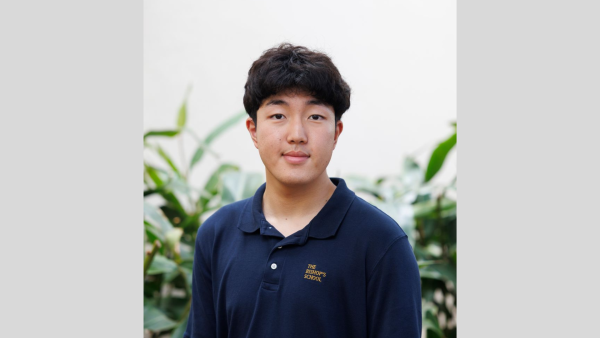
What began with four teams in the first competition has expanded steadily, drawing 17 this year before narrowing to 11 finalists. This year’s panel of judges included Current Ventures founder Mr. Nick Kellermeyer, Quantified AI VP of Customer Success Ms. Megan Costello, Wasabi COO and Uber Freight founder Mr. Lior Ron, Bishop’s History and Social Sciences Teacher Ms. Emily Smith, student judge and former winner Jake Kim (‘26), and Bishop’s alum and Sphere CEO Ms. Alex Wright-Gladstein (‘04).
Project Conexus: Ivy Yang (‘28) and Yuna Shi (‘28)
The first to take the stage was Project Conexus. They proposed a credit-based skill exchange platform where students teach one another and earn credits they can spend learning something else, with the explicit framing that the point was not resume padding but, as their project description puts it, turning passion into purpose and building community connections that “combat teenage loneliness and burnout.”
As Ivy, the project’s leader, commented, “A lot of students are doing really impressive things, but in isolation, when they could be turning that into a mechanism that connects people.” Her partner, Yuna, said that after months of work, what she was most looking forward to was “sharing this idea that [she’s] been working on for so long” for the night.
“It felt a little intimidating on the stage seeing hundreds of eyes on you,” Ivy said, after her pitch. “But it was also so exhilarating to share my idea with so many people at once.”
SheStands Colomba Joulin-Batejat (‘27) and Ava Grandinetti (‘27)
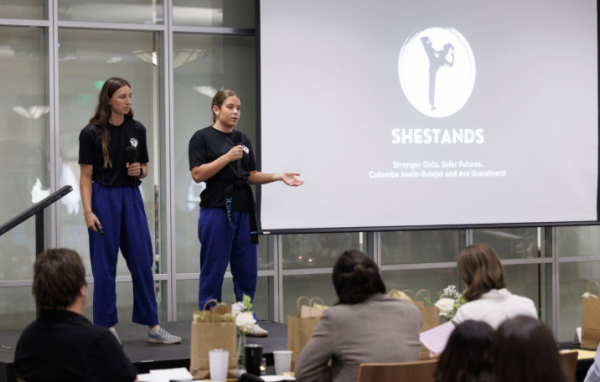
SheStands grew out of years of frustration with the underrepresentation of girls in martial arts and a desire to help more women learn about self-defense. Colomba, the only female first-degree black belt in her studio, said the concept shifted considerably over time, moving from a clothing idea into an after-school self-defense program for elementary school girls.
The team worked through what schools could actually implement, ultimately landing on an afterschool format because it was “the easiest to implement into schools, easier for the school, easier for a group like us,” noted Columba.
After the competition, the team hoped to expand into schools across San Diego by partnering with them, starting with Torrey Pines High School.
BetKind: Julia Pawl (‘27), Isabelle Banaie (‘27), Ronik Gupta (‘27), Maia Salami (‘27), and Ben Turner (‘27)
BetKind’s creation traces back to a very specific memory: Ronik and Maia, as kids, watching a man on a slot machine at Dave and Buster’s, feeding coins into the machine long past any reasonable point.
The team took on gambling addiction by redesigning the betting experience itself, stripping out manipulative features like free-money offers and gamified rewards while allowing users to allocate winnings toward verified charities and even improve their odds by choosing to donate.
The concept grew more specific as the team refined it, moving from an abstract engagement with gambling toward a concrete platform with a working prototype and a live website. Ben said the process taught him “a lot of insight in terms of how to reach out to people, how to do interviews, and how to develop an entrepreneurship idea,” which ended up being as valuable as the product itself.
The SafeDose Project: Kristen Yu (‘27), Veronica Yu (‘27), Nina Vaghar (‘27), and Sophia Noves (‘27)
The SafeDose Project proposed a youth-friendly Narcan case designed as a keychain or carabiner to make overdose reversal agents easier to carry and less stigmatized among teens. Veronica said the process pushed them into unfamiliar territory, specifically mentioning that they “learned a lot about marketing, planning a business, and getting to do three printings, which is something I wasn’t super familiar with,” and that one of the most meaningful skills they developed was learning to seek out and receive feedback without becoming defensive.
As Kristen explained, “When you pitch your idea to someone, don’t get defensive about it, and instead listen to their advice, because taking notes is the most helpful and helps us improve our project the most.” Sophia to the networking dimension: “Before this, we didn’t really put in a lot of effort to go talk to random adults,” and the project forced them out of that comfort zone in ways that stayed with them past competition night.
NeuroMap: Nolan Ameriks (‘27), Nathan Hong (‘27), Kent Isakari (‘27), Amaan Khan (‘27), Theron Schutz (‘27)
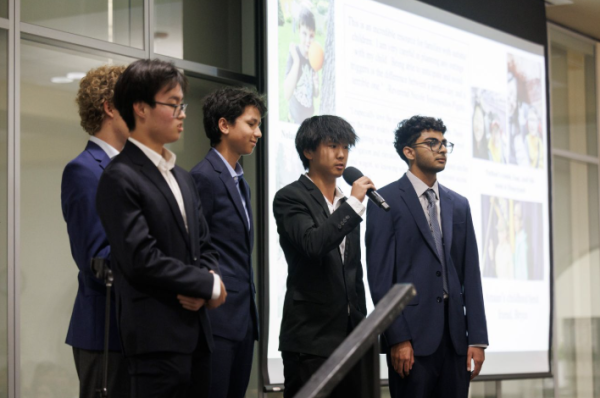
The idea for NeuroMap came out of a personal connection: Nathan spoke with his aunt over Thanksgiving break about what it’s like to bring an autistic child to places. The concept took shape from that conversation, and the team stayed with it from there.
“Establishing that personal connection is super key,” Theron said. “[It helps] to capture the audience.”
So what is Neuromap? The team described it as a parent-powered review platform for neurodiverse families that rates public places for factors like noise, crowding, and sensory accessibility, built around the premise that families should not have to guess whether an outing will end in sensory overload.
Nolan’s advice for next year’s competitors is to “do something you have personal ties to, so that way you’re motivated to do it and you’re not trying to force something.”
Project OpenLens Ethan Hu (‘29) and Avery Cain (‘29)
Ethan and Avery said they began with the broad goal of helping blind and low-vision users, then, after research and interviews, they realized that many existing products were built for older users, prompting them to focus on younger users who wanted more functionality and independence.
Their proposed app uses a phone camera and audio output to identify and read physical objects, buttons, and text, allowing users to independently interact with devices. What stood out in their presentation was not just the concept but the way they walked through its evolution without pretending they had arrived with a finished answer.
When asked what they would do if they won, Ethan made the goal clear: “Have that funding go towards developing an actual app, doing a lot of the programming and experimenting, and getting an actual app running so we can have an official thing going that the public can start using.”
The Story Bridge: Madison Gasaway (‘28), Kaitlyn Kuo (‘28), and Sanjeevni Vaidya (‘28)
The Story Bridge focused on youth in detention centers through a shared writing portal connecting students on campus with students in juvenile facilities — where they take turns writing a story together. Kaitlyn said the experience sharpened their professionalism, particularly around conducting interviews, following up with adults, and finding alternative ways to reach people who had not responded.
Much of their progress came in the final stretch when the project had to move from idea to actual execution. As Sanjeevni put it, “We’ve made the most amount of progress in this last month, month and a half,” and sticking it out through that period was what made the difference.
Madison described the interview process as unexpectedly rewarding: “I got to find connections and just talk to people about your idea, even if they might not necessarily be involved with it, they could have a connection to it, and it could reach further than you think.”
The Right Fit Project: Jojo Perham (‘28), Bitty Rooney (‘28), Raquel Shteremberg (‘28), and Stella Morera (‘28)
The Right Fit Project addressed homeless and housing-insecure middle and high school students who lack access to clothing that helps them feel confident. Their idea collects gently used, teen-appropriate clothing, washes and irons each item individually, and distributes them through local youth shelters and schools like The Monarch School, specifically so that students feel as though they are shopping in a store rather than receiving a donation.
Jojo said the biggest lesson was time management: “This deadline seemed so far away when we first showed up for the project, but then by fulfilling each little step of the way, it really just helped our project come together in the end.”
Their advice to next year’s teams? “Just do it like you are going to make an impact. No matter what you do, any tangible impact that you can make is an impact,” Raquel said.
StrongHER: Bailey Brightenburg (‘27), Margo Leong (‘27), Kasia Zwierzykowski (‘27), Lucy Wagner (‘27)
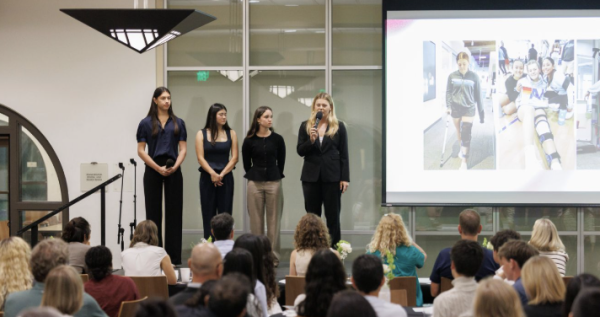
StrongHER focused on ACL injury prevention for female athletes in a space their project description calls out directly: 96% of sports science research is conducted on men, yet female athletes are two to eight times more likely to tear their ACLs. The team built an app designed specifically for female bodies, combining cycle-aware training, fatigue and sleep tracking, biomechanics education, and nutrition support in one platform.
When they reached out to doctors and medical professionals for input, Kasia said many did not respond initially — but their persistence paid off: “Most of the time, once they finally did respond, they were so excited to partner with us and help us with this process,” Kasia said.
Connect-A-Vet: Alex Serhan (‘29), Crawford Brown (‘29), JJ Penaloza (‘29), and Max London (‘29)
Alex remembered going to the Veterans Hospital for interviews. “It was pretty nerve-wracking, just going up to them and being like, can we interview you, because a bunch of them just turned us away,” he said.
Doing their research in the field led them to realize how difficult it can be for veterans with PTSD to access consistent mental health support. Connect-A-Vet is centered on pre-recorded therapeutic support for veterans with PTSD, designed around short video sessions developed by licensed therapists who specialize in working with veterans.
Throughout the competition night, JJ commented that the experience of answering unexpected questions from judges taught them to know their product deeply and “think on your feet, think quick.”
The Result
Judge Mr. Kellermeyer said he was struck immediately by the level of preparation, the production quality of the videos, and the strength of the ideas overall, going further than polite praise by saying the projects were “just as good as what you would find with adults working and coming up with ideas,” even if students sometimes lacked the depth of field knowledge that accumulates over the years.
Jake said he was more focused on implementation, business realism, and scale, asking whether an idea could go somewhere concrete if money were awarded. He also has “done this type of competition, like four to five different times at different events,” showing his credentials.
The final decisions were difficult enough that the judges debated multiple ways of splitting the $6,000 prize pool, and Kent said they at one point considered dividing it evenly among six different teams before landing on a different structure. As Jake put it, “It was a really tough decision,” and the teams were finally decided based on feasibility.
Ultimately, Project Conexus, The Story Bridge, and The Right Fit Project tied for third, each getting $1,000. StrongHER and SheStands tied for second, each winning $1,500, and NeuroMap won first, getting a check of $2,000.
The prize money, they said, would go toward advertising, app development, and a verification feature to prevent false reviews. More telling than any of that: the platform was already live and had already reached at least one parent outside their immediate circle.
Next year, Ms. Gomez plans to add an application process to ensure students entering are ready to take it seriously, and her longer-term hope is that students do not stop at the competition: “I don’t want kids to just stop at the competition. I want them to really dive into this after it’s over.”
As the crowds in the cafeteria dispersed and students snapped pictures with each other, the Sixth Annual Social Innovation competition came to an end. Standing in front of adults with real standards, defining something that had to hold up outside of the room, and producing quality work isn’t easy — but as Judge Mr. Kellermeyer would advise students, “Do it. Just go for it.”