

Nachas. In Yiddish, it means the pride that you feel in someone else’s accomplishment.
That’s how Speech & Debate Head Coach Mr. Matthew Valji felt about this year’s Speech & Debate State Qualifying tournaments. “I feel whether [Bishop’s speakers and debaters] win awards or not… a sense of that Nachas, that pride for others,” he shared.
That sentiment followed the team through a series of rigorous State Qualifying tournaments (often called “Squals”). Over the course of four weeks from February 27 to March 14, Bishop’s competed in three of the most important tournaments of the year that determine who advances to the 67th California High School Speech Association (CHSSA) State Championship.
The first tournament was Parliamentary Debate — often abbreviated by debaters as “Parli” — a two-on-two partner debate event in which teams are assigned a side and given 20 minutes of prep before debating. Despite being one of the smallest schools, 19 teams from Bishop’s showed up, making up about 33% of all participating teams from 18 schools.

On the first day of the competition, as the sky had already dimmed at 7 p.m., the only sounds coming from room 8104 at Carlsbad High School were the rapid clacking of keyboards, hushed whispers between partners, and pens frantically scribbling on papers. Bishop’s Parliamentary debaters were deep in the “prep room” trenches, brainstorming arguments for the resolution: “Policy: The United States should end its alliance with Saudi Arabia.”
With topics ranging from the regulation of the development of Artificial General Intelligence (AGI), California’s affordable housing, to the net benefits behind interventionist policies, debaters spent two days brainstorming, researching, and discussing these topics.
For many, these were also topics they hadn’t thought deeply about before. Benny Chen (‘29), a novice debater this year, said the rounds “definitely [helped] me understand more about geopolitics, the U.S.’s alliance, and the current circumstance of AI.”
And not every moment was smooth. For instance, in one round, Annika Mody (‘27) found herself and her partner, Andrew Wang (‘27), stuck halfway through prep with nothing written. “We hadn’t started writing our case because we didn’t understand the topic very well,” she shared. “And we were kind of panicking.”
To combat this pressure, the Mody/Wang duo adopted a new perspective: “We kind of made a little goal for ourselves this time to not stress as much,” Annika shared. “We just kind of want to live more in the moment and enjoy the activity.”
It’s safe to say that the strategy worked — Annika and Andrew ended up getting second place in Parli, along with Ella Xing (‘26) and Melanie Yau (‘26), and Thomas Kenney (‘26) and Ariadne Georgiou (‘26) making it to the top four. Andrew was also named the San Diego Imperial Valley Speech League’s (SDIVSL) Debater of the Year.
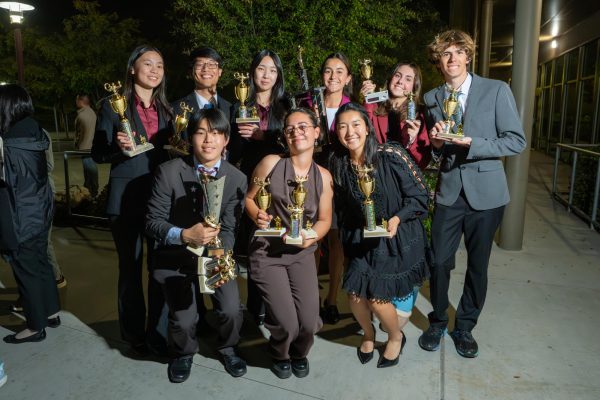
Because so many Bishop’s teams did so well, the tournament even saw a rare “walkover” situation. Because tournament rules prohibit two teams from the same school from debating, the higher-seeded team “walks over” the other to advance. This happened to Bishop’s twice during the Octofinals of the Parli tournament.
For many Bishop’s debaters, however, the tournament was less about immediate results and more about growth as well. “I feel like Speech & Debate is a really fun experience, and even though the majority of the team won’t make [the Octofinals], we’re all here to improve our speaking skills,” Maggie Hao (‘28), a two-year Parliamentary debater, said. “And overall, this will have long-term benefits.”
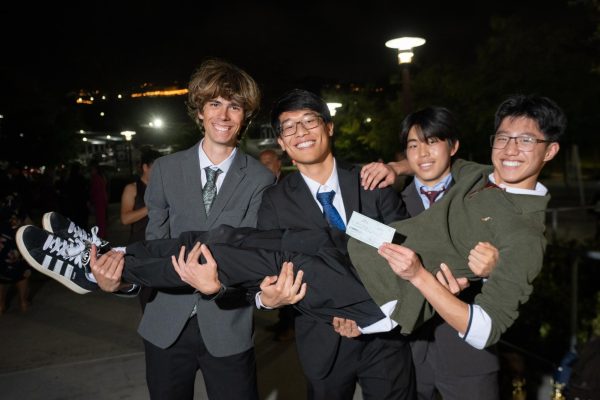
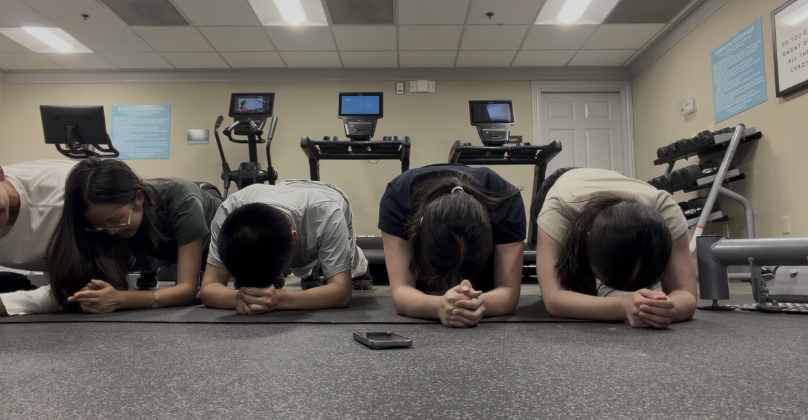
That mindset showed up everywhere — in the conversations, the laughter, and sometimes even spontaneous photo shoots between rounds. Benny described his favorite part as simply “hanging out with my partner [Adrian Fong (‘29)]… we’re going through struggles together,” adding that the tournament itself became “a really good friendship-building” experience.
Eliot D’Argenio (‘29), another novice Parli debater, agreed, saying, “Me and [Ian Shin (‘29)], our friendship has grown more than I even thought it could… we’re so dependent on each other in Parli.”
The next tournament was the Individual Speech Events (IEs) on March 6-7 at Poway High School. Bishop’s participated in a variety of events — from extemporaneous speaking on international issues to giving a speech composed of poetry and prose.
For Livia Li (‘28), a Declamation (or “DEC”) competitor, the challenge was managing the intimidation she felt watching other talented speakers. To keep her nerves at bay, she turned to her own unique philosophy, borrowed from Olympic figure skater Alysa Liu: “Joymaxxing.”
“I told myself many times during rounds to just, like, be happy that I’m here, be grateful that I can speak,” Livia said. She even developed a pre-speech ritual to project confidence. “Before I turned around… I’d smile at myself, like, really big… like a real smile. Then I’d turn around, and I’d still smile so the judges [can see].”
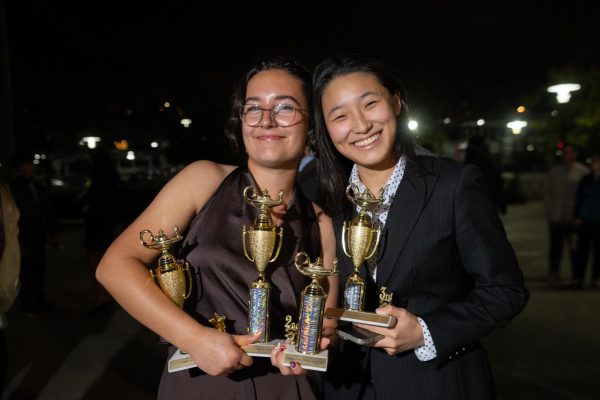
The sense of community also helped Charlotte Zheng (‘29) final for her event, International Extemporaneous (IX), during her first time competing in the event. “I think being in the prep room and being able to talk to people… everyone’s just supportive and wishes everyone the best,” Charlotte noted. ‘I went in with no expectations, no pressure. So then I was able to give a speech at my full capacity.”
Leadership member and Original Oratory (OO) competitor Yina Shate (‘26) made the funniest memories in between rounds — people bring homework to the tournaments, but no one ever does it. Instead, the time is spent on debriefing rounds and talking. “We’re all in an in-person life group chat, and we’re all talking and having fun and relaxing our brains for the next round,” Yina shared.
The final tournament on March 13-14 consisted of three events: Congressional — or “Congress” — Lincoln-Douglas (or “LD”), and Policy Debate.
In the Congress chambers, students acted as senators, debating a docket of bills ranging from solitary confinement for juvenile offenders to offering humanitarian and financial assistance to Sudan’s Civil Democratic Alliance — a resolution authored by leadership member Sophie Arrowsmith (‘26).
For her, this tournament was “bittersweet.”
“We’re debating some really cool things,” Sophie noted. But as a three-year veteran of the leadership team and a four-year senator, Sophie found herself reflecting on the underclassmen’s growth. “I was just asking [Athena Georgiou (‘29)] for help with my speech. She is a freshman, and she was more prepared than I was. And that’s so fun.”
Athena found the policy tournament to be a lesson in what it feels like to make policies. “A lot of bills are incredibly well-intentioned… and yet I still have to go against what one might say is like morals because of logistical things,” Athena observed. “I realized… writing and the logistics of it, like the implementation and funding, are all very important.”
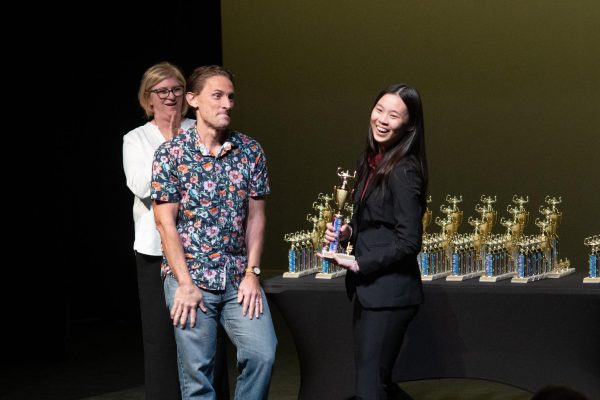
While Congress focused on the “how” of law, LD focused on the “why,” centering on philosophical values. For this tournament, they debated the topic: “Resolved: The United States military ought to abide by the principle of non-intervention.” Freshman Evelyn Fu commented on the inherent unpredictability of rounds as one of the main challenges: “It’s really all in the judges’ hands at some point… maybe [my arguments] didn’t resonate with the judge.” Despite this, she found a way to stay grounded. “I tell myself, like, I did my best… It’s not even in my control anymore. So there’s no point in worrying,” Evelyn said.
Despite this, Evelyn persisted — making it to the top 16, along with more seasoned debaters Melanie Yau (‘26), leadership member Caleb Tang (‘26), and Ella Xing (‘26), who ultimately placed first.
Speech & Debate Assistant Coach Dr. Leo Landrey noted that even with a tight schedule — three tournaments over four weekends and a midterm break in between to cut down on practice time — he was still impressed by the outcome. “We did really well relative to our preparation. So I think we outperformed what I expected, which is great.” For him, the joy of coaching comes from seeing students participate “for the love of it, for the joy of it, and for the friendships they make and for the fun they have at tournaments.”
While the goal was to qualify for States, Speech & Debate Leadership Parsa Avaz Barandish (‘27) and Policy competitor observed that the most important factor was that “team morale is strong and that people are having fun.” He noted that debates “force us to think a lot about our beliefs,” adding that it “helps us with humanizing… different positions of arguments.”
Ultimately, the Squals season ended with a record-breaking 27 state qualifiers, breaking the record set last year by 1. But rather than just the trophies, it was also about the community built behind the clacking of keyboards.

Mr. Valji recalled watching the team after the awards ceremony at Helix Charter High School: “The students were taking pictures with each other, not just for the gram, but also for their memories… it wasn’t even just about winning. It was just about getting to the end of the season and being one amazing team together.”
A piece of advice from Mr. Valji for those competing in Squals?
“The most important person in any round is not your opponent. It is the judge… your goal is not really to convince your adversaries, it is to convince everyone else.”
And, as Livia summarized, “Have fun.”