
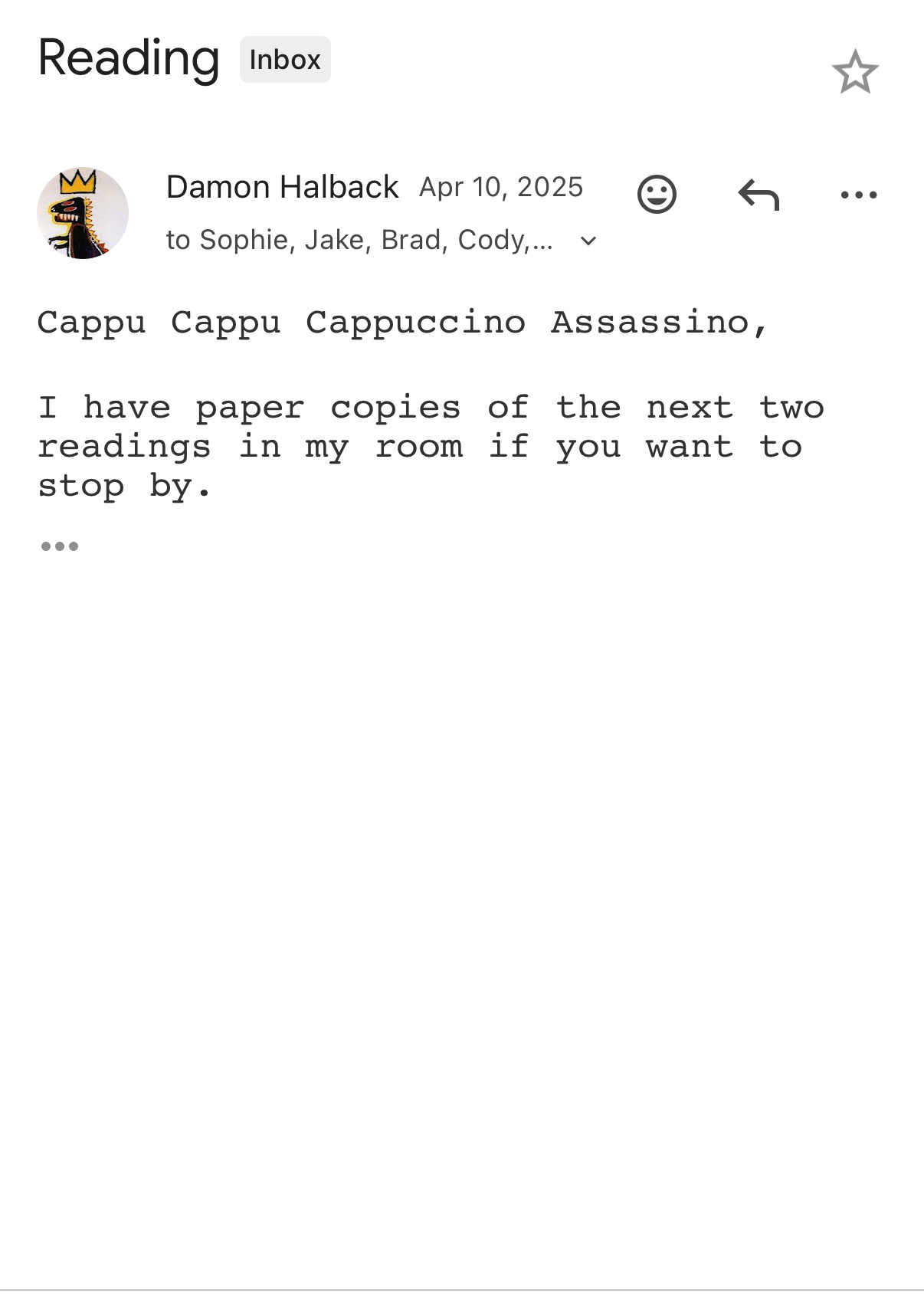
“My favorite Italian brain rot is Bombardillo Crocodillo,” said History and Social Sciences Teacher Mr. Damon Halback.
Brain rot — a vernacular that includes phrases like “skibidi toilet,” “tung tung tung sahur,” and “67” — can sound like a foreign language to anyone who’s not Gen Alpha, a cohort born between 2010 and 2025. Yet at Bishop’s, it’s not only students who talk in slang anymore.
Increasingly, teachers are speaking in brain rot terms, and even incorporating brain rot to meet different goals in class. Some teachers use it as a deterrent, others use it to build community, and some even use it as an experiment on their students, investigating the evolution of language.
Would you cringe if your teacher started saying “67”?
Some teachers, despite hating brain rot, cleverly wield it as a form of “deterrence.” For example, Math Teacher Ms. Jessi Chrystal says “67” to make the term “too uncool” for students, she explained.
“There was a time when students couldn’t get past anything that was 67 without freaking out in class,” she reminisced. “If an answer happened to be 67, everyone was like, ‘Oh, 67, 67’,” she said.
When Ms. Chrystal started noticing this trend, she utilized her students’ fervor for brain rot to her advantage, devising a plan to use brain rot against them in hopes that they would stop saying “67” in class. “Whenever adults start catching on to things, teenagers think it’s not cool anymore,” she added.
In one of her Honors Calculus BC tests, she intentionally tweaked some of the questions so that the answers would be adjacent to “67.” “I made a test where one problem asked the rate at which students at Bishop’s are saying 67. Some answers were like 6 pi over 7, or 6.7,” she said.
Ms. Chrystal’s plan is successful. She writes tests that all Calculus BC students take. “It’s so annoying because all I can think of the rest of the test is SIX SEVEN,” complained Sydney Mafong (‘26), who is in Math Teacher Dr. Camacho’s class.
“You can say that I gave them a taste of their own medicine,” Ms. Chrystal said, “Because right after that, students started rolling their eyes up, saying ‘that test was so stupid,’” she said, smiling sheepishly. “I figured, there has to be a point where I say it so many times that students eventually get tired of it, too.”
Similar to Ms. Chrystal’s tactics, Math Teacher Mr. Juan Vidal used 67 on the Honors Statistics cumulative exam last semester. “I don’t get why students use brain rot so much; it’s empty and utter nonsense,” said Mr. Vidal. “But I needed to come up with a question that was ridiculous for the kids, and since you guys are always doing 67, I figured, why not?” he said.
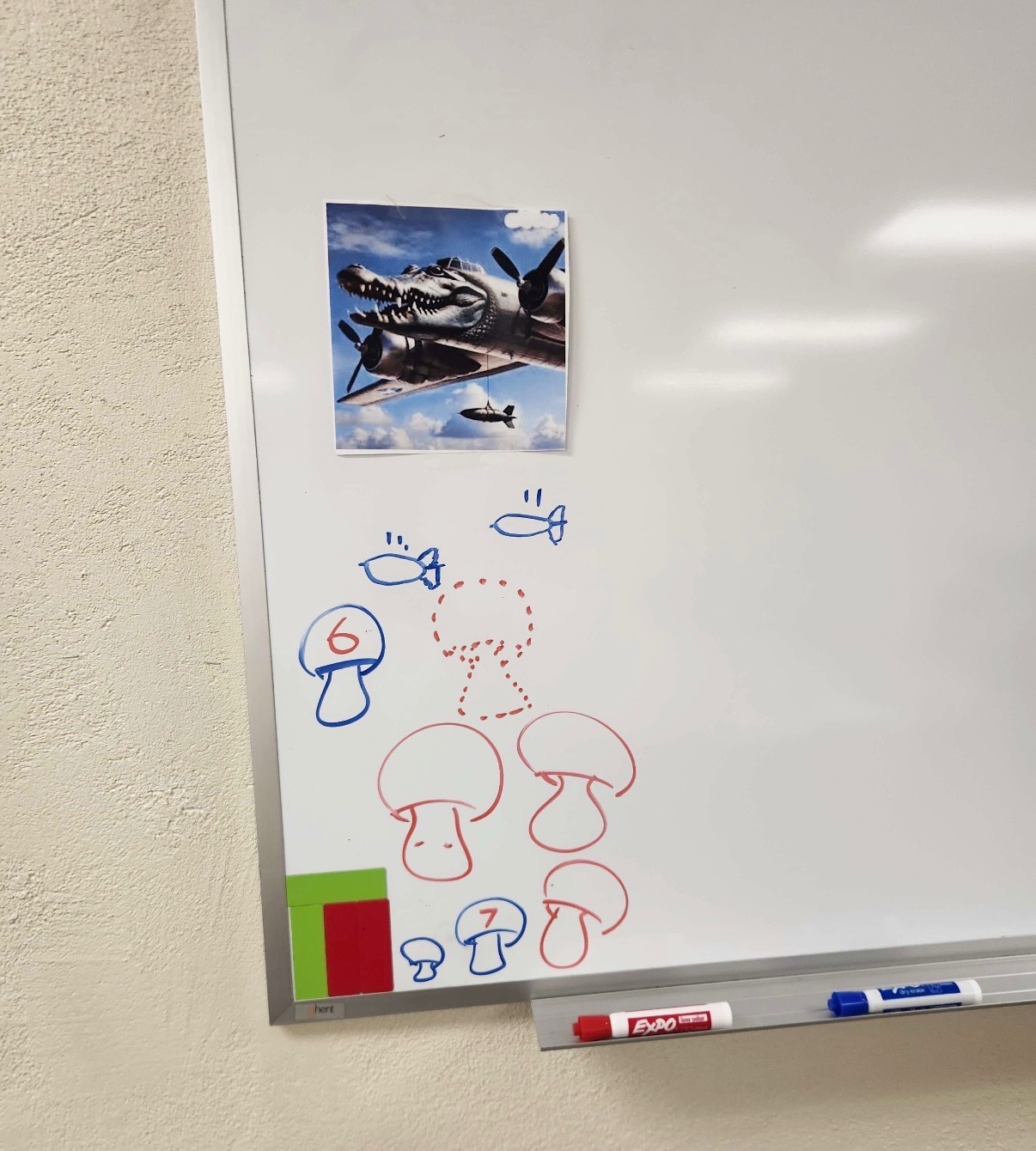
Mr. Halback, on the contrary, embraces brain rot. In his classroom, little Italian brain rot caricatures still cover the corners of the whiteboard, drawn by his students. But why does Mr. Halback love brain rot so much? Maybe it’s a spiritual calling — “I can’t say that I really chose the Italian brain rot,” he explained. “It chose me.”
Mr. Halback began carrying the flame of Italian brain rot last year, when he trailblazed its usage in his emails. Last year, he began the email with “Cappu Cappu Cappuccino Assassino” before giving out a homework assignment. “I think using Italian brain rot as an introduction to an email is always a welcome, discordant moment, as most emails tend to be mundane and logistically purposeful,” he said. “Italian brain rot gives [the emails] the opportunity to be useless and eccentric.”
Dr. Banta has also tried experimenting with brain rot with his students as his “test subjects.” “To test if my students were Gen Alpha or not, once, we looked for the most popular skibidi toilet video, and we projected it on the board and watched it as a class,” he said. “Surprisingly, they got no enjoyment out of it whatsoever.”
While Dr. Banta’s students might not enjoy brain rot in class, Mr. Halback’s senior advisory is all for it. “The excessive use of Italian brain rot is relatively unique to my cohort of students. It’s a way for students to be seen and shows off a student’s creativity,” Mr. Halback said. During Christmas break, Mr. Halback’s advisory was the only group that decorated their door with images of “Tralalero Tralala” — a shark wearing shoes — and “Tung Tung Tung Sahur” — a humanoid baseball bat — which made it a memorable door on campus.
“Brain rot is a statement of modern life,” said Mr. Halback, “It is self-referential, critical, ephemeral, and also meaningless, all at once — it’s absurd!”
Moreover, to Mr. Halback, brain rot extends from being a humorous phrase: it is a part of his advisory culture. One of Mr. Halback’s advisees, Noan Cheng (‘26), noted, “Italian brain rot in itself means nothing to me. But as a group, it represents the Halback community.” He continued, “We have imbued meaning into it. To us, Italian brain rot isn’t what gets us a cheap laugh, but a unique facet of our eccentricity. It is part of the memories that we formed together as the Halback advisory.”
Brainrot in Academia
Mr. Halback uses brain rotted emails, Dr. Banta projects them on the board, and Ms. Chrystal puts them on her tests. They all know that if they use it, it will create a reaction. “Honestly, it’s quite a mathematical process,” said Math Teacher Dr. Santiago Camacho. He further explained, “Brainrot is a type of algorithm…it tells you to make a certain choice,” he said. “The popularity of the trend is derived from statistical analysis.”
As an Economics Teacher, Mr. Halback interprets brain rot as an extension of consumerism and a capitalistic market. “I think that economics is closely related to brain rot. I consider economics to be the study of choice-making. And this is a kind of choice-making,” he said.
“In short, brain rot is just the outcome of a system driven by consumption,” explained Mr. Halback.
Similarly, Dr. Banta’s enjoyment of brain rot also relates to his professional background. “I’m professionally interested in language and linguistic change,” he explained. “I don’t think brain rot is necessarily a bad thing. I mean, that’s just the natural evolution of language. Languages are gonna change as you move along, and different vocabulary gets used.”
“I will always jump onto new languages and phrases people use. I’m in the business of being a linguist. Brain rot is one of those things that latches onto us,” he added.
Dr. Banta considers brain rot as its own form of language and as a speech pattern. “Brain rot is very similar to ancient language. In Latin, we’re also working with a weird, interesting, different, exotic language,” he said.
“For me, it’s all part of the fun of linguistic evolution. One positive thing is that … people are more willing to be playfully ironic with language,” Dr. Banta said. “They’re out there looking to be inventive with language.”
If Dr. Banta’s experiments have created no results on his students, they certainly worked on him. Dr. Banta admitted that his own speech has changed as a result of brain rot: “I want to use brain rot, not because I want to be able to talk like the kids do nowadays. I am an old man. But I embrace my age, so it’s like an ironic dad thing to do.”
As the world around us changes, teachers are noticing the effects that it has on students. Like Dr. Banta has noted, students from year to year change a lot. Their speech patterns change, their way of communication changes, and teachers need to adapt. Sometimes, teachers can wield that power against their students, while others can’t help but feel the need to also join in on the frenzy.
“Skibidi. Skibidi toilet. Skibidi toilet. I’m going Skibidi toilet!” concluded Dr. Banta.