
Picture this: you are a 10th grader in Dr. Fox’s English class. You walk into your English class, ready to take your final assessment after reading Mary Shelley’s Frankenstein; or, The Modern Prometheus. You do not open your computer, navigate to Exam.net, and punch in a code. You do not take out a pencil and an eraser and start writing in a blue book. Rather, you go into a room with your teacher, they ask you questions, and you talk.
While an exam like this may have been uncommon a few years ago, this year English Teachers Dr. Catherine Fox and Dr. Clara Boyle have begun experimenting with a new format administered live: the oral exam.
Going into this school year, faculty in the English department had already been interested in implementing an oral exam, and Dr. Fox saw a perfect opportunity to try it out. “They’d already written on [Volume 1 of] Frankenstein for the cumulative last fall,” she explained, “I was like, ‘Oh, maybe this is my chance.’”
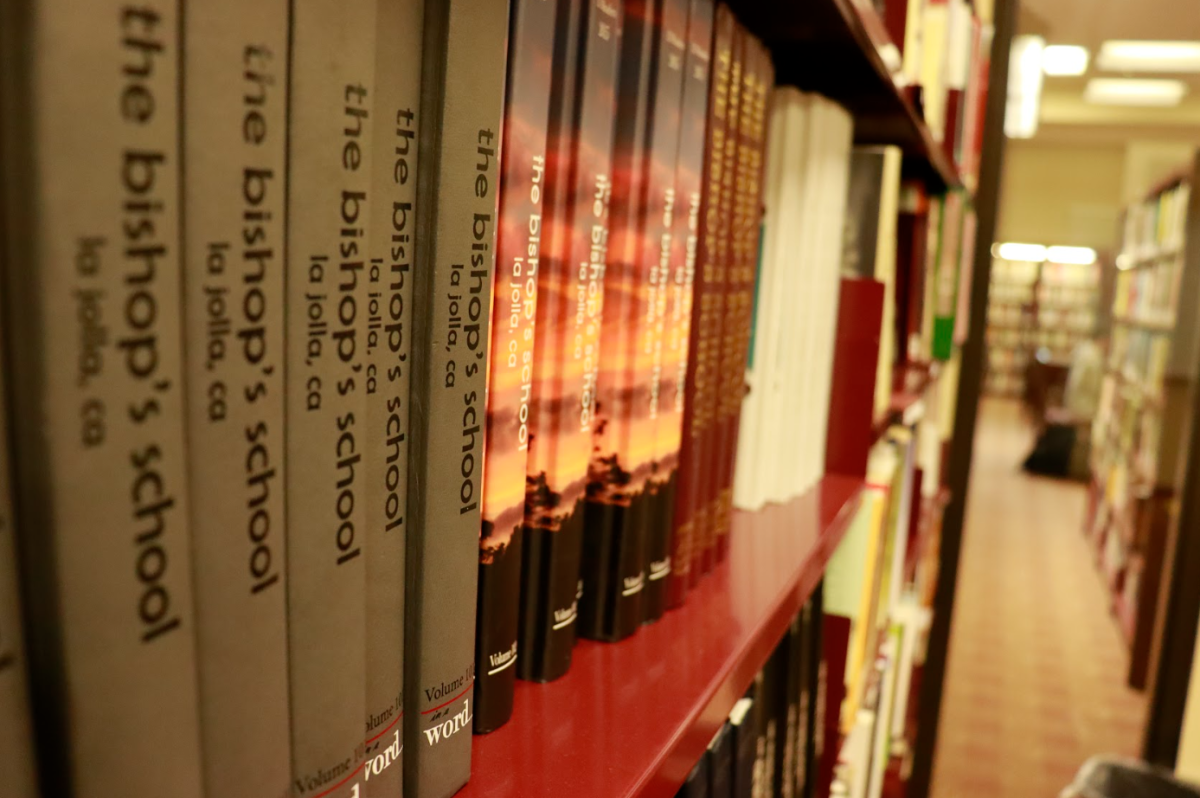
Dr. Fox’s exam consisted of an 11-minute conversation with each student in the library, during which they talked about a literary lens — a perspective that could be used to interpret Shelley’s work — that the student chose from a list which Dr. Fox provided. While the duration of the oral exam was rather short, the students spent a lot of time researching their lens up to that point. Students would start by giving a short overview of the topic they had chosen, along with some analysis of a prepared passage related to their topic. Afterwards, Dr. Fox would supply another passage, and the student would have to analyze it on the spot.
Livia Li (‘28), a student in Dr. Fox’s English II, greatly enjoyed her oral exam because it was conducted aloud. She prefers analyzing texts in English through talking, rather than just writing, saying, “It’s a lot easier to express yourself, since you don’t have to talk in a really formal way.”
English Teacher Dr. Clara Boyle also conducted an oral exam with her Honors American Literature III class. As a “three-part assignment” on Emily Dickinson’s poems, Dr. Boyle had her students choose and memorize one of Dickinson’s poems, take a timed writing responding to the poem, and then have a conversation with her about what they wrote. She commented that “oral exams have potential because, while students can prepare for them, they can only prepare up to a point.” During the conversation, the student would have to discuss with Dr. Boyle about what they had written, “flexibly and spontaneously.”
Dr. Boyle recognizes a central reason driving the department’s interest in oral exams. “In light of generative AI, we have been trying various strategies to try to circumvent it,” she said. In fact, timed writing on Exam.net was implemented for similar reasons, as reported previously by The Tower. Oral exams are just one of the several strategies the department has been experimenting with to discourage AI usage. In this current era of technology, Dr. Fox feels that “being able to confidently and competently deliver information orally could become more prized as a human quality.”
Pairing a timed writing with an oral exam was an intentional choice on Dr. Boyle’s part. Malaika Khanna (‘27), a student in Dr. Boyle’s Honors American Literature III class, believes that it helped balance out two different skills. “Many people have a hard time with writing something that is coherent in a short amount of time and therefore would benefit from having the option to explain it further at a different point,” she said. Malaika also brought in her experiences with discussion based around the Harkness method, commenting that the oral exam felt more comfortable for her in comparison to a typical discussion, since Dr. Boyle asked her “direct questions that helped me make my argument stronger while talking.”
Michael Sun (‘28) took Dr. Fox’s oral exam, but had a different experience. Michael considers his writing skills much stronger than his speaking skills, and when he realized that his class would be taking an oral exam instead of a timed writing, he felt “genuinely scared.” He describes his analysis style as “sporadic bursts of inspiration,” so he found having to memorize all of his notes “kind of weird.” In the end, he admitted, “It was a lot less scary than I thought it would be.” Michael attributed this to Dr. Fox’s attentiveness while he was talking, which made him feel less intimidated.

He said he still prefers “timed writes a lot better just because they’re more organized,” yet also acknowledges that the experience varied for everyone, based on how they preferred to express themselves. Furthermore, Michael feels that taking an oral exam is beneficial for everyone’s speaking skills. “At the end of the day, to be a functioning human being, you have to be able to talk and explain things,” he laughed.
To Dr. Fox, face-to-face exams like these help her understand and communicate with her students in a candid light. “It was very interesting to see how different students approached it,” Dr. Fox remarked. Throughout the exams she conducted with her students, she noticed significant differences in the way her students analyzed certain details during the oral exam: “For example, some students might not want to show off their capabilities at the Harkness table, but they might in a one-on-one situation.”
Dr. Boyle also appreciates the interactiveness of an oral exam. On preparing to talk with her students, she noted, “I had some ideas of what we might talk about, but the conversation took us somewhere else, and I really liked that. That’s not possible in Exam.net.”
Although oral exams are still being tested for use in Bishop’s English classes, Dr. Fox revealed that taking oral exams “is actually a very old format.” According to Dr. Fox, they have been frequently conducted in colleges for a long time. As proof, she provided a transcript of an oral exam at Dartmouth from 1804. “There’s some interest in the fact that it’s kind of tried and true,” she said.
Additionally, oral exams are a common feature in the World Languages department. In an effort to understand oral exam methods, Dr. Fox collaborated with Spanish Teacher Ms. Julieta Torres-Worstell, who is well-acquainted with this form of testing.
Both Dr. Boyle and Dr. Fox also emphasize that time is a major constraint for oral exams’ popularity, noting the immense effort it takes for teachers to have an individual conversation with each of their students. Since Dr. Boyle used time in class to conduct the exams, she also had to figure out what the students she was not meeting with could do during that period.
Despite this, Dr. Boyle expects oral exams to be a prominent subject in English department meetings this semester. In addition, Dr. Fox is currently preparing a presentation on the potential role of oral exams in English, which she plans on delivering to the department in the near future.
English teachers are still experimenting with other exam formats, but, for now, the oral exam seems a likely contender.