
At Bishop’s, the Manchester Library is a student hub, where conversations echo across three floors, revealing how quickly information — or misinformation — spreads.After Super Bowl LX, Library Director Ms. Alisa Brandt overheard a group of students talking about Bad Bunny’s halftime show. In his performance, Bad Bunny gave his Grammy award to a child, whom many online had mistakenly thought to be Liam Ramos, a five-year-old who was detained by U.S. Immigration and Customs Enforcement (ICE).
Parsa Avaz-Barandish (‘27) also heard stories percolating on campus about the Epstein files. Students were linking cannibalism to the files, a conspiracy theory that started as an internet rumor, and gained sizable traction online.
Despite both claims being false, the rumors that started off on social media rapidly made their rounds around school. As Parsa remarked, such conspiracies “can make their way effectively into a very educated [environment],” like Bishop’s. Understanding why lies in the skill of media literacy.
What is media literacy? Ms. Brandt defines it as “the ability to find, interpret, and create media ethically.” It’s a lifelong skill, she explained, that has become increasingly important in today’s media, permeated with Artificial Intelligence (AI) generated content and rapidly evolving algorithms. “Not only is media changing, [but] it’s changing incredibly quickly,” she added.
Ms. Brandt teaches media literacy during the seventh-grade computer science rotation, which she noted was the “only official opportunity” for such education. She and the library staff have to “cram [information] in two sessions.” In these lessons, students analyze different types of articles and determine the purpose of that piece of media.
Other than the short lessons to seventh graders and one twenty-minute lesson on media literacy for all grades during a well-being block, there is no set curriculum. “It’s not ideal, and I have been asking for opportunities to teach information literacy, which is the umbrella term that includes media literacy,” Ms. Brandt explained. “It’s really crucial that we try to find a way to work this in.”
History Teacher Ms. Katy Rees, who looks for opportunities to teach media literacy in her Honors U.S. Government class, agreed with Ms. Brandt. Despite her best efforts to teach it alongside the course’s curriculum, Ms. Rees said, “My one lesson might or might not stick if it’s not woven into each grade level.”
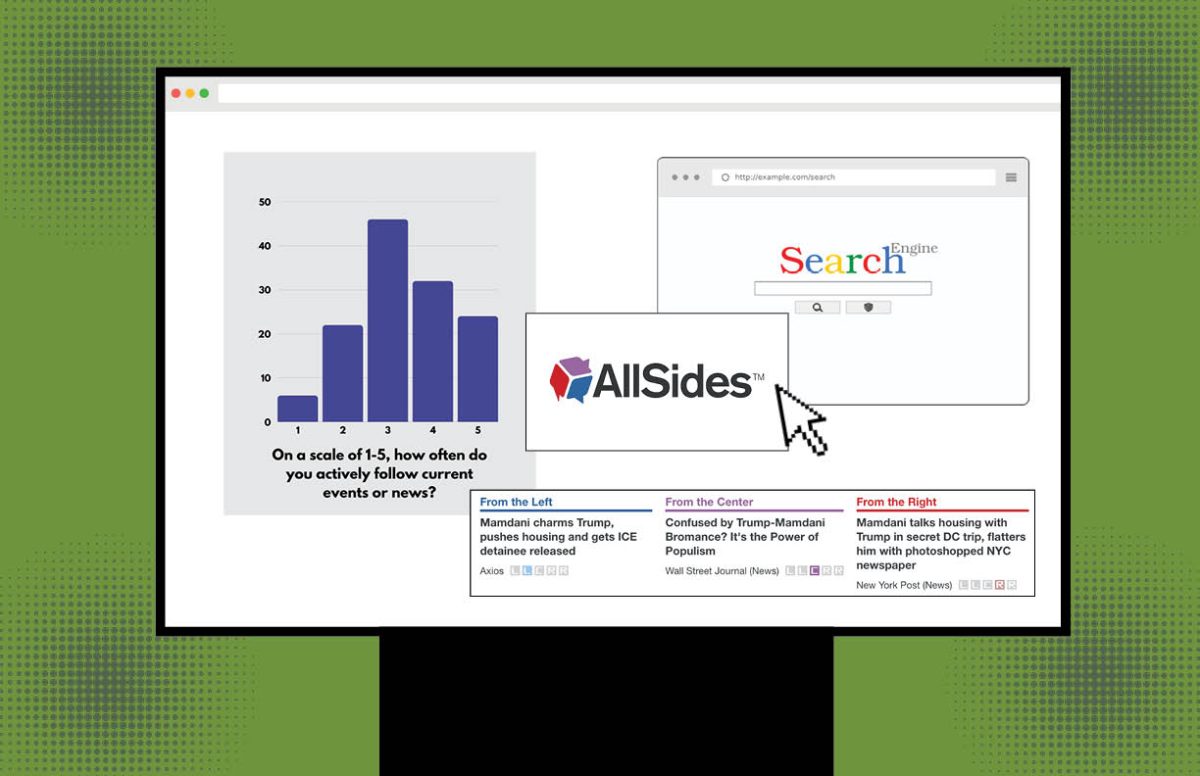
In an effort to better understand media literacy on campus, The Tower sent out a schoolwide poll that received 130 respondents. Among other questions, the poll asked how they received their news, what sources they relied on, and how much confidence they had in their abilities to identify bias and misinformation.

According to the poll, conversations at school or at home were the most common way respondents received their news, with 82% marking it as their source for information. Annika Mody (‘27), a member of Speech and Debate, remarked that “Speech and Debate has honestly been one of the outlets where I’ve gained the most information and awareness of things happening around me.” In preparation for debate tournaments, she tries to anticipate possible topics that could show up, pushing her to explore issues she otherwise wouldn’t have encountered — including China’s imperialistic presence in Africa, and America’s continued involvement in the Middle East.
While conversations ranked first, news outlets remained influential, too. 64% of respondents said that they used major news publications as a source of information — whether that be through daily emails or a news agencies’ social media account. The most popular publication was The New York Times — 73% of respondents said that they read it — perhaps due to increased access through Bishop’s provided subscription to all its content. CNN came in second with 42.3%, while other popular outlets included BBC, NPR, The Wall Street Journal, and The San Diego Union-Tribune — the latter two of which the School also provides access to.
All of the publications noted by the students in the poll fall anywhere between the categories of “center” and “lean-left,” according to AllSides. The most popular right-leaning publication from the poll was Fox News, earning 18% of the votes. Parsa commented on these statistics, saying, “I don’t think that’s an unfair representation of the school. I think, generally, given our location in Southern California and San Diego, we’re gonna be naturally left-leaning.” From KPBS News, A political map of La Jolla colors the community in light blue, reflecting the area’s generally left-leaning tendencies.

(AllSides)
Beyond publications and conversations, 67% of respondents marked “Scrolling videos/reels/etc. on social media that catch my interest, regardless of the source” as another way to receive news. This is the trend of “incidental news exposure,” which refers to “coming across news when online for other reasons” — according to Communication Science expert Dr. Svenja Schafer — such as at the will of the algorithm.
“I think that the problem with passively getting your news is that when you encounter it, you’re not really in the mindset of questioning it,” Parsa said. “You don’t consider who wrote it, or what their intentions are.” Whereas actively searching for news allowed for a “state of inquiry,” he continued.
When asked what sources on social media they followed most, 37% of respondents were “unsure.” That uncertainty suggests that while many encounter news through social media, they may not register where that information originates from. “Social media does a really good job of making us think we know everything about current events,” Annika explained. “And then I think [it] could possibly dissuade people from using other sources to find it out.”
Annika observed exactly that in the 2025 New York City mayoral election in November. “People thought they knew a ton about the candidates just based on their social media presence, without actually going and reading articles about their policy or researching them,” she remarked.
Social media isn’t purely negative — it makes credible reporting from a wide range of outlets more accessible. Parsa explained that encountering news on social media enabled him to see content from many different sources, as opposed to “just going into the New York Times app, because all you’re getting [there] is New York Times content,” he said. “On social media, you can see them all together, so I think social media can actually be a good thing.”
Social media’s popularity as a news source can also be attributed to its accessibility. Library Assistant Ms. Gracie Petersmeyer said, “So many online articles you have to pay [for], which annoys me to no end.” She remembers her frustration during college when it seemed like just about every article she wanted to use required a subscription. “People tend to gravitate towards free things, and that happens to be social media,” she continued.
As so many students use social media as a resource for news, they’re bound to come across misinformation. Respondents were very confident in their ability to identify misinformation. On a scale of one to five — five being the most confident — 94% gave a rating higher than three. At the same time, when asked whether they were aware of the biases of sources, 66% of respondents said “yes,” 22% said “no,” and the rest wrote some variation of “sometimes.”
This data is revealing. While almost all respondents were sure that they could identify misinformation, a significant portion remained uncertain about the political leanings or origins of the content they consume, particularly on social media. “It’s hard to know because sometimes it’s purposefully hidden,” Ms. Petersmeyer noted. While perhaps time-consuming, she recommended conducting research on the media company producing the information. Or, she offered, “they can read the article and think to themselves, ‘this could have a political affiliation,’ and keep that in mind as they’re learning.”
“Truly, there’s nothing that’s unbiased. That doesn’t really exist. Even choosing what to cover could be biased,” Ms. Brandt said. “So the best thing you can do is to sort of build up your ability — your awareness of what bias looks like.”
“What we learn in our history, English, math, science classes, and language classes are not always going to protect us from the world of the online,” Parsa said. And like a math problem, the vast media landscape demands intense critical thinking.