
For three weeks, all eyes were on Milano Cortina, the twin host cities for the 2026 Winter Olympics. Half a world away, 3,500 athletes competed across 16 disciplines, chasing medals on snow or ice. And at Bishop’s, during lunch, the Games played out on large projectors in the dining hall.
But with more than 3,200 hours of coverage available, who could possibly watch it all? Beyond the lunch broadcasts, most of us might have caught a clip online about an Olympic moment here and there, but did you catch the full story?
Consider this a rewind and a recap. In no particular order, here are seven moments that left the audience buzzing and ended up shaping the 25th edition of the Winter Games.
Lindsey Vonn’s Comeback Ending Crash

At 41 years old, alpine skier Lindsey Vonn made her fifth Olympic appearance, twenty four years since her debut at Salt Lake City. The comeback lasted just 12.5 seconds. Early in her first run on February 8th, Vonn’s right shoulder hitched onto an orange gate, sending her crashing down the slope. Despite wearing an inflated air bag that might have softened her fall, Vonn’s skis did not come off in the accident, leaving her with a complex fracture on her left tibia.
Vonn had come into the games with an ACL injury from a competition prior to the Olympics, though she later confirmed that the earlier injury did not cause the fall. From her hospital bed, she wrote on Instagram, “Life is too short not to take chances on yourself. Because the only failure in life is not trying.” She is now in stable condition and returned back to the U.S. on February 17th.
The Rise and Redemption of Alysa Liu
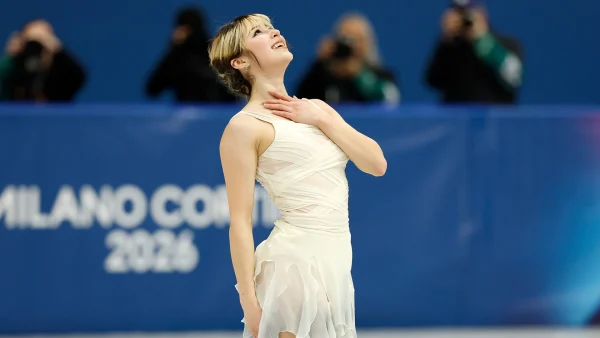
When figure skater Alysa Liu stepped foot in Milan, she had just over 350,000 followers. Fast forward to the closing ceremony, and she has now amassed 7 million. That number only continues to grow. Liu’s free skate to MacArthur Park by Donna Summer — which has received exponential growth in streams — has garnered 7 million views on Youtube, while her bubbly gala performance to Stateside by PinkPantheress and Zara Larsson sits at 4.2 million. She’s had quite the impact, to say the least.
After the Beijing Olympics, Liu decided to retire from competition, citing burnout. Two years later, she announced that she would be returning. This time, however, she would have more control over her career. In one interview in Milan, Liu said, “I’m really confident in myself. Even if I mess up and fall, that’s totally okay. I’m fine with any outcome.” That outcome ended up being a gold medal.
As for her soar in popularity, Emma Liu (‘27) attributes Liu’s likeability to her positive attitude on the ice. “She has this really fresh, revolutionary, perspective on figure skating,” Emma said. “It kind of feels like she just forgets about the stakes of it all.”
A U.S. Sweep in Ice Hockey…and One Derisive Phone Call
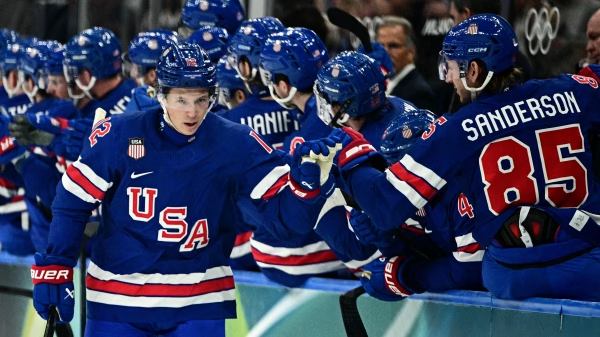
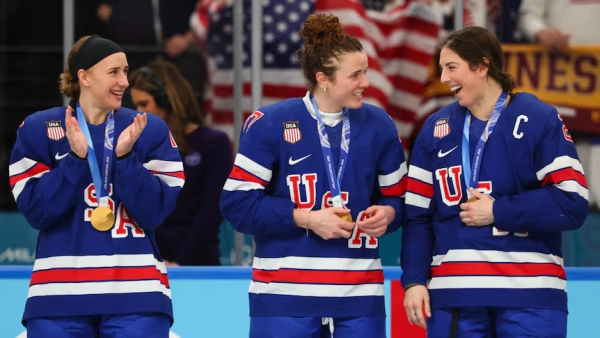
It was a dominant Olympics for United States hockey — both the men’s and women’s teams left with gold medals, each narrowly defeating Canada, a powerhouse in hockey, in dramatic overtime games.
From the beginning, the American women blazed through the tournament. They posted 5-0 games left and right, including one against Canada in the preliminaries. The gold medal game was much closer. In the finals, the United States fought from a 0-1 deficit to tie the game with a goal by captain Hilary Knight. In overtime, Megan Keller scored the golden goal, ending a phenomenal few weeks in Milan.
On the last day of the Olympics, the U.S. men’s team followed suit. Goaltender Connor Hellebuyck put on a stellar performance, stopping 42 shots — including a crucial one in the third quarter to preserve the tie. Like the women’s game, the men’s final required overtime to decide the outcome. Less than two minutes into the extra period, Jack Hughes scored the winning goal, giving the U.S. its first men’s hockey gold medal since the 1980 Olympics.
“Only if you actually watched the game, which I woke up at 5 a.m. to do, you would have seen how our goalie singlehandedly carried a country on his back,” Angela An (‘27) said. “They called the 1980s goal a miracle and while our chances this time were higher, it was pretty miraculous.”
Yet amidst celebrations, controversy arose. A congratulatory phone call from President Donald Trump to the men’s team drew backlash, in which he said, “I must tell you, we’re going to have to bring the women’s team, you do know that.” The players chuckled in the background. If he didn’t, he said, “I probably would be impeached.” More laughter followed.
Knight stated her disappointment for this phone call to eclipse what should have been celebration for Team USA’s wins. She also said, “I think this is a really good learning point to focus on how we talk about women, not only in sport but in industry. Women aren’t less than. Our achievements shouldn’t be overshadowed by anything else other than how great they are.”
Scores Under Scrutiny in Ice Dance
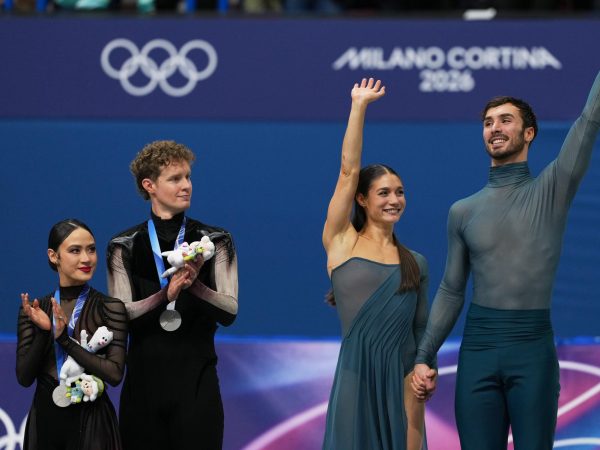
For the American ice dance couple, Madison Chock and Evan Bates — endearingly nicknamed “Bock” by fans — their second place finish at the Olympics was bittersweet. Partners since the spring of 2011, Chock and Bates entered the Games undefeated this season and as the reigning world record holders.
Standing between them and a possible first place finish was the newer partnership of France’s Laurence Fournier-Beaudry and Guillame Cizeron, who only teamed up just last year. Cizeron had previously won silver in Pyeongchang and gold in Beijing with Gabriella Papadakis, a partnership that dominated ice dance for years.
On Olympic ice, despite a visible error in their twizzles — the travelling spins done side-by-side — Fournier-Beaudy and Cizeron set a new personal best and captured the gold medal. But judges were sharply divided; four placed the French team in first, while five favored Chock and Bates instead. The gold medal ultimately came down to the individual scores from judges. Data analysis following the event highlighted obvious national scoring patterns, with each country awarding higher scores to their own team. Calista noticed, “It seems that the French judge overscored the skaters who represented France.” Indeed, the French judge scored Fournier-Beaudry and Cizeron 7.71 points higher than the American team, a difference large enough to raise eyebrows.
Off the ice, both Fournier-Beaudry and Cizeron face scrutiny. Papadakis recently came out with a memoir in which she calls Cizeron “controlling” and “demanding,” while Fournier-Beaudry’s longtime boyfriend — Nikolaj Sorenson — received a ban of at least six years for “sexual maltreatment.” Fournier-Beaudry has publicly defended him. “What an awful message the sport of figure skating just sent to sexual abuse survivors and victims, and parents who want their children to participate in a safe sport,” Christine Brennan of USA Today wrote after their win.
“In hindsight, it probably was quite close between the two teams,” Ethan Yang (‘27) admitted. “Still, I feel like [Chock and Bates] should have won based on some of the mistakes that the French made during the [free skate]…they were technically better, and I like[d] their storytelling more.”
Sturla Holm Laegreid’s Unexpected Confession

Among the 41 medals won by Norway, Sturla Holm Laegreid contributed to five, earning three silvers and two bronze in his second Olympic Games. It was not his podium finishes, however, that captured the most attention. Immediately after he won his first bronze medal in the individual biathlon race, Laegreid used a Norwegian interview to confess to his infidelity.
“Six months ago I met the love of my life. The world’s most beautiful, sweetest person. And three months ago I made the biggest mistake of my life and cheated on her,” he said, visibly holding back tears. “I had the gold medal in life, and I am sure there are many people who will see things differently, but I only have eyes for her.” The emotional admission quickly went viral, drawing confusion and criticism from viewers who felt the moment to be misplaced.
“Oh my god. I thought that was so stupid. I’m so annoyed that it went viral because I feel like it sucks for everyone involved,” Emma said. “Keep your private life to yourself.” Ethan agreed, adding, “I’m just confused. I’m just really baffled at like…why?”
Laegreid later addressed his ill-timed words, apologizing to Johan-Olav Botn — the gold medal winner of that event — for drifting away attention from his compatriot’s win. He also apologized to his ex-girlfriend for bringing their private relationship into the intense public spotlight.
Stone-Cold Controversy
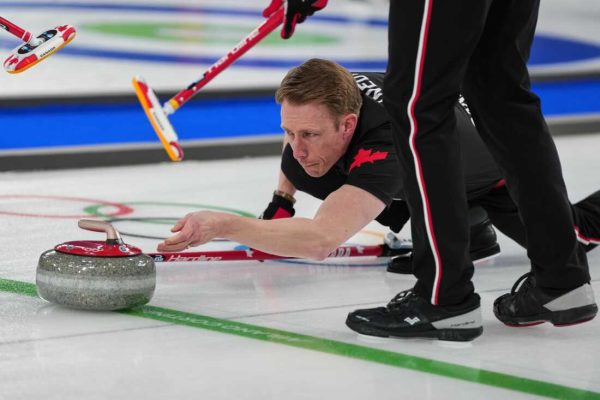
Marc Kennedy touching the curling stone is perhaps the most popular photo — and meme — to come out of Milano Cortina. The drama arose in a men’s round-robin match between Canada and Sweden. Swedish skip Oskar Eriksson questioned Canadian third Marc Kennedy’s illegal contact of the stone’s granite after its release. The exchange grew heated. “Who’s doing it?” Kennedy demanded. “You don’t know it?” Eriksson replied. “I haven’t done it once. You can f*** off,” Kennedy said.
There was no replay review at the moment, so officials did not call a violation. Afterwards, angles circulating online showed that Kennedy had in fact touched the granite. World Curling, the governing body of the event, issued a statement that emphasized contact with the granite past the hog line was not allowed. The same thing occurred on the women’s side. Canadian skip Rachel Homan was involved in a similar touch incident, but while Kennedy’s touch went unpenalized, Homan’s was.
“Some people argue that the touch didn’t do anything, but still, he cheated,” Angela said. “The fact that it didn’t do anything doesn’t change the fact that he cheated and I think it’s very odd that the committee didn’t do anything.”
Gold Medal Favorite Ilia Malinin Ends in Eighth as Mikhail Shaidorov Wins
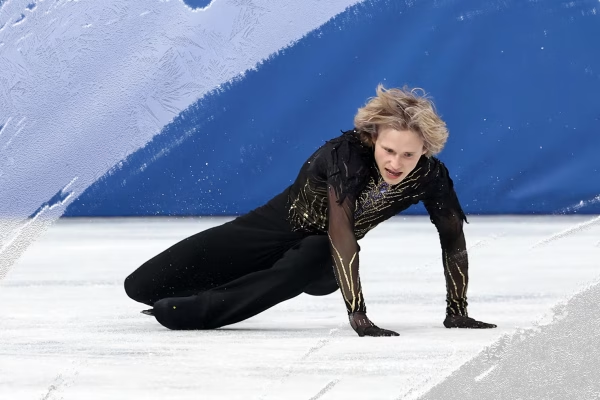
Coming into the Olympics, Ilia Malinin had won fourteen consecutive gold medals. Earlier in the season, he had also set a world record in a free skate, landing seven clean quadruple jumps. He was the self-proclaimed “Quad God.” Walking away as the Olympic champion only looked more inevitable after an impressive short program. Then came the free skate.
Malinin attempted the quad axel — four and a half revolutions in the air, the most difficult jump ever landed in figure skating, and one only he has successfully completed in competition. But not on Olympic ice. He ended up jumping just a single revolution, and major mistakes ensued. Errors on multiple quad jumps that followed saw him finish the free skate in fifteenth place and eighth place overall, one of the biggest upsets of the Games., “It was understandable,” Calista Upton (‘26) said. “Because he hasn’t been to a competition this big before.” As a figure skater herself, she added that she could relate to the pressure she saw in the athletes on-screen, including Malinin.
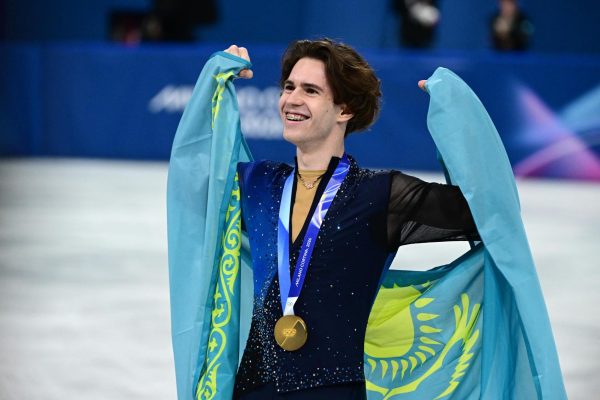
Instead, it was Mikhail Shaidorov of Kazakhstan who won the gold medal, who became just Kazakhstan’s second gold medal at the winter Olympics. Shaidorov was never considered a gold medal contender, and in the two events leading up to the Games, he placed 5th and 6th, respectively. But he delivered a flawless performance when it mattered most. After returning home, Shaidorov was congratulated by the President of Kazakhstan and awarded the Barys Ordeni (Order of the Leopard) to honor his historic achievement.
From overtime hockey thrillers to messy confessions on camera, Milano Cortina gave viewers its fair share of memorable moments. And still feel like you missed some of the Olympic action? Time to queue up the highlights on Youtube and watch all the replays!