

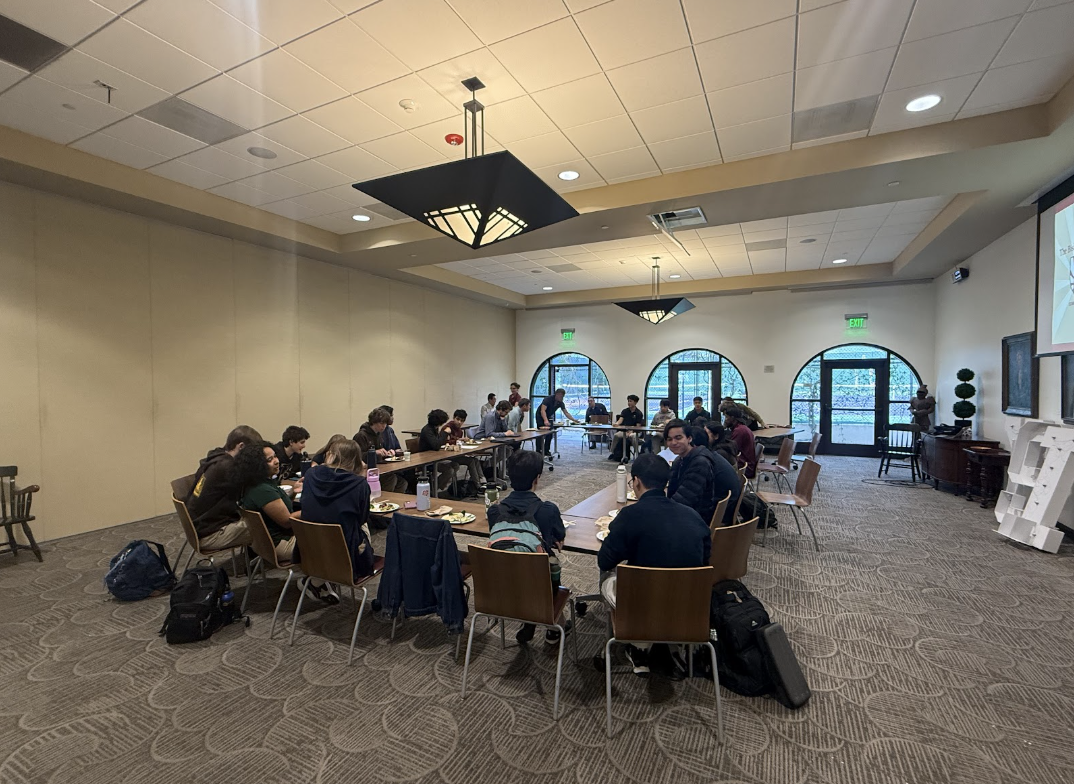
At 1:23 p.m on February 9, just minutes before the official start, the room was already buzzing. As tables filled and extra chairs pulled in, students funneled into the Town Hall — hosted by the DEIJ (Diversity, Equity, Inclusion, and Justice) Office during both Middle and Upper School lunch. By the time Ariadne Georgiou (‘26), one of the leading organizers of the event, stepped forward to introduce the question, the atmosphere felt like a community ready to wrestle with the question: How is justice used or misused in a democracy?
Beneath this prompt lies a web of questions spun through conversation at the event about trust, power, representation, media, and what it actually means to live inside a democratic society.
For Ariadne, the Town Hall emerged from questions she had noticed or overheard — students processing current events, or debating democratic institutions and the power of the law to protect or alienate. She explained, “I wanted to create an environment for my peers to say the things that are on their mind, and try to truly hear each other’s concerns.”
In many ways, the Town Hall aimed to offer something different from classroom dialogue. Ariadne noted, “In classes, discussion is stifled by its graded nature, and at home or among friends, there’s often pressure to conform to the majority opinion, and these crucial conversations are often limited to those you are closest with.”
By providing a space outside the classroom and social circles, the Town Hall mirrored the very civic participation it sought to examine. Naveen Hernandez (‘26), a senior who attended, reflected, “Democracies only work if the constituents they represent fully understand the gravity and nuances of current events. To that end, events like this Town Hall are paramount to the survival of a democracy.” Ariadne added, “By creating a broad and diverse space for civic discourse, Town Halls are an important exercise in active listening and respectful dialogue.” Valissa Thomas, Director of DEIJ, emphasized the importance of that structure. “They create space for real dialogue,” she said. “They help us grow not just academically, but as citizens and community members.”
Before the discussion started, Ms. Thomas projected a slideshow introducing the guidelines for the Town Hall. On the next slide were several questions for participants to consider, serving as a framework to help guide the discussion. Ariadne took the lead, inviting everyone to share their thoughts about justice in a democracy. After a brief, awkward silence, one voice finally spoke up. Gradually, more voices confidently emerged in the conversation, from freshmen to seniors, and engaged in respectful dialogue.
Naveen noted, “At no point did I feel personally attacked or afraid to be in that room.” He added, “It was nice hearing from younger students on their perspectives regarding democracy, and it made me happy that the Bishop’s community remains strongly committed to discussion, just as when I was a freshman.”
Sophomore Kiran She (‘28), who attended the middle school meeting because of a schedule conflict, commented, “Everyone had a chance to voice their opinions, even if they’re not mainstream, without being subject to judgment.” Kiran felt the Town Hall successfully enabled students to speak openly and converse respectfully.
Ariadne reflected, “There was a feeling of incredible energy and dedication to tackling hard questions and understanding each other’s sense of justice that I witnessed in both teachers and students, sixth graders and seniors alike.”
“‘Justice’ is our school theme this year,” Ms. Thomas noted. “And democracy depends on how justice is interpreted and applied. We’re living in a time where many people debate what justice looks like in practice, so it felt both timely and relevant for students to explore that question together.”
A big part of justice in democracies that emerged in discussion, especially in the modern age, was the role and influence of social media. The speed at which social media can disseminate information today raises questions about what sources can be trusted. The recent ICE (US Immigration and Customs Enforcement) shooting and killing of a man in Minneapolis just over a month ago was brought up, and how quickly videos of the encounter spread in conjunction with different articles covering what happened.
Though students didn’t offer any opinions on the shooting, points were brought up about how social media’s diverse perspectives and capacity for misinformation on current events like the shooting can cause polarization in society.
Additionally, students spoke thoughtfully about what it actually feels like to live in a democratic society: the right to vote, the responsibilities of the state, and the importance of equal and fair representation.
Trust became a central thread. Can we trust the government system? Can we trust each other? How do we “get both sides” of an argument in an era of information overload?
Ms. Thomas reflected, “The meeting achieved its purpose in that it created meaningful dialogue and encouraged students to think more critically about justice and democracy.”
Almost more importantly, the discussion didn’t feel finished. Ariadne said, “The knowledge that these conversations will continue beyond that room, and the desire that students have expressed to have a follow-up Town Hall to continue this discussion, gave me a sense of hope and pride in our community’s commitment to have difficult conversations when they matter.”
Naveen concluded, “I think we at Bishop’s are lucky to have such events available to us.”