

In the early hours of January 3, headlines around the world shifted abruptly toward Venezuela. Reports of an overnight attack spread quickly, and Venezuelan president Nicolás Maduro had been captured; according to AP News, the U.S. had “ infiltrated Maduro’s home and whisked him to the United States, where the Trump administration planned to put him on trial.” Venezuela was thrust into the international spotlight.
While these events unfolded thousands of miles from San Diego, their ripple effects were felt closer to home. Heightened global tensions have the ability to prompt rapid changes to travel advisories, transportation routes, and security protocols; this disrupted the systems of travel that people – Bishop’s students and families as no exception – rely on without a second thought.
According to reporting from The Guardian, a U.S. military operation in Caracas, Venezuela resulted in the detention of Venezuelan president Nicolás Maduro and his wife, Cilia Flores, who were transported to the United States to face federal charges related to drug trafficking and narco-terrorism. The operation marked a dramatic turning point in the long-running standoff between the U.S. and Venezuelan government.
Cooper Armstrong (‘27) and his family went on a trip to St. Barths – about 700 miles from Venezuela. Cooper mentioned, “We were lucky, we got out like a day before everything shut down. I mean, I heard about it when we were leaving and the airport felt chaotic. I woke up the next day to my dad watching the news about what happened and my mom sending videos to our family groupchat about people getting stuck exactly where we just were. We were very very lucky.”
Two days later, following reporting from The Guardian, Maduro appeared in a Manhattan federal courtroom, where he pleaded not guilty to all the charges he faced. He denounced his arrest as a “kidnapping” and insisted that he remains Venezuela’s legitimate president – a subject of significant international dispute as many countries consider later elections to be fraudulent – arguing that the United States had no legal authority to seize a sitting head of state. U.S. prosecutors, however, maintained that the charges justified the operation, opening a legal battle that challenges long-standing norms around sovereign immunity – the legal principle that a government or its leaders cannot be prosecuted by another country’s courts without consent – and the limits of U.S. jurisdiction.
Critics questioned whether the operation violated international law and warned that forcibly removing a foreign leader could set a dangerous global precedent. Supporters, meanwhile, framed the action as a decisive response to corruption and criminal networks. As world leaders debated the legality and implications of the raid, uncertainty spread — not just about Venezuela’s political future, but about how such an intervention might reshape international norms.
Within the Bishop’s community, students encountered the fallout of the event in markedly different ways. With many travelling over the winter break, some were fortunate enough to return home right before travel systems unraveled, experiencing the crisis only through headlines and news alerts. Others found themselves caught in the uncertainty firsthand, navigating cancellations, rerouted flights, and abrupt changes to carefully planned trips. And for many, the disruption was experienced secondhand – through classmates, friends, or family whose winter breaks were unexpectedly extended or reshaped by the unfolding events.
Izzy Rizo (‘28) and her sister Angie Rizo (‘29) went on a family trip to a few different regions in the Caribbean – less than a thousand miles from Venezuela – to Turks and Caicos, Puerto Rico, and the Dominican Republic. Izzy remembered, “About 24 hours before the time of our flight home, we received an official message from the airline regarding all flights being cancelled. They mentioned it was a concern of safety as Maduro had just been captured and it could be dangerous to fly.”
Izzy explained, “the hotel was genuinely pure chaos. Everyone was confused and just wondering how they would get home. People were even considering taking boats to Florida and then flying internationally.” She added, “Some people didn’t have a place to stay that night. I mean — they obviously planned to leave.” Angie added, “It was really scary, I’ve never been in a situation like this before. I’m so glad we got out.”
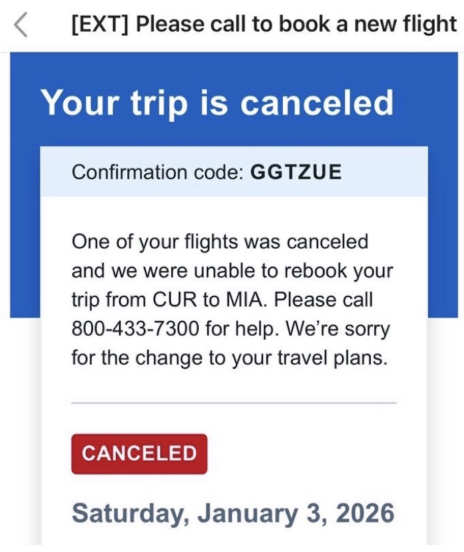
While some Bishop’s students may not have experienced these challenges personally, many know family or friends who found themselves in similar situations. Jojo Perham’s (‘28) close friend Sofia Simpfendorfer faced similar disruptions while traveling in the Caribbean – in Curaçao only 40 miles North of Venezuela – with her father during the wave of flight cancellations following the events in Venezuela. Jojo explained, “Sofia had been staying in Curaçao when airport shutdowns caused her return flight to be canceled.”
The earliest rescheduled option would have delayed Sofia’s return by nearly a week; Jojo said, “this was impossible given both school obligations and her father’s work commitments.” Direct flights home, to Miami, were priced far beyond what was reasonable, forcing the family to take a more complicated route home. Jojo noted, “Sofia and her family ultimately flew through Chicago before reaching Miami, extending what should have been an easy journey into something exhausting and uncertain.” She added, “While Curaçao doesn’t seem like a bad place to be stuck for a few extra days, the situation seemed so stressful.”
Fortunately for these families, they were able to make it back to their homes despite the challenges, uncertainty, and inconvenience.
For the Bishop’s community, the impact surfaced not through foreign policy debates, but through disrupted travel plans — a reminder that distant geopolitical crises can quietly seep into the everyday rhythms of student life.


Evelyn Demoss • Jan 19, 2026 at 10:55 AM
This article on the events unfolding in Venezuela and their impact on travel and students at Bishop’s School is beautifully written. The piece is clear, informative, and engaging, making a complex and sensitive situation easy to understand without oversimplifying it. Hritika does an excellent job of connecting global events to their local consequences, especially for students, which adds relevance and emotional depth to the article. The writing flows smoothly and keeps the reader interested throughout. Overall, it’s a thoughtful and well-researched piece. Great job, Hritika.