

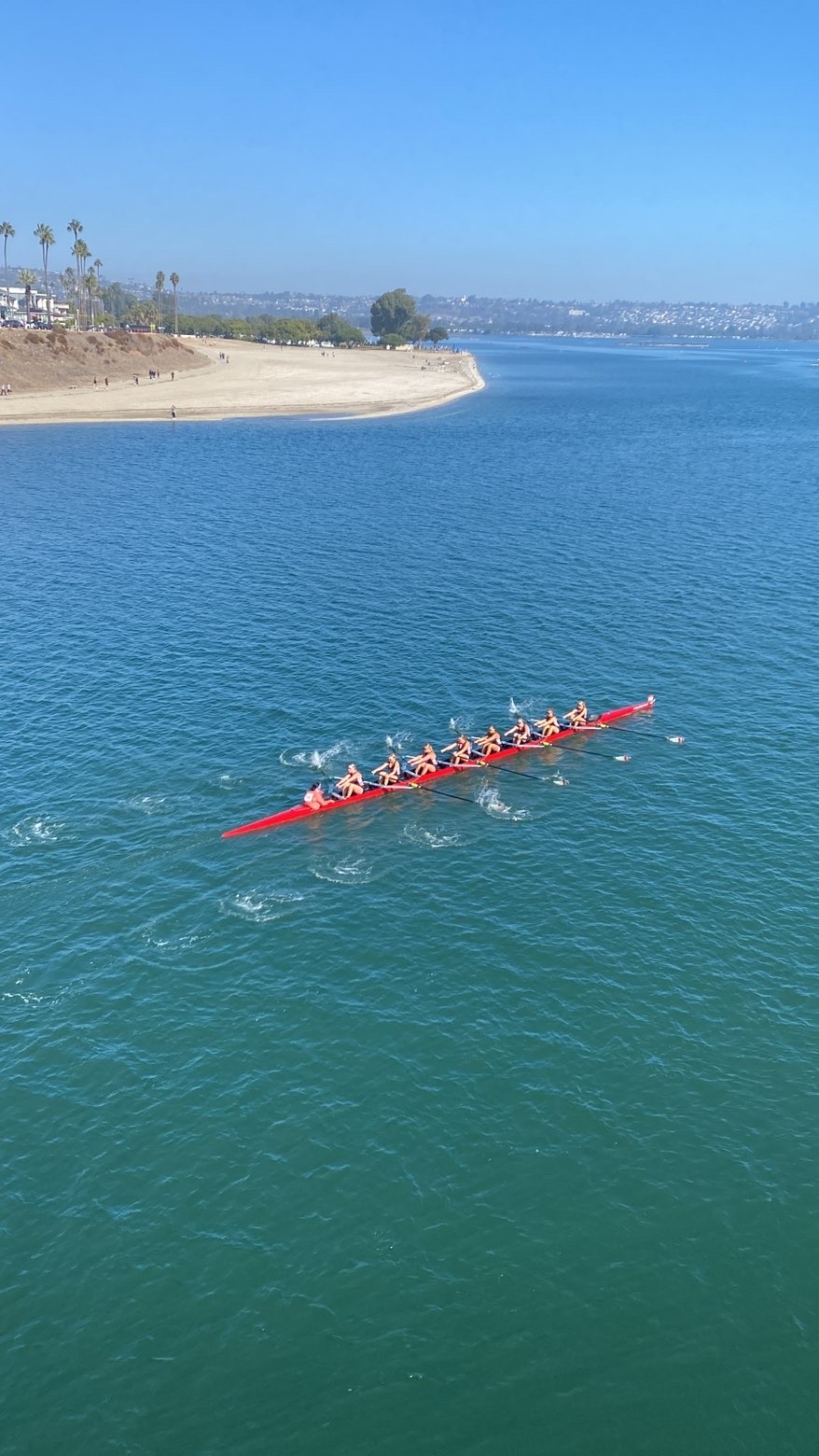
House music blares from a speaker as eight rowers — and their coxswain, who does not row but gives the crew commands — rush around the boat for last-minute checks, tightening the oarlocks and sliding the seats along the runners to ensure everything moves smoothly. Their coach orders the athletes to huddle up, and the team goes over the race plan one final time. The rowers gently place the shell into the water, push off, and row into position. The competitors wait tensely for the starter to fire the pistol. Bang! They’re off.
The pressure and pain are experienced weekly by a small number of Bishop’s students who row competitively, including Priyanka Raisinghani (‘27), Aviva Wrosch (‘27), and Annika Balog (‘28).
Because Bishop’s lacks a rowing team, these athletes train with rowing clubs outside of Bishop’s: Priyanka and Annika at San Diego Rowing Club, and Aviva at ZLAC Rowing Club. Both groups practice at Mission Bay six days a week for two and a half hours.
Priyanka, Aviva, and Annika all row in eight-person boats (called eights), which consist of eight rowers and one coxswain positioned on the bow of the boat facing the rowers. The role of the coxswain is to steer the boat and give strategic and motivational commands to the crew. Aviva and Annika both serve as rowers while Priyanka — once a rower — transitioned to the coxswain position.

The sport is demanding both physically and mentally, but when explaining why they began rowing, the athletes all agreed that the core reason was because they simply enjoyed it. Priyanka’s older brother rowed, so she just decided to try it out in seventh grade and has been competing ever since. Aviva picked her oars up for the first time this year because History Teacher Ms. Vandeweghe, a member of ZLAC, recommended that she row. Annika did a “learning to row” camp, discovered that she liked it, and started rowing three seasons ago.
Unlike many sports, rowing has two seasons in a year, one in the fall and one in the spring. During fall seasons, the races are five kilometers long, a test of endurance, on winding courses, and the crews race separately, the results based on time. The spring season consists of two-kilometer races on straight courses where the boats race head-to-head, focusing on pure speed.
Despite the commitment of the athletes, rowing gets little attention at Bishop’s aside from “the small section at the end of the yearbook,” as Priyanka put it.
Although a Bishop’s team would likely increase the sport’s popularity, the rowers agreed that forming one is unrealistic because of the costly equipment and the difficulty of finding a qualified coach.
Priyanka also said, “I personally like rowing with my club because it’s like an escape from school and you get to make new friends.” Annika added, “I feel like the community of rowing comes from the fact that the team comes from different schools, so everyone can bring their own perspective.”
Priyanka explained the team aspect of the sport, saying, “I think the biggest misconception about rowing is that it’s an individual sport. But it’s actually very team-oriented.” Aviva agreed, “You stay in time with everyone else, or the boat tips. So maintaining that level of togetherness, I think, is really fun.”
To perform at the highest level, rowers must hold each other accountable. “I love all my teammates,” Annika explained, “But sometimes it can be frustrating if people have a bad day or don’t put in as much effort as you do. You have to trust them to do as much as you are. And that applies both ways, so you have to do it not only for yourself, but also for the people around you.”
During races, Annika is motivated by performing well for her teammates. She also thinks to herself, “We do this 18 hours every week. We practice in the exact same conditions at the exact same speed. The race is nothing different.” Aviva admitted, “Competitions are really stressful, especially since I’m new.” She said, “When I’m racing, I’m just trying to stay focused,” to push herself.
Rowing is physically demanding and requires both strength and technique. Aviva explained, “There’s a certain pace I need to maintain, and sometimes I kind of lose it, especially over long distances. So trying to maintain the pace and keeping my technique in check is the hardest part.”
Annika agreed, “I did tennis and surfing before, but they never required the level of dedication that rowing does. Discipline is something you need to develop because you’re forced to do a lot of hard things.” She gave an example: “This weekend we have to do a 25-minute row as hard as we can, then run five miles, and when you get back, you have to row for 25 minutes again.”
As a coxswain, Priyanka faces pressure to guide her crew to victory. Questions flood her mind during competitions: “What am I going to call? How can I keep the boat straight? What can I say to make them go as fast as they can while keeping their technique good?” But, she explained, “For me it’s important to keep calm because if I’m freaked out then my teammates are going to be completely freaked out.”
The high stakes also create great memories for the rowers. Annika said her favorite regatta, a competitive rowing event, was the national race in Florida because “to qualify, it’s only your boat, not your club. So it’s your crew’s responsibility to make your boat fast. We have to put in the work.” Last season, Annika explained, “My team made it, and it was a really fun opportunity to be with my teammates.”
Priyanka recalled a race from November 9th of this year, the San Diego Fall Classic, at Mission Bay. Her boat faced a crew that had beaten them by 30 places in a race earlier in the season. “We came back with a very determined mindset, and we worked really hard,” she explained, “And we won, so we were able to see that the work had paid off.”

Aviva explained a recent regatta when her team placed second. “We were a completely novice boat, and placing in a race for the first time was really fun,” she said.
Looking towards the future, the athletes agreed that they hope to row in college, though they’re not treating it as their life’s mission.
The recruiting process for rowing is intense; colleges review videos of the rowers, evaluate the placement of their shell in races, and the performance of the athletes on the ergometer (erg for short), a stationary rowing machine. Priyanka explained that “they really focus on your race results,” emphasizing the importance of the team.
Annika said, “I like rowing, and getting into a college [would be] like a cherry on top.” Aviva added, “I’m definitely doing it for fun now… but if I get good enough, I might as well try to get recruited.”
Priyanka explained, “I think everybody automatically assumes that [the goal] of rowing is to get recruited because they think: ‘it’s so easy to get into college with rowing.’” She elaborated, “It’s easy [to get offers] if you’re good, but it’s not easy to be good.”
For Priyanka, Aviva, and Annika, the results matter. But when crossing the finish line, exhausted yet united, the athletes are reminded of the camaraderie through both hardships and triumphs that define the sport.