

Evelyn Fu (‘29) had very few issues with security before this year. Bringing in an outside coach to play tennis around three times a week, Evelyn would often hit late into the night on the Bishop’s courts. It wasn’t until 8 p.m. that security would ask them to leave, and later in the year, “[security] got more lenient and then it didn’t even have to be 8 p.m. anymore.” However, this summer, Evelyn was kicked off the court in the middle of a lesson. She said that she hasn’t hit with an outside coach on the Bishop’s courts since.
Last year, if you walked by the tennis courts during winter — both the Bishop’s Varsity Girls’ and Boys’ tennis off-season — you were bound to be greeted by the sound of tennis balls being slapped against a racket, often seeing someone hitting with a friend, or in many cases, an outside coach. However, this summer, Bishop’s began to enforce an existing policy that disallowed hitting with a paid partner on the Bishop’s tennis courts.
There was no particular event causing this change in enforcement. Director of Athletics Coach Paula Conway explained that Bishop’s must be aware of potential liability. She said, “Bishop’s has to be extremely careful about liability because, as a school, it has a legal and ethical responsibility to provide a safe environment for our students and employees.” The Bishop’s Student and Family Handbook 2025-2026, states, “Bishop’s is not an open campus.” All visitors must gain permission to enter prior to coming onto the campus, something not being done with the tennis coaches.
Last year, Elias Odmann (‘29) used the Bishop’s courts almost daily, bringing in an outside coach most of those days. The only time security intervened, he said, “the only problem was that my dad wasn’t there watching us.” The policy with a complete ban of paid hitting was not being enforced at that time. Assuming the courts would remain open, Elias brought a coach to the courts with him this summer. However, when he entered the Bishop’s tennis courts, he said he “heard about [the policy] by being kicked off.”
Other organizations such as La Jolla Shores Water Polo Club, and La Jolla Knights Volleyball are able to use Bishop’s facilities by obtaining permission in advance. Coach Conways said that this is because “Both of those nonprofit organizations secure their facility rentals through our Events Department at Bishop’s,” something outside tennis coaches did not do prior to using the courts.
According to the Senior Director of Alumni Engagement and Annual Giving, Ms. Lori Boyle, the rental of The Bishop’s School facilities helps cover essential expenses such as staffing, maintenance, security, and equipment setup, and usage. However, the most important aspect of the rental process is ensuring the safety and security of everyone on campus, as well as those visiting. Individuals or groups renting the facilities must complete a series of forms, contracts, and rental agreements so that Bishop’s is fully informed about who will be on campus, when they will be there, and the purpose of their visit.
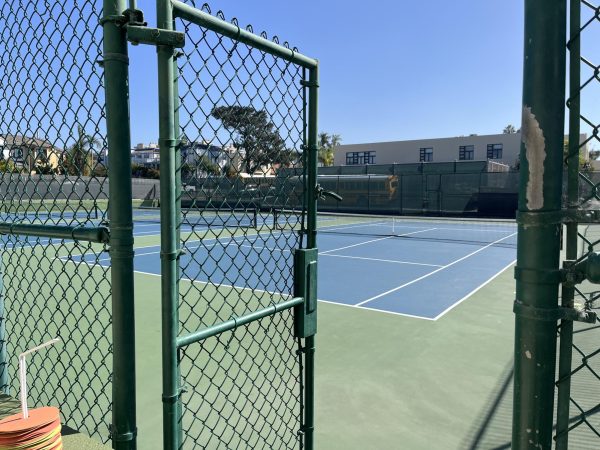
The Bishop’s courts were convenient for Elias and Evelyn to use, being within walking distance from their houses. But now, after the enforcement change, they need to drive around 20 minutes to public courts — such as the University of California, San Diego (UCSD) courts — and 20 minutes back home, to hit with their coaches. The 20 minutes may not seem like much, but over the course of the year, it can easily snowball into several hours.
“It’s gonna be a lot more time that I’m gonna need to travel,” Evelyn said. With the increase in school work from middle to high school and added travel time, Evelyn worries about her time management and how she will balance academics and tennis.
The courts are always open for student use, however. “I’ve been on the courts every day this year,” said Ryan Park (‘27). As a member of Bishop’s Boys’ Varsity Tennis Team, having the courts readily available allows him to always make time for tennis in his busy schedule.
The enforcement of restricting paid private coaching has led students such as Elias and Evelyn to find new courts, face new commutes, and worry about their time management. However, citing student safety, liability, and consistency as reasons for the change, the Bishop’s administration highlights, with the updated enforcement of the policy, the balance it seeks to achieve between student needs and campus security.
However, one thing seems clear: come winter, the tennis courts will be emptier than in years prior.