

Written nearly 250 years ago, the United States Constitution reads, “Congress shall make no law… abridging the freedom of speech, or of the press.”
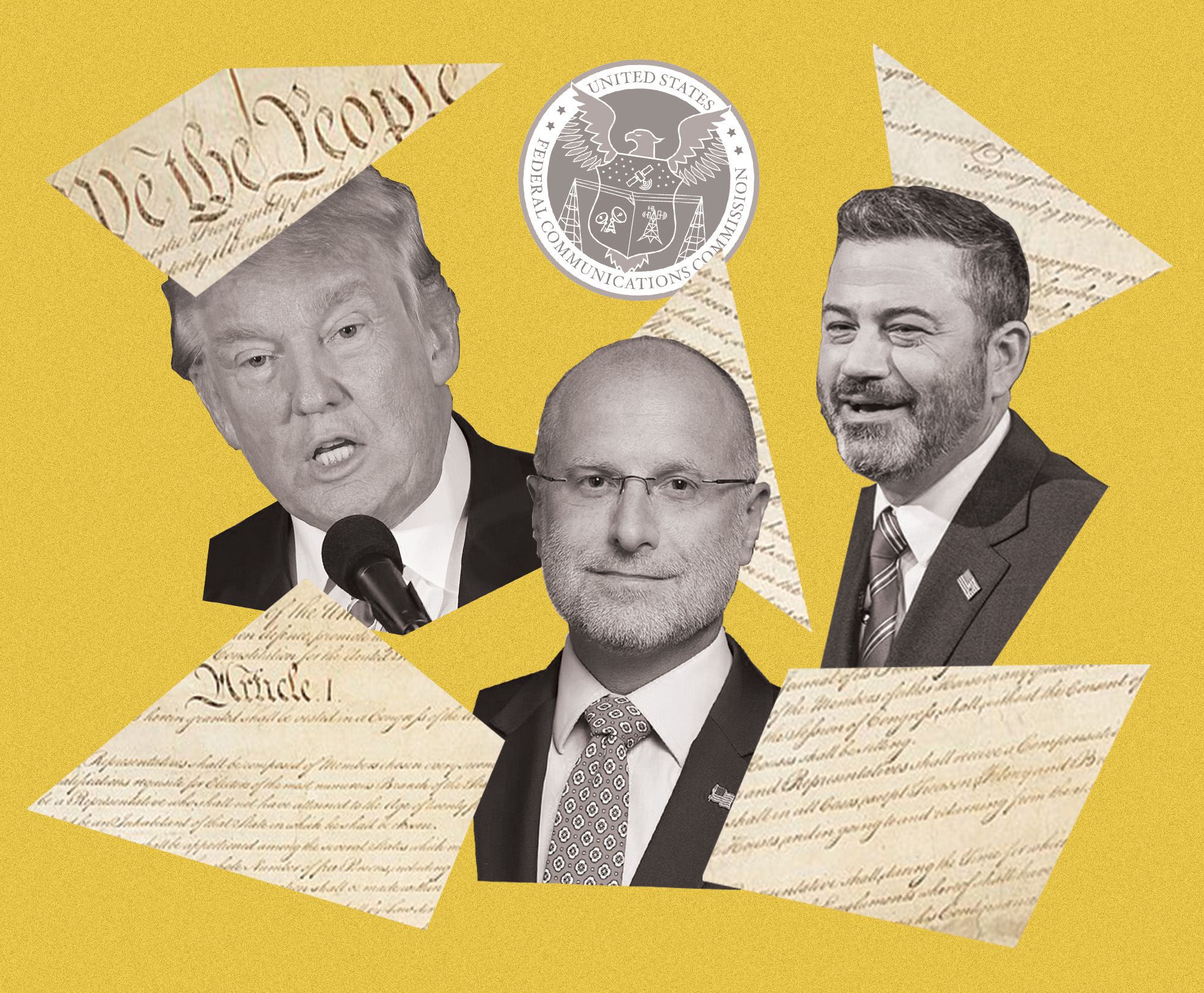
The First Amendment may seem unambiguous. And yet, on September 17, the American Broadcasting Company (ABC) indefinitely suspended Jimmy Kimmel Live! following mounting pressure from the Federal Communications Commission (FCC), the government agency responsible for regulating American media.
It has become clear that the suppression of speech doesn’t always require explicit law. In this case, all it took was a proposed merger, a regulatory threat, and corporate self-preservation.
Following the assassination of conservative activist Charlie Kirk on September 10, Jimmy Kimmel opened his late-night show’s monologue criticizing the conservative response, saying, “We hit some new lows over the weekend, with the MAGA gang desperately trying to characterize this kid who murdered Charlie Kirk as anything other than one of them.”
Days later, FCC Chairman Brendan Carr appeared on conservative commentator Benny Johnson’s podcast, issuing a direct threat by stating, “We can do this the easy way or the hard way. These companies can find ways to change conduct and take action frankly on Kimmel or…there’s going to be additional work for the FCC ahead.”
Nexstar, which owns 32 ABC affiliate stations, was pursuing a $6.2 billion merger with Tegna. The merger between the two media corporations required direct FCC approval, and thus, Nexstar swiftly announced it would take Jimmy Kimmel Live! off the air “for the foreseeable future.” Sinclair, owner of 31 regional ABC affiliates, quickly followed suit. Shortly after, ABC’s owner, Disney, suspended the show entirely.
The timing was not coincidental. It was meticulously calculated, revealing a dangerous blueprint for how free speech can be dismantled without overtly violating the First Amendment. Through pressure and leverage rather than government decree, speech can be restricted while staying within constitutional limits. This is what modern censorship looks like.
Understanding what happened to Kimmel first requires an understanding of media consolidation. According to testimony before the House Judiciary Committee, as reported by The New York Times, in 1983, 90% of the media consumed by Americans was controlled by 50 companies, but by 2012, that same percentage of media was controlled by just 6 conglomerates.
The Nexstar-Tegna merger would push this consolidation even further, giving one company control over more than 265 stations in 44 states — likely exceeding the FCC’s nationwide household reach cap of 39%.
This increasing concentration creates a key vulnerability that the government can exploit. When a handful of corporations control the vast majority of what Americans see and hear, the government doesn’t need to directly regulate what can be aired. It only needs to pressure a few executives to achieve a similar effect without constitutional constraints.
History Teacher Ms. Katy Rees explained, “This concentration of ownership means that influence — whether from government officials, corporate leaders, or interest groups — can be exerted by targeting a few powerful entities.”
Some argued that Kimmel’s comments warranted consequences. His monologue was definitely politically charged. His jokes were an arguably unfair characterization of the perpetrator. His speech was sharply polarizing in the midst of such recent violence and already widespread division in our country.
Independent conservative journalist Jack Posobiec accused Kimmel of being disingenuous during his return monologue, characterizing his emotional display as “fake crying” in a post to X on September 23. Meanwhile, Jerry Dunleavy, chief investigative correspondent for Just The News, insisted Kimmel “absolutely falsely insinuated that Charlie Kirk’s assassin” was conservative.
But here’s what really matters: criticism and censorship are fundamentally different responses. Even if Kimmel may have mischaracterized Kirk’s assassin by suggesting the shooter was motivated by conservative rhetoric, that’s precisely what free speech protects — speech that can be challenged and corrected through counterarguments, fact-checks, and competing commentary. That’s how free societies self-correct. What they cannot do without abandoning their founding principles is allow government officials to pressure corporations into silencing dissent.
The Supreme Court established in Federal Communications Commission v. League of Women Voters of California (1984) that a statute barring non‐commercial broadcast stations that received federal funds from “editorializing” violated the First Amendment. Writing for the Court in a 5-4 decision, Justice William J. Brennan Jr. held that the statute was “an attempt to directly regulate the content of speech that was at the heart of the First Amendment” and that suppressing editorial speech “deprived listeners of commentary about matters of public importance.”
Kimmel’s monologue adhered to the First Amendment. It didn’t incite violence, nor did it pose an imminent threat. Emma Baluja (‘27), who had been following the story closely, said that “It seemed like another time in which this administration was using its power to kind of change the narrative or direct the narrative.”
In America, this speech is supposed to be protected, even if it angers those in power. While courts can address genuine defamatory falsehoods, the notion that certain speech deserves consequences simply for being controversial or offensive is fundamentally incompatible with the very principle of free speech.
What makes the Kimmel suspension particularly insidious is how easily we can rationalize it. Disney wasn’t forced to suspend the show — they chose to. The FCC didn’t ban Kimmel — they simply expressed concerns about regulatory consequences. Nexstar didn’t censor anyone — they simply decided what content to air on their stations.

As History Teacher Mr. Matthew Valji remarked, “When the government has that kind of authoritative state power and uses it in that way, especially when it targets specific individuals or corporations, that absolutely is censorship.” When the government creates conditions where corporations have no real choice but to comply, it is still censorship.
Oliver Baum (‘26) said, “Regulatory agencies like the FCC should have zero influence over what content gets aired. The government should not have the power to determine what can or cannot be said, as that goes hand-in-hand with authoritarian regimes.” The pattern is recognizable to anyone who has studied how democracies slip towards authoritarianism.
When Jimmy Kimmel Live! was reinstated to the air on September 24 with record-breaking viewership — 6.26 million viewers compared to his usual average of 1.6 million — it might have seemed like a victory for free speech. Disney had defied the pressure and reinstated the show.
However, Nexstar and Sinclair continued to blackout programming, preventing some 23% of American households from accessing the show. The show only returned after widespread backlash and subscription cancellations created pressure.
President Donald Trump immediately threatened legal action, posting to his social media platform, TruthSocial, that Kimmel was “another extension” of the Democratic National Committee, the executive board of the Democratic Party, and stating that “we’re going to test ABC out on this.” He went on to reference a past lawsuit, writing that, “Last time I went after them, they gave me $16 Million Dollars. This one sounds even more lucrative.”
This kind of threat underscores the enduring significance of New York Times Co. v. Sullivan (1964), which held that public officials must prove “actual malice” to win a defamation suit—a safeguard meant to prevent powerful figures from using legal threats to intimidate critics or suppress public debate. Trump’s framing of litigation as a lucrative weapon highlights exactly the coercive dynamic that the landmark case sought to restrain, reinforcing why the decision remains vital to protecting open criticism of public officials.
This is the new playbook: threaten regulatory consequences, let corporations do the dirty work, and if they reverse course, threaten lawsuits. Either way, the message to media companies is clear: cross the administration at your own risk. Mr. Valji said, “When the government starts to target individuals for their viewpoints, whether those viewpoints are liberal or conservative, all of us should be on notice and all of us should be wary, regardless of who’s involved.”
The Kimmel controversy also resurrects questions surrounding the Fairness Doctrine, an FCC policy requiring broadcasters to present contrasting viewpoints on controversial issues, which was abolished in 1987. Some have argued that FCC Chairman Carr’s intervention represents a return to balance, in which he forced the liberal-leaning late-night show to face consequences for one-sided political commentary.
But this reasoning fundamentally misrepresents both the Fairness Doctrine and free speech in its entirety. The Doctrine required broadcasters to air opposing views, but it did not empower the government to silence views it disliked. And it certainly did not give the FCC authority to threaten the removal of content that offended the administration.
The real danger is not what happened to Kimmel, but rather how it reveals the government’s attitude towards dissenting speech. Kimmel is wealthy, famous, and has a robust audience. However, what happens when someone without his resources or platform criticizes those in power? The real danger is the chilling effect this creates across media companies that now understand the cost of defying the government’s pressure.
Democracies die under increasingly extreme precedents. Each small step creates a foundation for the next, larger one. Each time indirect censorship is justified due to political disagreement, more extreme actions can follow with less resistance.
As Parsa Avaz-Barandish (‘27) remarked, “If you look at the development, the nature of the development of totalitarian regimes throughout history, I think you’ll see a pattern that they start with small steps like this. They’ll mildly suppress freedom of speech here…And then gradually, as it becomes normalized, people become less reactionary.”
The biggest problem isn’t what happened to Jimmy Kimmel. It’s what happens next. The bigger problem is whether we want to live in a country where government officials can effectively silence critics without ever passing a law. Whether we’re comfortable with regulatory agencies weaponizing merger approvals to control content. Whether the First Amendment still means something when the censorship is indirect.
Ms. Rees believes the responsibility falls to citizens: “At the end of the day, it is the people who determine the shape of our democracy. Democracy depends on the vigilance and engagement of its citizens.” That means pointing out silenced speech even when it doesn’t look like traditional censorship. And it means understanding how regulatory power over mergers can become a weapon against dissent.
The Constitution is only as powerful as our willingness to defend it. Otherwise, it is simply 250-year-old ink on parchment paper.


Arjay • Nov 21, 2025 at 9:39 AM
A very well researched article that requires all of us to be vigilant and speak up when free speech is being threatened directly or indirectly!